
Why is the taxpayer funding this?
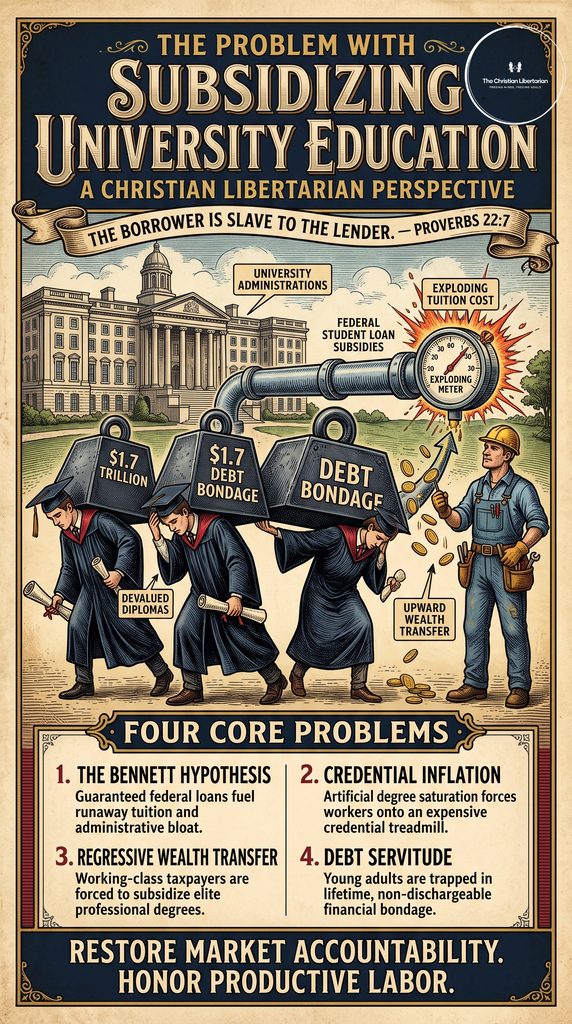
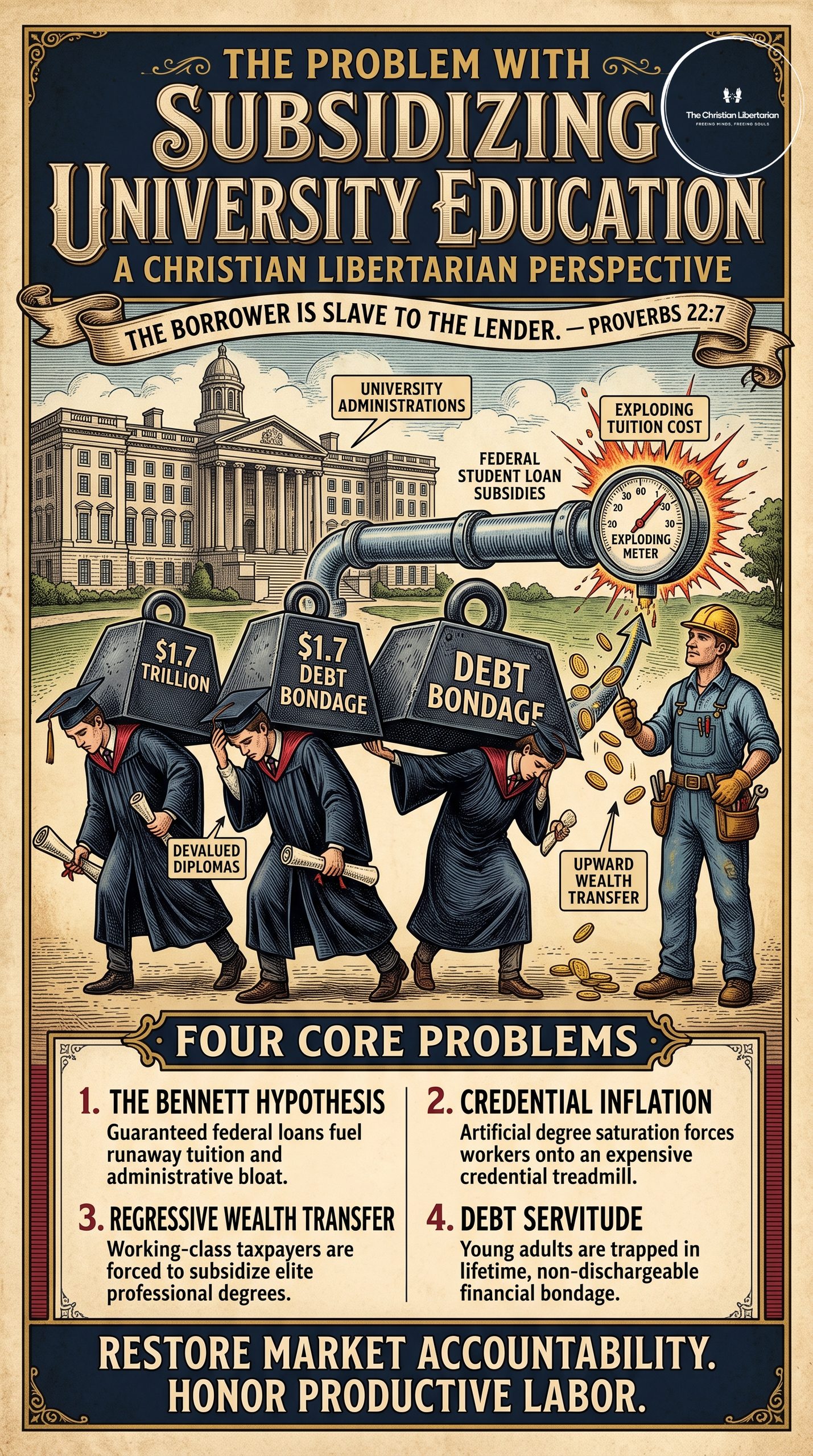
For decades, Americans have been told that a four-year college degree is the indispensable ticket to the middle class. Federal and state governments promised that by flooding universities with subsidized student loans, direct institutional grants, and tax credits, higher education would become accessible to everyone. But decades into this massive social experiment, the outcome is impossible to ignore: runaway tuition costs, a generation shackled by $1.7 trillion in debt, severe credential inflation, and the transformation of universities into bloated, unaccountable bureaucracies.
Subsidizing higher education was never an act of public benevolence; it is an economic distortion that violates basic justice, penalizes honest manual labor, and traps young people in financial bondage.
The economic engine behind soaring tuition is well-documented as the Bennett Hypothesis: when the federal government guarantees an unlimited stream of easy credit to students, colleges respond not by keeping costs down, but by aggressively hiking prices to capture every available dollar. Since the late 1980s, college tuition has increased at nearly four times the rate of general inflation. Because the government removed market discipline and made student loans virtually impossible to discharge in bankruptcy, universities faced zero financial risk for jacking up fees. Instead of investing in elite instruction, campuses engaged in a bureaucratic arms race, pouring billions into luxury student amenities, multi-million-dollar athletic complexes, and an explosion of non-teaching administrators who outnumber instructional faculty at many institutions.
Meanwhile, flooding the market with paper credentials did not make the workforce smarter; it simply devalued the degree. When subsidies make college attendance artificial and ubiquitous, employers begin requiring a bachelor’s degree for administrative, entry-level, and clerical jobs that historically required only a high school diploma. This credential treadmill forces young people to spend four to six of their most energetic, formative years out of the workforce, accumulating tens of thousands in high-interest debt just to achieve baseline employability.
From a Christian libertarian perspective, the deepest problem is moral. Scripture is clear about the integrity of economic exchanges and the protection of the laborer. Proverbs 20:10 condemns unequal weights and measures, while Luke 11:46 rebukes leaders who “load people down with burdens they can hardly carry.” Coercively taxing society to subsidize higher education represents a regressive, upward transfer of wealth. A roofer, welder, long-haul trucker, or small mechanic who enters the workforce at eighteen is forced, through their tax dollars and the hidden tax of inflation, to underwrite the credential of a corporate consultant, attorney, or software executive who will statistically out-earn them over a lifetime. Forcing the blue-collar working class to pay for the professional credentials of the white-collar elite is institutionalized theft.
Furthermore, Proverbs 22:7 warns that “the borrower is slave to the lender.” Enticing eighteen-year-olds to sign complex, five-figure government loan notes before they have developed career skills or financial maturity is predatory state behavior that delays marriage, depresses family formation, and mortgages the future of the next generation.
Both political orthodoxies enable this dysfunction while peddling half-truths.
Progressives frame college subsidies and student loan “forgiveness” as the ultimate civil rights cause. They view education as a public entitlement that should be made universal and tuition-free through federal tax revenue. But writing off student debt with the stroke of an executive pen does not make the debt vanish; it transfers a private contractual obligation onto the backs of working-class taxpayers who never attended college or who already sacrificed to pay off their own loans. Subsidizing universities further will only pour more fuel on the fire, supercharging administrative bloat, feeding ideological monocultures, and driving credential requirements even higher while ignoring the reality that not every productive calling requires four years in a lecture hall.
Conservatives, on the other hand, spend endless hours lamenting the political bias of the academic establishment, yet they remain deeply complicit in funding the institutional apparatus that creates it. Conservative state legislatures routinely pass multi-billion-dollar higher education appropriations, subsidize massive Division I athletic empires and stadium vanity projects, and protect institutional accreditation monopolies that block dynamic, low-cost alternatives. Rather than dismantling state funding, many conservatives advocate for state-mandated curriculum boards, taxpayer-funded “patriotic” academic centers, or government-run workforce tracking. Attempting to manage or counter-program state-funded universities through political power instead of cutting off their subsidized lifeblood is political theater, not free-market conservatism.
A moral society does not coerce manual laborers into funding academic degree cartels, nor does it seduce its youth into lifetime debt to purchase a piece of paper. The path to educational flourishing requires removing the state’s thumb from the scale, letting universities compete on merit and price, and restoring the dignity of productive labor.
Immediate Structural De-Subsidization Checklist
- Phase Out Federal Student Loan Originations
Eliminate federal Direct Loans and PLUS loans over a statutory three-year sunset window, forcing higher education financing into competitive, private underwriting where interest rates and capital access reflect real default risk and degree return on investment. - Restore Full Bankruptcy Protections to Student Debt
Repeal the 1976 and 2005 statutory bankruptcy exemptions (11 U.S.C. § 523(a)(8)) for education loans, allowing unpayable student debt to be discharged under standard Chapter 7 terms and forcing lenders to price risk honestly. - Institute Direct Institutional Risk-Sharing (Skin in the Game)
Require any college or university participating in federal Title IV funding to co-sign all outstanding student obligations and directly reimburse taxpayers for any student loan defaults originating from their degree programs. - Break the Regional Accreditation Monopoly
Decouple employment licensing, state hiring, and professional credentialing from federally recognized regional accreditation cartels, enabling low-cost apprenticeships, competency-based exams, and private certifications to compete on equal legal footing.
Sources and Documentation
- Biblical Foundations on Debt, Labor, and Justice: Proverbs 20:10; Proverbs 22:7; Luke 11:46; 2 Thessalonians 3:10; James 5:4 (condemning unjust extractions, debt servitude, and the exploitation of productive laborers).
- The Bennett Hypothesis on Tuition Inflation: William J. Bennett, “Our Greedy Colleges,” The New York Times (February 18, 1987); David O. Lucca, Nada Eichengreen, & Karen Shen, “Credit Supply and the Rise in College Tuition: Evidence from the Expansion in Federal Student Aid Programs,” Federal Reserve Bank of New York Staff Reports, No. 733 (2015, rev. 2017), documenting that every $1 increase in subsidized federal loan caps drives tuition up by roughly 60 cents.
- Administrative Growth vs. Instructional Staffing: U.S. Department of Education, National Center for Education Statistics (NCES), Digest of Education Statistics, tracking non-instructional administrative and managerial staff growth outpacing faculty hiring and enrollment over four decades.
- Distributional Inequity of Loan Forgiveness: Sylvain Catherine & Constantine Yannelis, “The Distributional Effects of Student Loan Forgiveness,” Journal of Financial Economics (2023), demonstrating that universal and broad student debt cancellation disproportionately benefits upper-income households and constitutes a regressive wealth transfer.
- Credential Inflation and Labor Market Distortions: Joseph E. Stiglitz, “The Theory of ‘Screening,’ Education, and the Distribution of Income,” The American Economic Review (1975); Bryan Caplan, The Case Against Education: Why the Education System Is a Waste of Time and Money (Princeton University Press, 2018), analyzing degree signaling and artificial educational credentialism.