
Our dollars aren’t what we think they are.
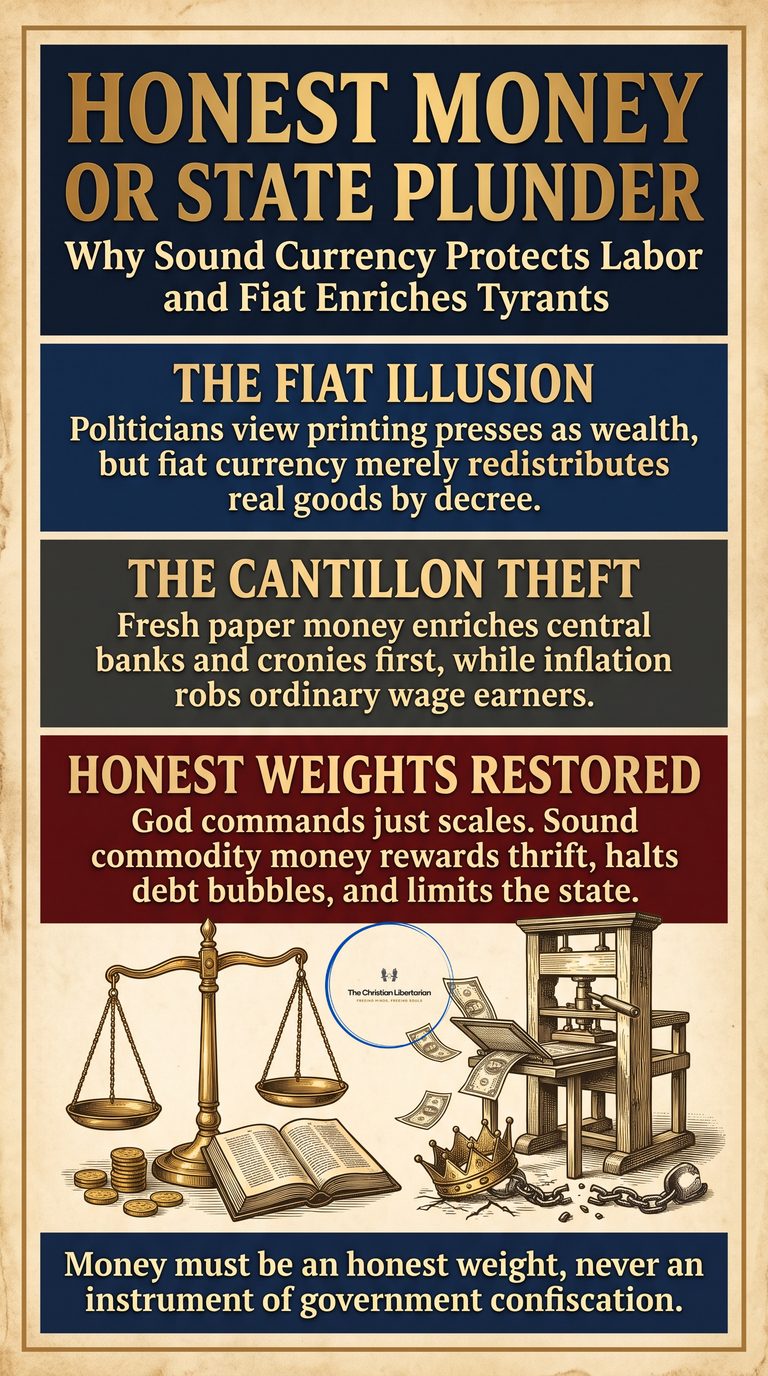
Most discussions about central banking get bogged down in technical jargon about basis points, overnight repo facilities, and open-market operations. But beneath the veneer of complex financial engineering lies a fundamental moral issue. Money is not an arbitrary tool of state power; it is an objective measure of human time, physical labor, and stored energy. When a centralized monopoly is granted the legal authority to create currency out of nothing, it possesses the power to quietly confiscate the fruits of human labor without consent.
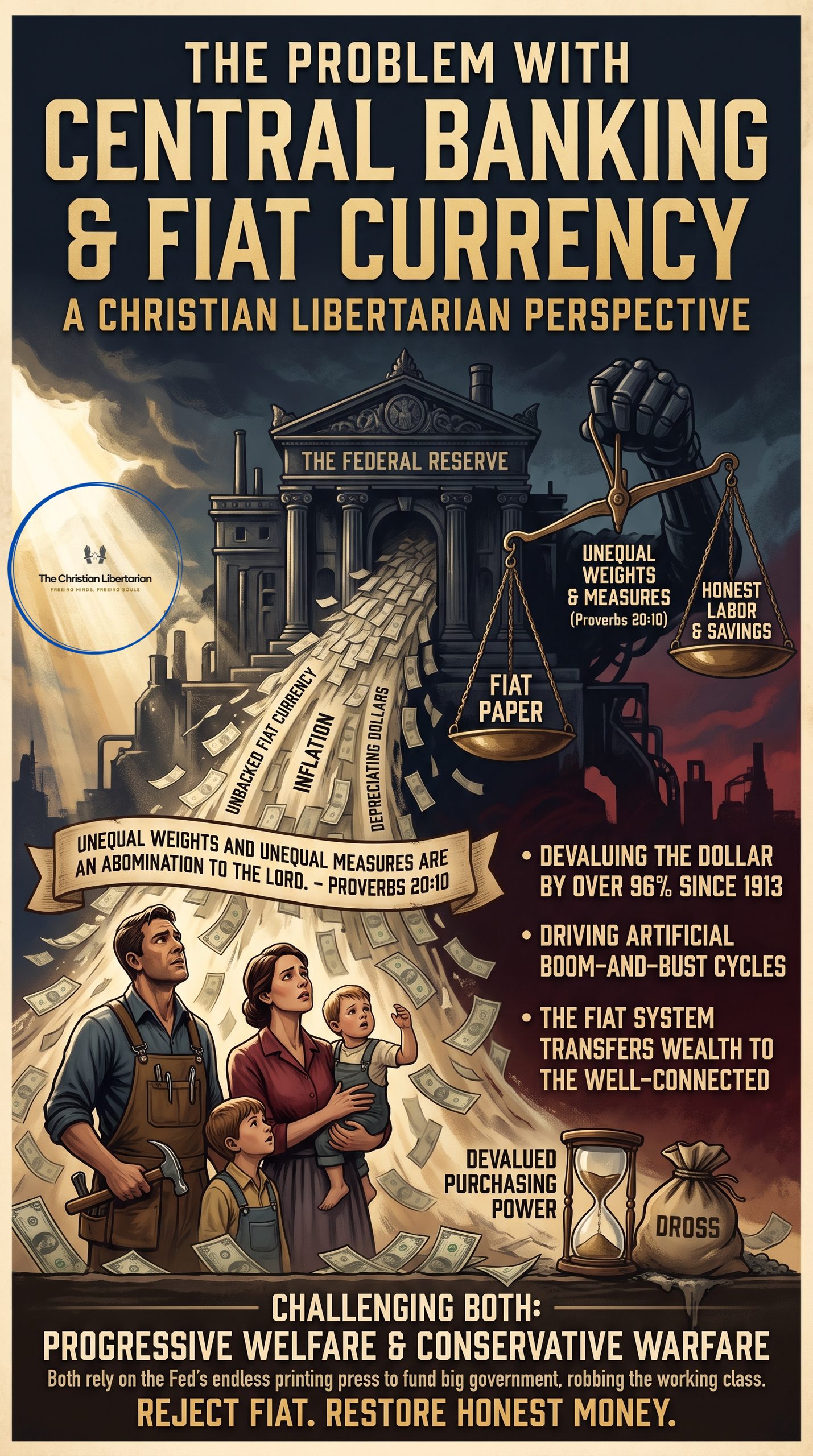
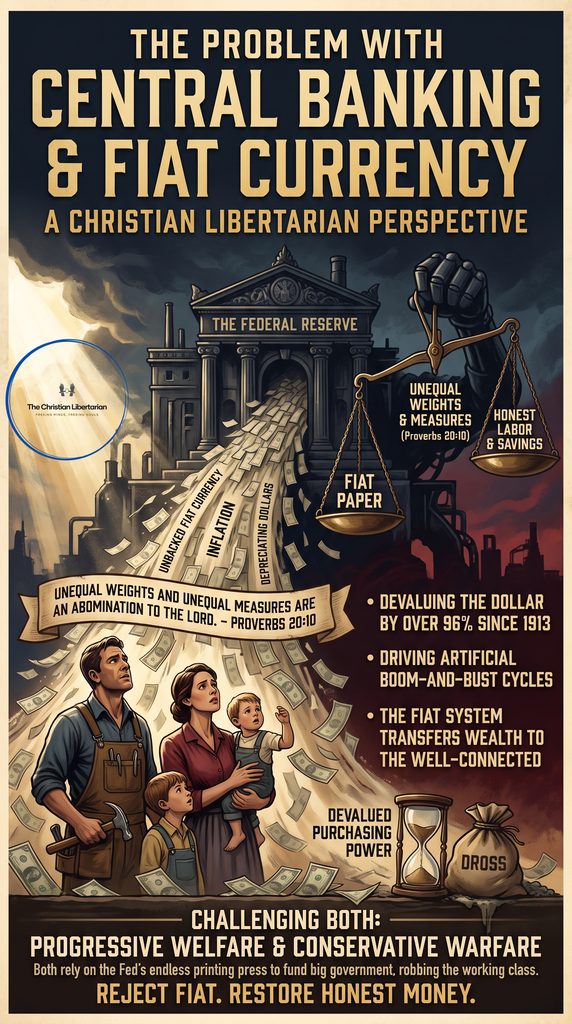
The Federal Reserve was sold to the public in 1913 as an institution designed to stabilize the financial system and prevent panics. Instead, it replaced a market-driven economy with an unelected monetary politburo that centrally plans the most crucial price signal in existence: the price of time, known as the interest rate. By severing money from tangible value and finalizing that break in 1971, the state established a regime of pure fiat. The result has been the systematic destruction of over 96 percent of the U.S. dollar’s purchasing power, perpetual boom-and-bust business cycles, and an unprecedented concentration of financial power.
Central banking operates via the Cantillon Effect, a mechanism where those closest to the monetary spigot—megabanks, Wall Street primary dealers, and federal contractors—receive newly created digital dollars first, spending them at pre-inflation prices. By the time that diluted currency trickles down to wage earners, retirees, and local small businesses, consumer prices have already adjusted upward. This is not an unintended byproduct of monetary policy; it is the structural engine of modern inequality, redistributing real purchasing power upward while disguising it as natural inflation.
Scripture leaves zero ambiguity regarding this practice. God explicitly condemns the manipulation of standards of value: “Unequal weights and unequal measures are both alike an abomination to the Lord” (Proverbs 20:10). Leviticus 19:35–36 commands absolute honesty in scales, balances, and measures. When the prophet Isaiah pronounced judgment on a decaying, corrupt nation, he singled out monetary debasement: “Your silver has become dross, your best wine mixed with water” (Isaiah 1:22). Creating unbacked fiat currency to dilute the savings of a population is a direct violation of the Eighth Commandment. It is legalized counterfeiting backed by the state’s monopoly on force.
Both sides of the political establishment depend entirely on this counterfeit system to sustain their agendas.
Progressives view the Federal Reserve as an indispensable engine to fund an ever-expanding administrative state without the political fallout of passing transparent direct taxes. Modern progressive theorists openly embrace fiat manipulation to underwrite limitless welfare expansions, green infrastructure projects, and social engineering, believing central bankers can fine-tune human society from a conference room in Washington. But fiat currency is the most brutally regressive tax ever conceived. It punishes working-class families who hold their modest wealth in cash and wages, while inflating the speculative paper assets of the ultra-wealthy. You cannot claim to defend the poor while cheering for an institution that systematically erodes their grocery budget.
Conservatives, meanwhile, frequently profess reverence for the free market while fiercely protecting the state-sponsored banking cartel. Conservative administrations have spent decades pressuring the Fed for artificially suppressed interest rates to goose equity markets ahead of election cycles, cheering on the paper wealth created by easy-money asset bubbles. More critically, the conservative foreign policy agenda—maintaining global military dominance, sprawling bases, and endless overseas interventions—would be mathematically impossible under a sound monetary system. It is fiat currency that enables trillion-dollar foreign expenditures without requiring immediate taxpayer sacrifices. Defending capitalism while endorsing central bank market manipulation and corporate debt bailouts is not conservatism; it is mercantilism.
A just society cannot be built upon dishonest money. As long as a centralized committee holds the sovereign privilege to debase the currency, individual liberty will continue to erode, savings will be penalized, and the state will grow unchecked at the expense of ordinary families.
Immediate Sound Money Agenda
- Abolish Capital Gains Taxes on Specie
Eliminate all federal capital gains and sales taxes on gold, silver, and recognized precious metals to remove artificial tax penalties on the constitutional use of sound money. - Pass Full and Unrestricted Federal Reserve Audit Legislation
Authorize the Government Accountability Office (GAO) to conduct a complete, unredacted audit of all Federal Reserve operations, including open-market transactions, discount window lending, and foreign central bank liquidity swaps. - Repeal Federal Legal Tender Coercion
Repeal statutory legal tender laws that compel market participants to accept depreciating federal fiat notes, thereby legalizing voluntary currency competition in private contracts. - Prohibit Central Bank Digital Currencies (CBDCs)
Enact an explicit statutory ban prohibiting the Federal Reserve and Department of the Treasury from piloting, developing, or deploying programmable digital currencies that enable surveillance or direct balance confiscation.
Sources and Documentation
- Biblical Foundations: Proverbs 20:10; Leviticus 19:35–36; Isaiah 1:22; Exodus 20:15 (prohibitions against dishonest balances, dilution of precious metal standards, and theft).
- Cantillon Effect and Monetary Distortion: Richard Cantillon, Essai sur la Nature du Commerce en Général (1755), formalizing the non-neutrality of newly injected money and structural wealth redistribution.
- Austrian Monetary Theory: Ludwig von Mises, The Theory of Money and Credit (1912) and Human Action (1949), explaining how central bank credit expansion distorts interest-rate signals and drives the artificial boom-bust business cycle.
- Denationalization of Currency: F.A. Hayek, The Denationalization of Money (Institute of Economic Affairs, 1976), arguing for consumer choice and the elimination of government monetary monopolies.
- Federal Reserve History and Dollar Devaluation: Federal Reserve Bank of St. Louis (FRED), Consumer Price Index for All Urban Consumers: All Items (1913–present), showing cumulative purchasing power decay exceeding 96% since the enactment of the Federal Reserve Act.