
Interest paying are a massive tax drain.
There is a point where financial mismanagement stops being an accounting failure and becomes an urgent moral crisis. In Washington, the national debt is routinely discussed with eyes glazed over, dismissed as an abstract multi-trillion-dollar ledger entry that politicians can perpetually kick down the road. But compound interest does not negotiate with political rhetoric. The United States has crossed an ominous fiscal threshold where the sheer carrying cost of our debt is consuming the federal government from the inside out.
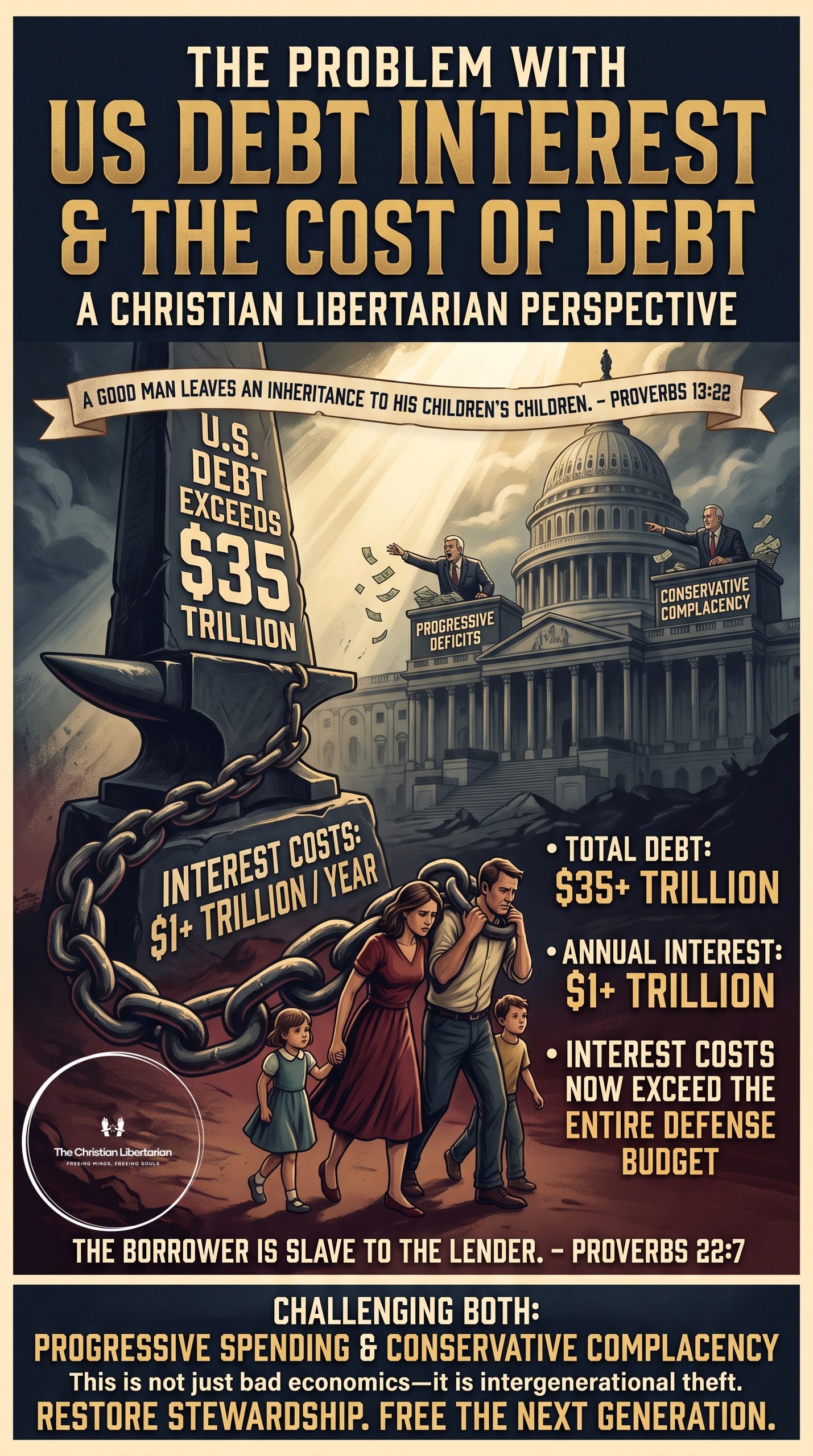
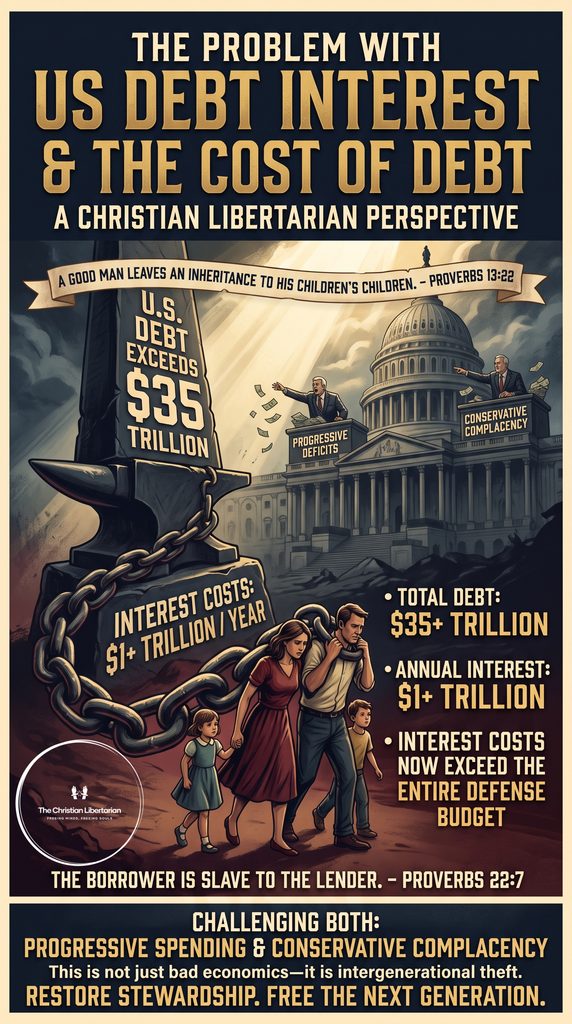
The raw numbers from the Congressional Budget Office paint an alarming picture. Gross federal debt now exceeds $35 trillion, and annual net interest costs have surged past $1.0 trillion per year. To put that in perspective, servicing the interest on past borrowing now costs more than our entire annual national defense budget ($918 billion) and dwarfs federal spending on Medicaid ($600 billion). Interest payments alone now eat up nearly 19 to 20 percent of every single tax dollar Washington collects—meaning one out of every five dollars sent to the IRS buys zero goods, zero infrastructure, and zero services. It simply pays the finance charge on yesterday’s consumption. Over the next decade, the CBO projects the federal government will spend $16.2 trillion purely on net interest, with approximately 66 cents of every newly borrowed dollar going straight toward servicing existing debt.
From a Christian libertarian perspective, this is not merely fiscal incompetence; it is institutionalized theft. Scripture is brutally clear about debt: “The rich rule over the poor, and the borrower is slave to the lender” (Proverbs 22:7). Furthermore, Proverbs 13:22 establishes a foundational principle of intergenerational stewardship: “A good man leaves an inheritance to his children’s children.” Passing down a free, prosperous, and solvent society is an act of love. Passing down a compounding, unpayable lien against the future labor of children and grandchildren who never voted for it is generational exploitation. When a state exhausts its capacity to borrow, it invariably turns to the printing press, debasing the currency through inflation—an unequal weight and measure that silently confiscates the purchasing power of the working poor and retirees on fixed incomes.
Both political establishments bear equal guilt, each clinging to comfortable delusions.
Progressives operate under the fantasy of Modern Monetary Theory and limitless deficit spending, arguing that deficits do not matter because “we owe the money to ourselves” or can simply tax billionaires to make up the difference. But the math is completely broken. Confiscating every dollar of wealth from every American billionaire would not fund federal spending for even eight months, let alone tame a $1.8 trillion annual structural deficit. By treating the national credit card as a bottomless social program piggy bank, progressives have engineered a dynamic where runaway debt interest actively crowds out the very vulnerable populations they claim to champion, while fueling the regressive hidden tax of monetary inflation.
Conservatives, meanwhile, preach fiscal restraint on the campaign trail and govern with complete fiscal nihilism. They perform outrage over deficits while in the minority, yet vote for near-trillion-dollar defense packages, maintain billions in corporate handouts and agricultural subsidies, and pass debt-financed tax cuts without eliminating a single dollar of spending to pay for them. More critically, conservative leaders routinely treat automatic mandatory entitlement spending—the primary structural driver of our long-term fiscal insolvency—as an untouchable political third rail. Demanding balanced budgets while keeping defense and mandatory spending off the table is political theater, not serious stewardship.
A civilization that knowingly bankrupts its posterity to sustain the present comfort of its political class has lost its moral compass. Breaking the debt spiral requires facing fiscal reality before the bond market and currency debasement make the decision for us.
Immediate Fiscal Stabilization Checklist
- Establish a Statutory Primary Spending Cap
Legislate an enforceable cap tying total non-interest federal outlays to a hard ceiling of 18 percent of GDP, enforcing across-the-board sequestration on any spending beyond that threshold. - Institute Chained-CPI for Entitlement Programs
Transition all mandatory entitlement cost-of-living adjustments (COLAs) to the Chained Consumer Price Index, accounting for consumer substitution to reflect true cost-of-living shifts and flatten baseline mandatory trajectory. - Enact a Five-Year Freeze on Discretionary Baseline Spending
Hold non-defense and defense discretionary spending flat at FY 2024 nominal levels for five consecutive fiscal years, removing all automatic inflation escalator assumptions from congressional budget baselines. - Prohibit Federal Reserve Debt Monetization
Enact statutory firewalls barring the central bank from absorbing federal Treasury debt issuances onto its balance sheet to artificially suppress Treasury yields.
Sources and Documentation
- Congressional Budget Office (CBO):The Budget and Economic Outlook: 2024 to 2034 and Baseline Budget Projections (February & June Updates), detailing the $35T+ debt trajectory, $1.0T net interest projections, $16.2T ten-year cumulative interest costs, and net interest overtaking national defense outlays.
- Peter G. Peterson Foundation:Monthly Interest Tracker: Rising Interest Costs on the National Debt, analyzing net interest as a percentage of federal revenues (18.5%–19%) and comparison against mandatory and discretionary outlays.
- Committee for a Responsible Federal Budget (CRFB):Net Interest Costs Will Double, Again, Over the Next Decade, tracking the growth of debt service as the fastest-growing major item in the federal budget.
- Scriptural Citations: Proverbs 22:7 (the servitude of the debtor); Proverbs 13:22 (the duty of generational inheritance); Proverbs 20:10 (prohibition against unequal weights and measures).