
Part 4: Who Owns the Earth? Why Property Rights, Not Bureaucrats, Heal Creation
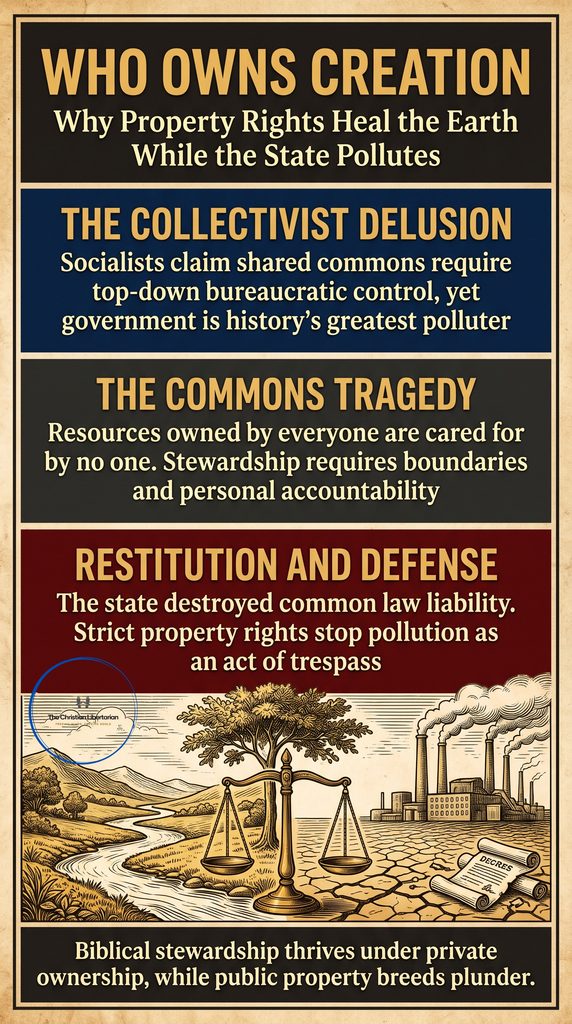
Environmental collapse is the ultimate trump card in modern political debate. Critics of Austrian economics argue that while free markets might efficiently produce smartphones and tennis shoes, the price system completely breaks down when facing public goods, shared commons, and ecological crises. From global carbon emissions and ocean acidification to microplastics and biodiversity loss, socialists insist that unhampered markets suffer from a fatal flaw. They claim that because market prices only register immediate private profits, profit driven corporations inevitably dump their waste onto the rest of society.
To the socialist mind, the Austrian proposal of extending private property rights and resolving pollution through tort law is an absurd fantasy. They ask how anyone can fence off the atmosphere, privatize the open Atlantic Ocean, or track wandering carbon molecules to specific smokestacks through local civil courts. Leftist theorists argue that environmental protection requires top down central planning, massive state green investments, and strict administrative prohibitions enforced by regulatory agencies. In their view, reliance on private incentives rewards ecological destruction, leaving political command as the only salvation for the planet.
This critique sounds persuasive to anyone who loves nature and mourns the devastation of our environment. Yet when we examine ecological damage through biblical stewardship, the Nonaggression Principle, and Austrian economic theory, the reality is reversed. Environmental destruction does not stem from an excess of private property rights; it occurs wherever property rights have been destroyed, socialized, or undermined by the state.
First Principles Analysis
The conversation about environmental stewardship must begin where history begins: with the sovereign Creator. In Genesis 1:1, God declares His ownership of the cosmos. In Genesis 1:26 to 28 and Genesis 2:15, God places mankind in the garden to work it and keep it. Human beings are not owners with absolute license to plunder, nor are we biological parasites who must be managed by an elite political class. We are stewards appointed by God, made in His image with moral agency and bound by His moral law.
Stewardship requires personal responsibility, and personal responsibility requires boundaries. Scripture protects these boundaries through the Eighth Commandment forbidding theft and the Tenth Commandment forbidding covetousness. When God divided the Promised Land among the tribes and families of Israel in Numbers 33:54, He established clear hereditary allotments. Why? Because when a piece of land belongs to a specific family, that family bears the long term economic and generational consequences of how they treat the soil, the water, and the timber.
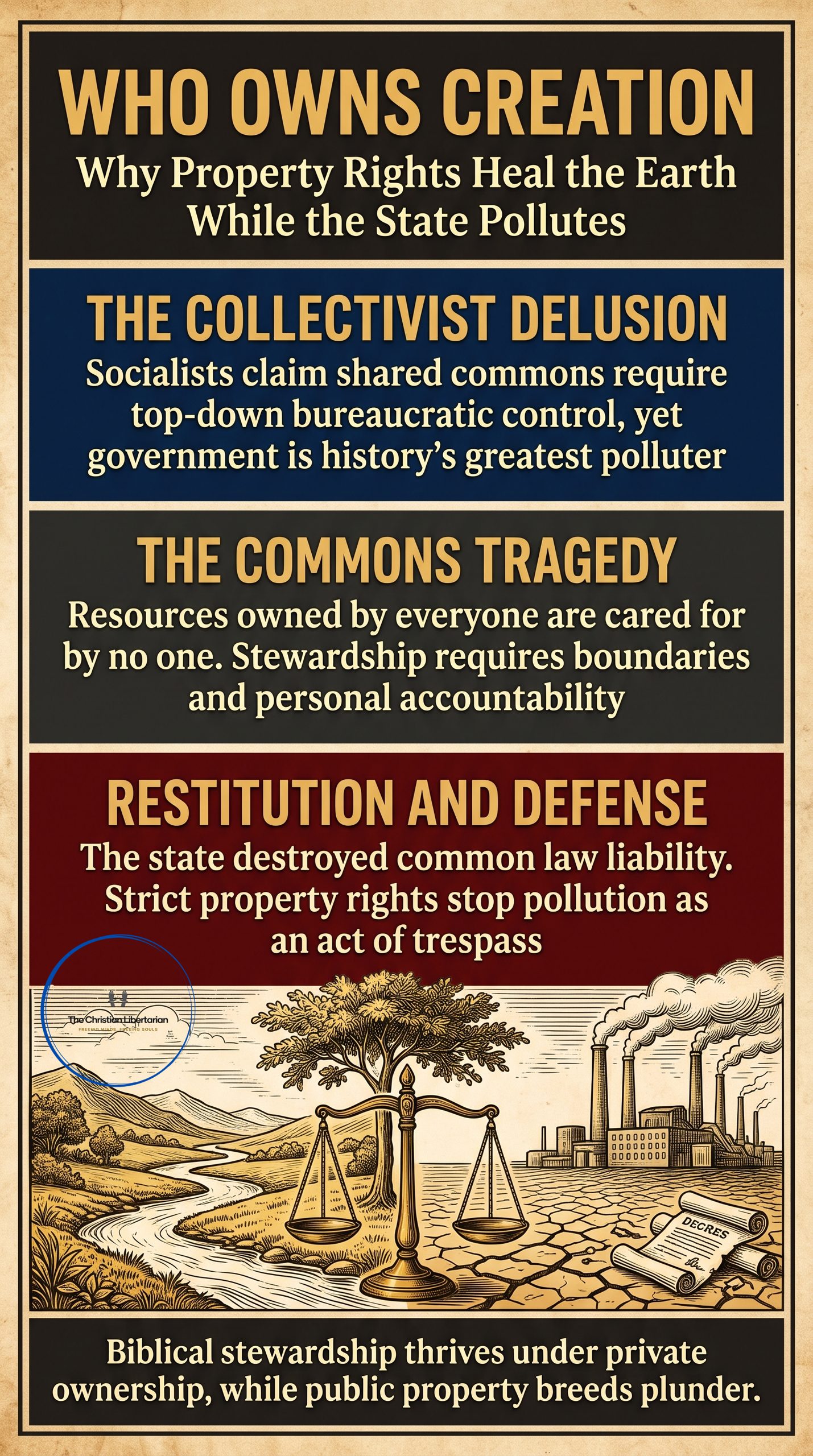
This biblical pattern explains the tragedy of the commons, a fundamental insight of Austrian economics and classical philosophy. Aristotle observed over two millennia ago that what is common to the greatest number receives the least amount of care, because everyone thinks someone else will attend to it. When an ocean, an air basin, a pasture, or a forest is owned by everyone, it is legally owned by no one. When a resource is unowned or held in common by a state bureaucracy, individual users face an incentive to extract as much value as possible before a competitor takes it, while dumping waste freely because the cost is shared by the entire public. Private property eliminates this destructive race to the bottom by linking authority, economic interest, and legal liability to the specific owner.
Why cannot state bureaucrats simply fix this tragedy through regulation? The biblical doctrine of total depravity answers this clearly. Scripture warns in 1 Samuel 8 and Psalm 146:3 that fallen rulers and bureaucrats are not benevolent, omniscient angels. They are sinful human beings who pursue their own prestige, political power, and budget expansion. Under Public Choice theory, we know that government agencies do not suffer personal financial losses when their environmental policies fail, nor do they face personal bankruptcy when they misallocate billions in subsidies.
Worse still, modern history reveals that the state itself is responsible for the very externalities socialists blame on capitalism. Under historical English and American common law, private property rights were strictly defended against pollution through the legal doctrines of trespass and nuisance. If a factory dumped chemical waste into a farmer’s creek or blew toxic sulfur smoke across an orchard, the property owner could go to a judge and secure an immediate injunction shutting down the polluter, alongside punitive cash damages.
During the industrial revolution of the nineteenth century, however, the state actively intervened to overturn common law property protections. Influenced by politically connected corporate barons, state courts and legislatures declared that the public interest and economic progress were more important than individual property deeds. Judges began throwing out pollution lawsuits, ruling that private owners had to tolerate foul air and poison water for the greater good of national industry. In the twentieth century, the state replaced common law liability with administrative agencies like the Environmental Protection Agency. These agencies do not abolish pollution; they issue official permits that legally authorize corporations to pollute up to a bureaucratic threshold while granting them legal immunity from direct lawsuits by injured neighbors. The state created modern systemic externalities by stripping private citizens of their natural rights to defend their homes and bodies against physical aggression.
Concrete Illustration and Case Study
In this hypothetical scenario, consider two identical freshwater lakes separated by a narrow mountain ridge.
Lake Liberty is entirely surrounded by private family homesteads, fishing lodges, and local eco tourism camps, where every resident holds a clear, recorded deed extending into the waterbed. Under the local legal charter, any physical invasion of soot, chemicals, or foreign runoff constitutes trespass and property damage under the Nonaggression Principle. When a manufacturing firm buys a nearby plot and begins dumping industrial dye into a feeder stream, the downstream lodge owners immediately file a joint tort lawsuit. Within forty eight hours, the court grants an emergency injunction that halts factory production until the company installs a zero emission filtration system, paid for entirely out of the polluter’s profits. Because the water is private property, the owners diligently test the water daily, protect fish breeding grounds, and preserve the lake as a valuable generational asset.
On the other side of the ridge sits Lake Leviathan, designated as a public natural commons managed by the state Department of Natural Resources. Because the lake belongs to the public, no individual citizen has the legal standing to sue polluters directly. Instead, residents must submit formal complaints to a distant regulatory commission. The manufacturing lobby donates heavily to the political campaigns of the commissioners, securing an administrative variance that officially designates Lake Leviathan as an industrial development corridor. Over the next decade, competing companies dump millions of gallons of runoff into the water. Algae blooms smother the fish, the beaches reek of decay, and the water turns acidic. When outraged citizens demand accountability, the bureaucrats blame underfunding and request a five hundred million dollar tax hike to clean up the mess they sanctioned.
This scenario is not fiction in the real world. Consider the staggering ecological catastrophe of the Aral Sea under twentieth century Soviet central planning. In the 1960s, Soviet planners at Gosplan decided to turn the Central Asian republics into the cotton capital of the world. State commissars ordered the diversion of the two main rivers feeding the Aral Sea into massive, unlined desert irrigation canals. Because all land and water belonged to the socialist state, there were no private landowners to object, no independent courts to issue injunctions, and no market prices to signal the immense value of the disappearing freshwater. By the 1990s, the Aral Sea, once the fourth largest inland sea on earth, had lost over ninety percent of its volume, leaving behind a poisoned wasteland of toxic dust and rusting ships. Central planning did not save the commons; it annihilated an entire inland sea.
Empirical Evidence and Policy Impact
The empirical record demonstrates that state control consistently produces ecological destruction, whereas secure property rights generate conservation and resource abundance:
- The State as the World’s Greatest Polluter: According to studies by researchers at Brown University’s Costs of War Project, the United States Department of Defense is the single largest institutional consumer of petroleum and one of the largest greenhouse gas emitters on the planet, producing more annual emissions than industrialized nations like Sweden, Portugal, or Denmark. Furthermore, the federal government manages thousands of highly contaminated Superfund sites across military bases and federal facilities, shielded behind sovereign immunity that prevents private citizens from suing the government for damages.
- Socialist Ecocide: While Western environmentalists point to private factories as polluters, historical data reveals that socialist economies were far more destructive. A landmark study published by the Cato Institute and the National Bureau of Economic Research showed that prior to the fall of the Iron Curtain, the Soviet Union and its satellite states produced twice as much toxic emissions per unit of Gross Domestic Product as Western market economies, creating uninhabitable dead zones like Lake Karachay, which was so saturated with radioactive nuclear waste that standing on its shore for an hour in 1990 delivered a lethal dose of radiation.
- Reversing Ocean Collapse Through Individual Transferable Quotas: While open access government managed fisheries across the world suffered from severe stock depletion, market based property rights reversed the trend. When New Zealand, Iceland, and Alaska implemented Individual Transferable Quotas, which assign secure, tradable property rights to a percentage of the sustainable annual catch, commercial fishing fleets suddenly had an economic interest in protecting the fish population. A comprehensive global study of over eleven thousand fisheries published in the journal Science in 2008 demonstrated that implementation of these private harvest rights cut the rate of fishery collapse by half compared to traditional open commons under state regulation.
- Wildlife Protection in Southern Africa: In Kenya, where the central government banned private hunting and commercial wildlife management in 1977 while keeping wildlife as a public ward of the state, wild game populations on public lands plummeted by nearly seventy percent due to rampant poaching. By contrast, when Zimbabwe, Namibia, and South Africa granted local landowners and tribal communities private property rights to manage, hunt, and sell wildlife on their land, game populations exploded. South African private game reserves now protect more than sixteen million wild animals, ensuring that white rhino and elephant populations grew on private land while shrinking in neighboring state reserves.
- The Failure of Central Green Planning: Between 2009 and 2024, western governments poured hundreds of billions of dollars in taxpayer subsidies into politically favored green energy schemes, leading to high profile bankruptcies like Solyndra and severe energy grid destabilization in Western Europe, where German industrial electricity rates jumped to triple the international average without achieving promised emission milestones.
The Free and Moral Alternative
True environmental healing does not come from expanding the coercive power of a fallen state. A biblical and Austrian framework protects creation through accountability, honest law, and voluntary stewardship:
- Restore Strict Common Law Liability: Abolish the regulatory shield of state pollution permits and sovereign immunity. Return to strict property rights where any release of airborne, waterborne, or solid pollutants onto the land, water, or person of another without explicit consent constitutes actionable trespass, giving victims immediate access to court injunctions and full financial restitution.
- Define and Privatize the Commons: Extend property rights wherever technologically possible. Establishing tradable water rights, privatized riverbanks, and secure fishery quotas aligns the long term self interest of owners with the health of the ecosystem.
- Empower Voluntary Conservation Trusts: Free market institutions like private land trusts, fraternal associations, and Christian conservation charities, such as Ducks Unlimited and The Nature Conservancy, already preserve millions of acres of wetlands, forests, and wildlife corridors peacefully without state coercion, demonstrating that love for God’s creation flourishes best through voluntary dedication.
Sources and References
- Holy Bible: Genesis 1:1, Genesis 1:26 to 28, Genesis 2:15, Numbers 33:54, 1 Samuel 8:10 to 18, Psalm 24:1, Psalm 146:3, Proverbs 11:1, Romans 13:1 to 4, 1 Peter 2:13 to 14.
- Murray N. Rothbard, Law, Property Rights, and Air Pollution (1982), the foundational Austrian analysis showing how state courts subverted common law nuisance to benefit corporate polluters.
- Garrett Hardin, The Tragedy of the Commons, Science (1968), establishing how unowned public resources inevitably suffer depletion.
- Terry L. Anderson and Donald R. Leal, Free Market Environmentalism (Revised Edition, 2001), detailing how property rights and market incentives protect wildlife, forests, and waterways.
- Neta C. Crawford, Pentagon Fuel Use, Climate Change, and the Costs of War, Watson Institute for International and Public Affairs, Brown University (2019).
- Christopher Costello, Steven D. Gaines, and John Lynham, Can Catch Shares Prevent Fisheries Collapse? Science, Volume 321 (2008).
- Mikhail S. Bernstam, The Wealth of Nations and the Environment, Institute of Economic Affairs (1991), comparing Soviet and Western environmental records.
- Frederic Bastiat, The Law (1850).