
Part 2: Scarcity Is Not Slavery: Why Wage Labor Liberates and State Privilege Exploits
At the heart of Austrian economics sits a simple observation: whenever two peaceful people make a trade, both expect to walk away better off, or else they would never agree to the exchange. To critics on the political left, this claim is little more than a cruel ideological fairy tale that ignores material leverage and class power.
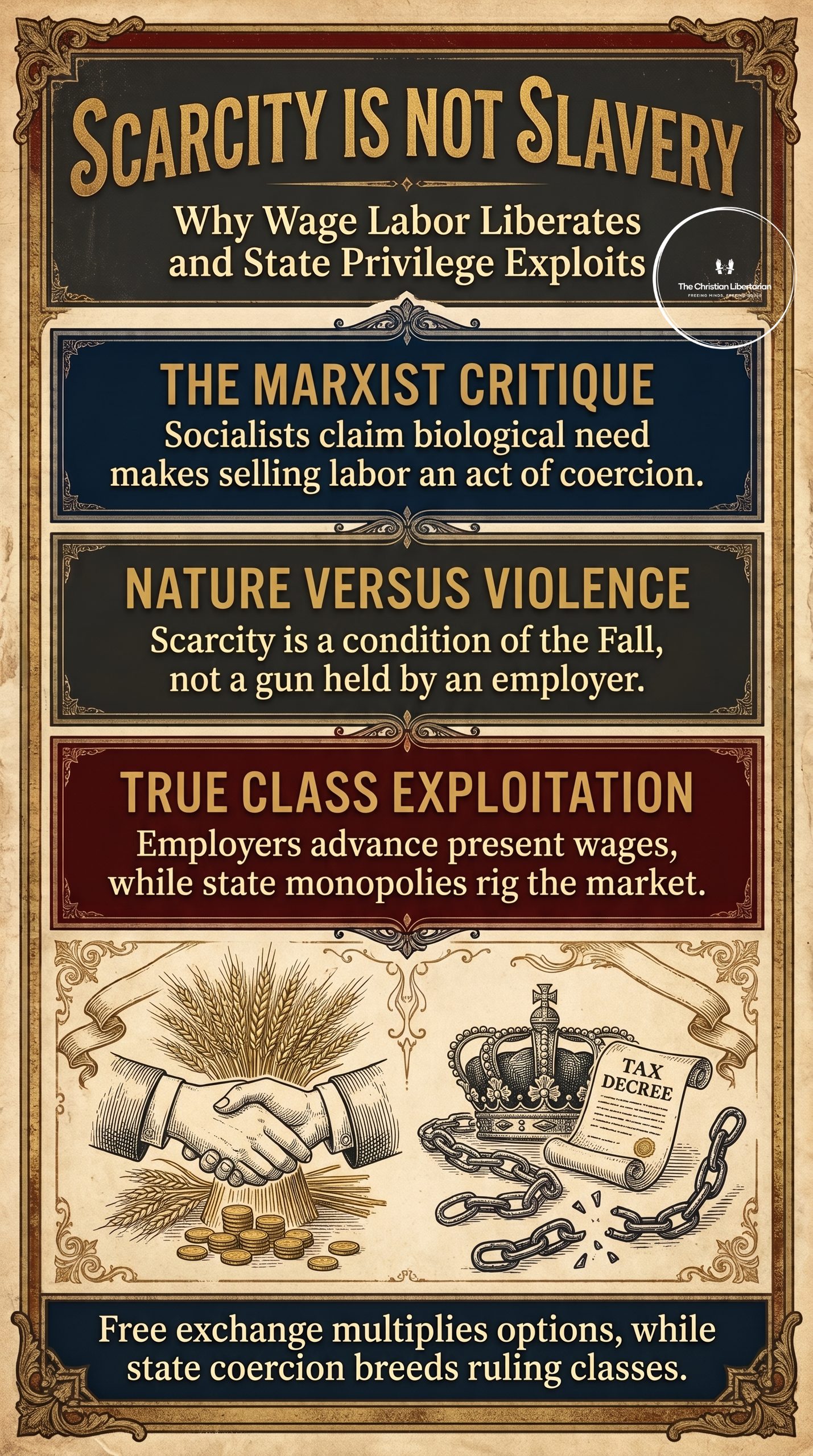
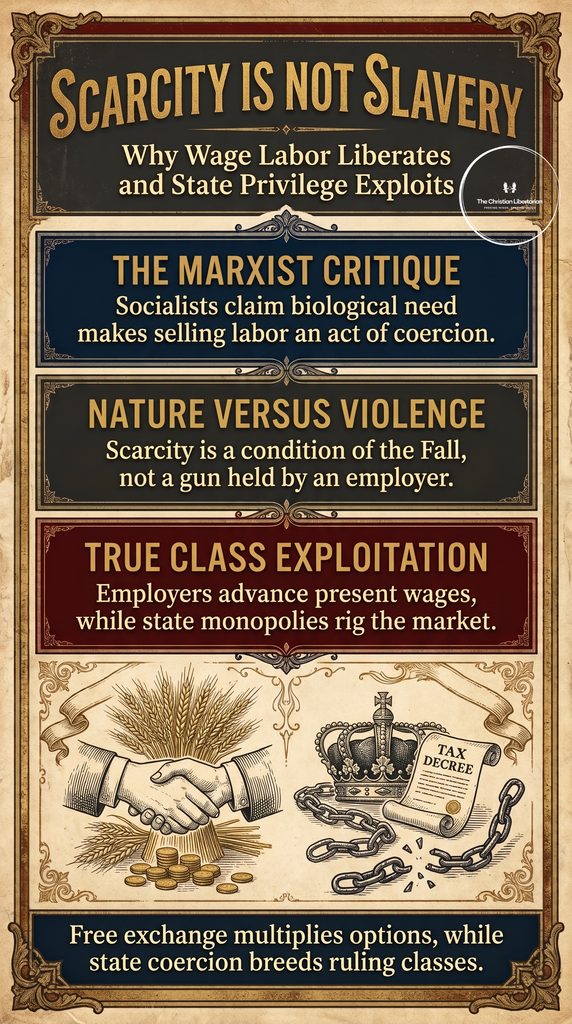
Drawing from Karl Marx and economic historian Karl Polanyi, socialists argue that workers and business owners never meet as equals in the marketplace. A wealthy factory owner can afford to wait months to fill a job opening, whereas a propertyless worker must sell labor immediately to buy groceries, pay rent, and secure medicine. When the only alternative to taking a low wage job is eviction and starvation, critics insist that calling the employment contract voluntary is a dark joke. In the Marxist view, because workers lack independent access to land and tools, capitalists extract surplus value from their labor, paying them a fraction of what they produce and pocketing the rest as profit. Viewed through this lens, Austrian economics is dismissed as a nineteenth century bourgeois defense mechanism designed to disguise class exploitation as free choice.
This critique resonates emotionally because human suffering and the abuse of power are very real. Yet when we examine the socialist argument from first principles, we discover that it rests on a profound confusion between the biological realities of a fallen world and the violent coercion of human tyrants.
To untangle the charge of coerced labor, we must first ask a foundational question: who is holding the gun? In both biblical theology and libertarian philosophy, coercion has a precise moral meaning. Under the Principle of Nonaggression, coercion occurs when one human being initiates physical violence, fraud, or the threat of force against the person or justly acquired property of another.
Scripture explains why every human being wakes up with an empty stomach. After God created humanity in His own image with rational moral agency (Genesis 1:26 to 27), our first parents rebelled. In Genesis 3:17-19, God pronounced a universal judgment upon creation: the ground was cursed, and humanity was told that only by the sweat of the brow would we eat bread. Material scarcity is not a capitalist conspiracy. It is the baseline condition of life East of Eden.
Imagine a solitary man stranded on an uninhabited island. There are no billionaires, landlords, or corporations anywhere within a thousand miles, yet that man must still work every single day to gather food and build shelter, or he will starve. He is constrained by nature, not coerced by a ruling class. Now suppose a second person washes ashore with a fishing boat and offers the castaway ten percent of the daily catch in exchange for helping haul in the nets. Has the boat owner exploited or coerced the castaway? Quite the opposite. The boat owner did not cause the castaway’s hunger, nor did he take away the castaway’s freedom to keep foraging on the beach. By offering a wage contract, the employer expanded the worker’s options and made survival far easier. Treating a peaceful offer of productive work as an act of violence turns morality upside down.
Scripture consistently affirms the justice of private property and voluntary wage labor. The Eighth Commandment against theft and the Tenth Commandment against coveting protect the fruits of honest industry. Luke 10:7 and 1 Timothy 5:18 declare that the laborer is worthy of his wages, while 2 Thessalonians 3:10 commands that if anyone is not willing to work, let him not eat. At the same time, the Bible fiercely condemns employers who commit actual fraud by withholding agreed upon pay after the work is completed (James 5:4).
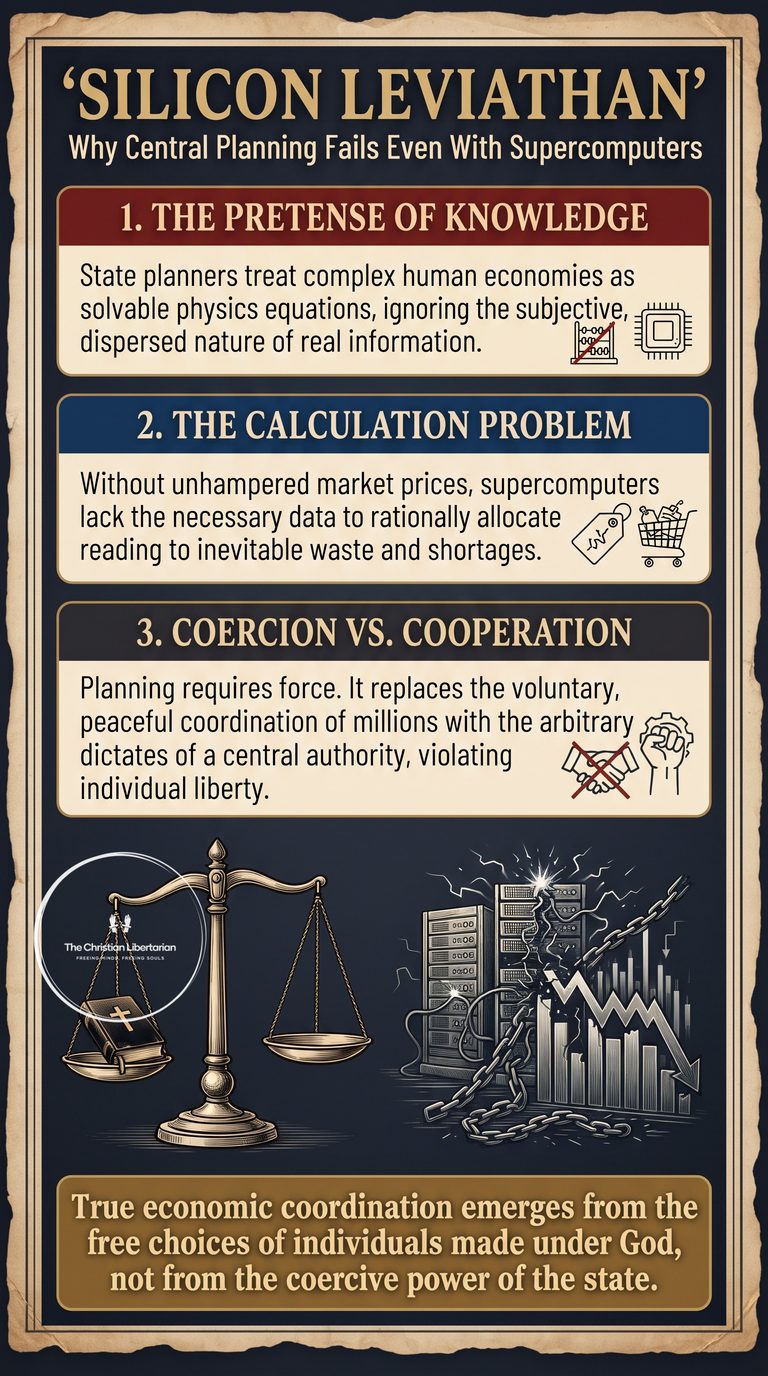
What about Karl Marx’s claim that all profit is stolen surplus value? The Austrian economist Eugen von Bohm Bawerk demolished this fallacy over a century ago by explaining time preference, the universal truth that human beings value present goods more highly than future goods of the same kind. Production takes time. Before a carpenter can sell a dining table, someone must plant trees, harvest timber, build a sawmill, transport lumber, craft the furniture, and wait for a buyer. A worker cannot wait two years for a customer to buy that table in order to eat dinner tonight.
The capitalist solves this problem by advancing present money to the worker right now, trading immediate, guaranteed purchasing power for future, uncertain goods. What Marxists call stolen surplus value is actually the natural discount for time and risk. If the product fails to sell, the business owner absorbs the loss while the worker keeps every dime of the wages already paid. Furthermore, as Ludwig von Mises demonstrated, employers cannot set wages arbitrarily low in an unhampered market. When entrepreneurs compete for labor, they bid wages up toward the worker’s discounted marginal revenue product, which is the actual value that the worker’s labor adds to the final consumer good.
Does this mean Austrian economists ignore structural power and class hierarchy? Not at all. Following Frederic Bastiat, Franz Oppenheimer, and Murray Rothbard, Austrian libertarians have developed a rigorous theory of class conflict. The crucial distinction lies between the economic means of acquiring wealth through peaceful production and voluntary trade, and the political means of acquiring wealth through taxation, monopoly privilege, and state violence.
Marxists routinely blame free exchange for historical crimes that were actually committed by the state. When Karl Polanyi documented how the British government used parliamentary Enclosure Acts to seize common peasant lands and hand them to politically connected aristocrats, forcing dispossessed farmers into early industrial towns, he was not describing laissez faire capitalism. He was describing state land theft. Because human nature is fallen and rulers are sinners (1 Samuel 8, Psalm 146:3), political power always attracts predators who use legal plunder to rig the market against ordinary workers. True class hierarchy does not divide voluntary employers from employees. It divides net tax consumers and crony monopolists from the peaceful workers and entrepreneurs who are forced to fund them.
In this hypothetical scenario, imagine a frontier valley where fifty families farm their own small plots and trade freely. One industrious blacksmith saves half of his grain every harvest for ten years, builds a water powered forge, and offers young apprentices steady daily wages in silver to help craft steel plows. Both the blacksmith and the apprentices prosper, and local crop yields double. Seeing this wealth, the territorial governor steps in at the lobbying of a wealthy baron. The governor passes a decree banning private forges, seizes half the valley’s farmland through eminent domain, and imposes a heavy head tax payable only in the governor’s paper currency. Suddenly stripped of their land and forbidden from opening competing shops, the townspeople are forced to work in the baron’s state chartered mines for pennies. When a visiting socialist observes their misery, he blames the wage system and private property, completely ignoring the government decrees that destroyed their independent livelihoods in the first place.
Empirical economic history refutes the claim that market capitalism impoverishes workers while proving that state intervention is the real engine of structural exploitation:
- According to historical data compiled by economic historian Deirdre McCloskey and the Maddison Project, as capital accumulation multiplied worker productivity after 1800, real per capita income in market economies grew more than tenfold while average weekly working hours in the United States fell from roughly 65 hours in 1850 to under 38 hours today.
- United States Bureau of Economic Analysis records show that employee compensation consistently accounts for 60 to 65 percent of net national income while corporate profits average between 8 and 12 percent, and Bureau of Labor Statistics data shows that nearly 50 percent of new private businesses fail within five years, shielding workers from capital losses that wipe out investors.
- Wherever twentieth century socialist regimes abolished private capital to liberate the working class, the state became a single monopoly employer, binding Soviet workers to factories with internal passports in 1932 and causing manmade famines that killed millions in Ukraine and Maoist China.
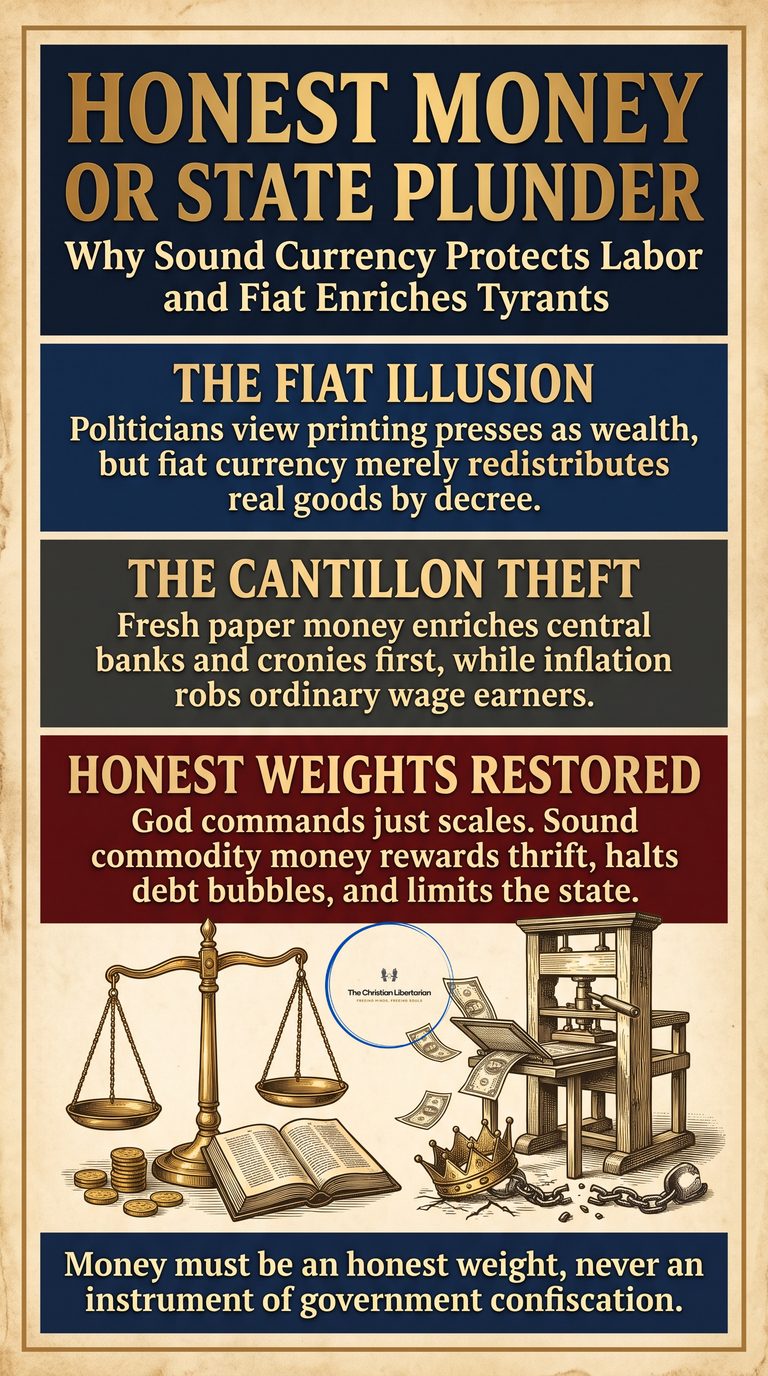
- When modern workers face limited independent alternatives, state intervention is the culprit: Institute for Justice studies reveal that occupational licensing laws now lock roughly 25 percent of the American workforce behind expensive government permits compared to fewer than 5 percent in the 1950s, while Federal Reserve fiat inflation devalues working class wages to benefit Wall Street banks in violation of Proverbs 11:1.
True liberation for the working person will never come from handing even more coercive power to politicians and bureaucrats. A biblical and free society dismantles structural exploitation at its actual source by repealing occupational licensing cartels, restrictive zoning laws, and payroll taxes so workers can easily start home businesses and compete with large corporations. Ending corporate bailouts and central bank money printing restores honest weights and measures (Proverbs 11:1) and stops the hidden transfer of wealth from wage earners to politically connected elites. Finally, restricting civil government to its defensive biblical mandate of punishing force and fraud (Romans 13:1 to 4, 1 Peter 2:13 to 14) frees families, local churches, and voluntary mutual aid societies to care for the vulnerable with dignity and genuine Christian charity.
Sources and References
- Holy Bible: Genesis 1:26 to 27, Genesis 3:17 to 19, 1 Samuel 8:10 to 18, Psalm 146:3, Proverbs 11:1, Matthew 20:1 to 16, Luke 10:7, Romans 13:1 to 4, 2 Thessalonians 3:10, 1 Timothy 5:18, 1 Peter 2:13 to 14, James 5:4.
- Eugen von Bohm Bawerk, Capital and Interest (1884) and Karl Marx and the Close of His System (1896).
- Ludwig von Mises, Human Action: A Treatise on Economics (1949) and Socialism: An Economic and Sociological Analysis (1922).
- Murray N. Rothbard, Power and Market: Government and the Economy (1970).
- Franz Oppenheimer, The State (1908).
- Frederic Bastiat, The Law (1850).
- Rose Wilder Lane, The Discovery of Freedom (1943).
- Karl Polanyi, The Great Transformation (1944).
- Deirdre N. McCloskey, Bourgeois Equality: How Ideas, Not Capital or Institutions, Enriched the World (2016).
- United States Bureau of Economic Analysis (National Income and Product Accounts), United States Bureau of Labor Statistics (Business Employment Dynamics), and Institute for Justice, License to Work (3rd Edition, 2022).