
The Problem With: Business Taxes
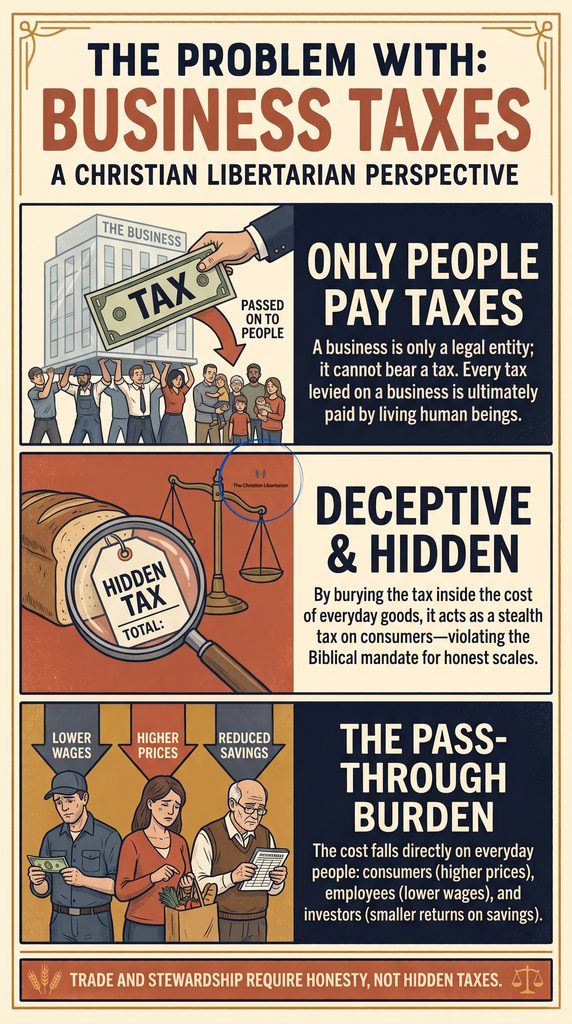
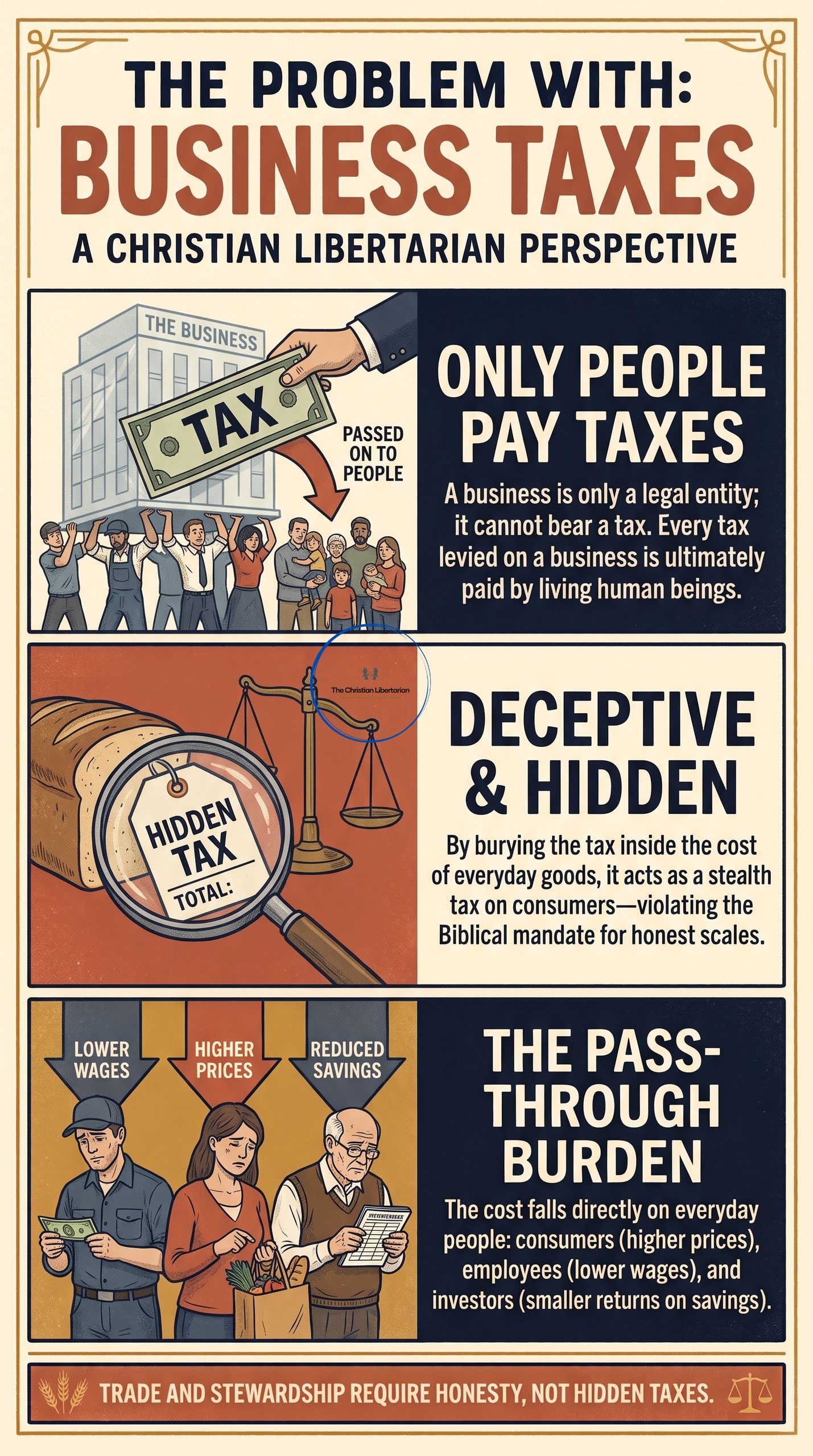
The political debate over business taxes is built entirely on a theatrical illusion. Politicians across the spectrum treat “the corporation” as an independent entity with deep pockets that can either be squeezed to fund state programs or coddled to stimulate the market. Both sides miss the most elementary truth in economics: inanimate institutions do not pay taxes. A corporation is legal paperwork stored in a state database. It cannot bleed, it cannot feel economic pain, and it cannot produce tax dollars out of thin air. Only human beings pay taxes.
When the state levies a tax on a business, that cost does not vanish into corporate ether. It is merely passed along to real people through three unavoidable channels: consumers who pay higher prices on final goods and services, workers who receive lower wages and diminished opportunities, and investors—including everyday retirees with 401(k)s and pension funds—who receive smaller returns on their savings. Business taxes are not absorbed by corporate logos; they are simply embedded directly into the price tags of the food, clothing, energy, and tools that households purchase every day.
This mechanism makes corporate taxation fundamentally deceptive. It functions as a stealth consumption tax designed to conceal the real cost of government. By collecting revenue from businesses rather than directly from citizens, politicians successfully hide their hand in the inflation of living costs. This deception violates the basic Christian ethical command of honest weights, balances, and measures found throughout Scripture (such as Proverbs 11:1 and Proverbs 20:23). When rulers intentionally obscure who is actually funding the state, they strip away financial transparency, promote covetousness, and insulate themselves from political accountability.
This reality thoroughly dismantles progressive orthodoxy. The slogan “make corporations pay their fair share” is an exercise in public gaslighting. Progressive tax proposals target corporate balance sheets under the banner of soaking the wealthy, but the empirical incidence lands heaviest on ordinary consumers and blue-collar labor. Imposing higher corporate rates simply drives up grocery and retail prices while stunting domestic job growth and wage expansion. It uses class envy to extract wealth from the very working-class families it claims to defend.
At the same time, this view exposes establishment conservative policy. Conservatives frequently talk about free markets while treating the corporate tax code as a playground for industrial engineering. Rather than pushing for total structural honesty, they create a dizzying labyrinth of targeted tax credits, accelerated write-offs, and subsidies aimed at picking winners and losers in domestic manufacturing. This dynamic does not foster free enterprise; it breeds corporate welfare. Massive conglomerates with armies of accountants and lobbyists legally minimize their liability, leaving local small businesses and independent merchants to carry the full brunt of compliance and taxation. Lowering rates while maintaining complex carve-outs is simply state-directed patronage under a pro-business mask.
A consistent Christian libertarian framework rejects this entire apparatus. Trade and production are natural expressions of human stewardship, not privileges granted by political rulers. If a society decides to fund government services, that extraction ought to be open, direct, and transparently billed to individual citizens—never concealed inside the grocery bill of a struggling family through deceptive accounting.
Action on this issue requires peeling back the political rhetoric. When evaluating tax proposals, treat every corporate tax increase as a direct price hike on your own household and every targeted corporate tax cut as an act of political favoritism. Demand that legislators eliminate hidden intermediary taxes entirely, dismantle the corporate subsidy complex, and publish full incidence estimates showing the direct cost to workers and consumers before any tax legislation reaches the floor.
Sources:
- Mankiw, N. G., Weinzierl, M., & Yagan, D. (2009). Optimal Taxation in Theory and Practice. Journal of Economic Perspectives, 23(4), 147-174.
- Congressional Budget Office (2012). International Comparisons of Corporate Income Tax Rates and the Incidence of the Corporate Tax.
- Friedman, M. (1962). Capitalism and Freedom. University of Chicago Press.
- Harberger, A. C. (1962). The Incidence of the Corporation Income Tax. Journal of Political Economy, 70(3), 215-240.
- Scripture references: Proverbs 11:1, Proverbs 20:23, Leviticus 19:35-36 (dishonest weights and deceptive measures).