
The Problem With: Property Taxes
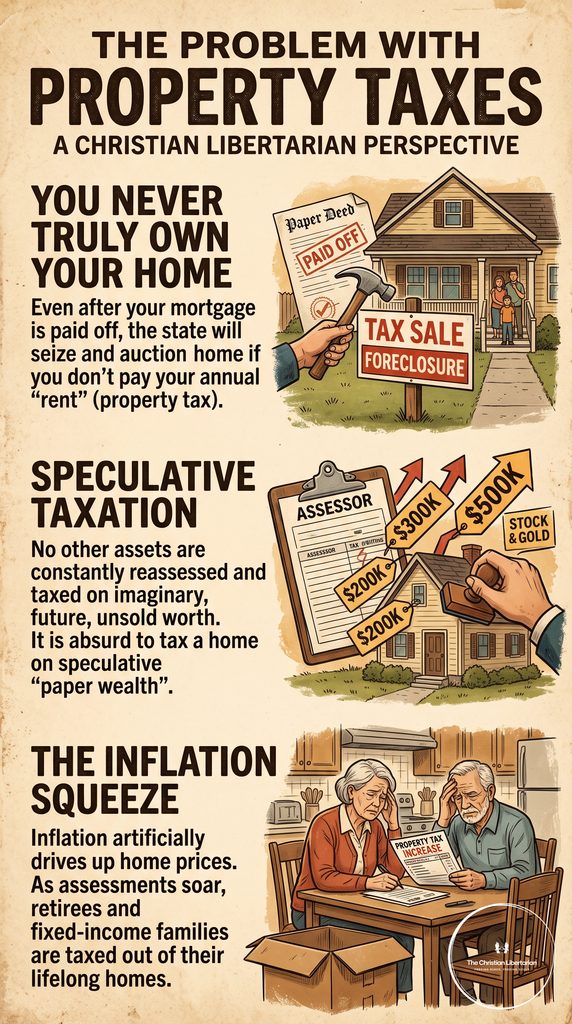
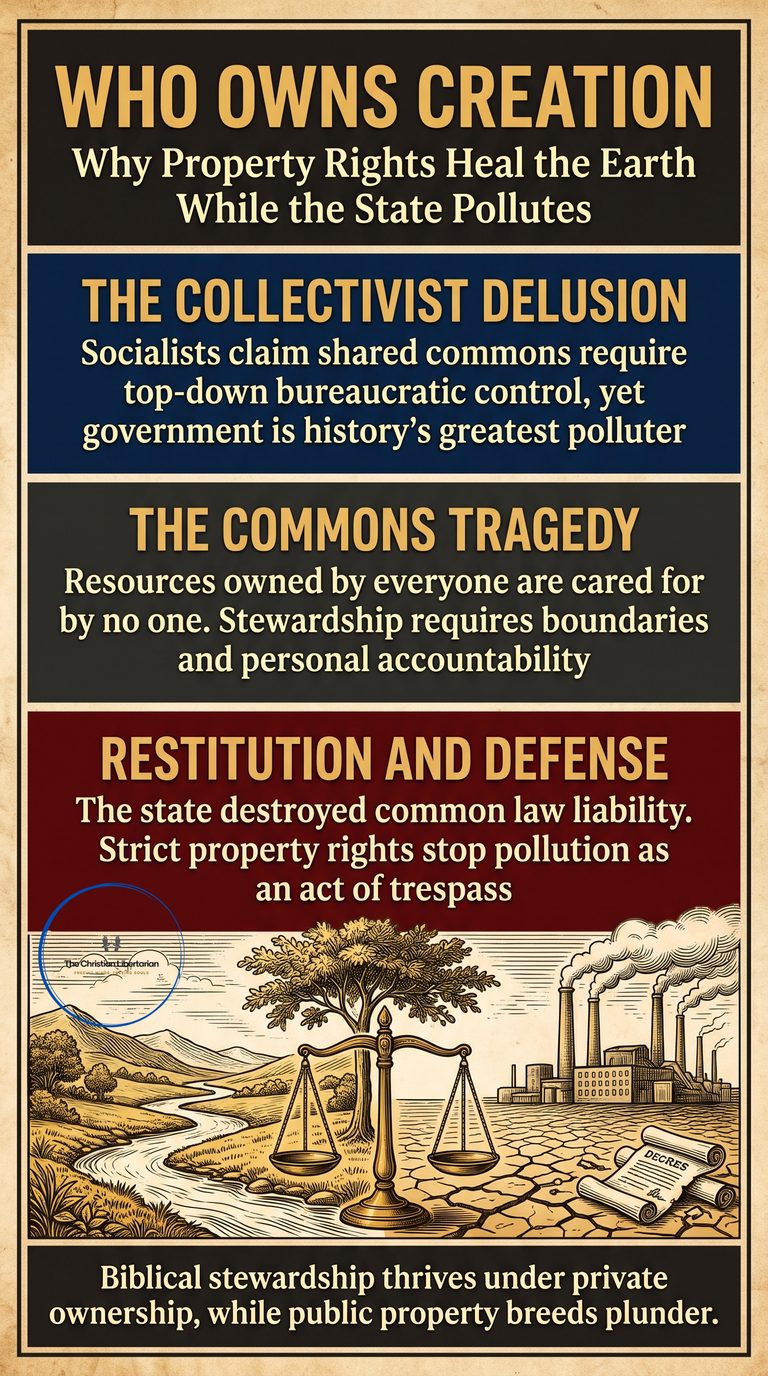
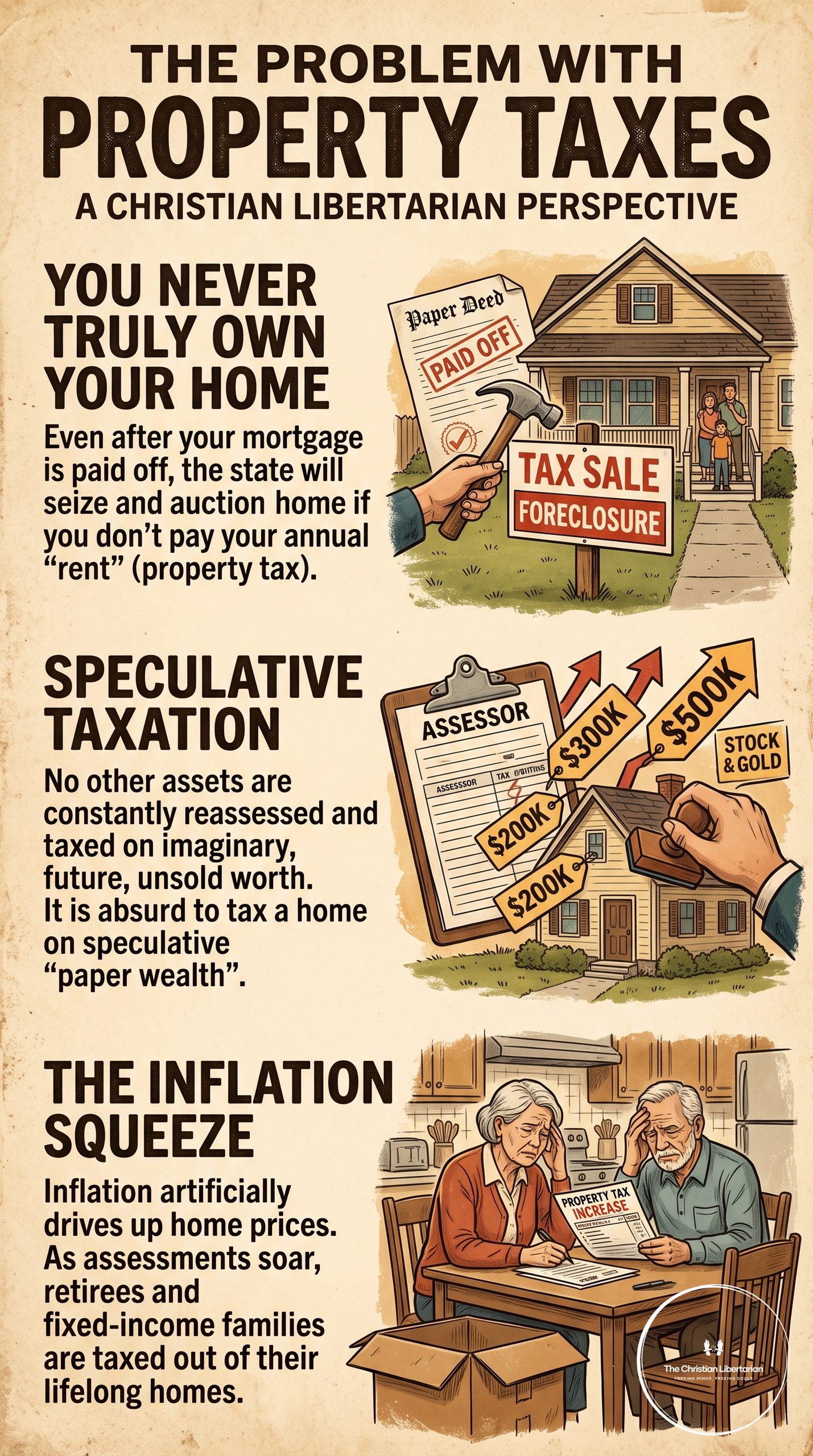
Do you actually own your home? Even after you spend thirty years paying off your mortgage and hold the deed in your hands, stop paying your annual property taxes, and a county sheriff will eventually show up to auction your land on the courthouse steps. Under a system of property taxation, you are never truly an owner; you are merely a permanent tenant leasing your own shelter from the civil government. When examined through the lenses of sound economics and Christian stewardship, the property tax emerges as one of the most insidious levies in existence: an ongoing assault on private property that quietly resurrects a modern form of feudal serfdom.
This reality challenges both the political Left and the political Right.
For progressives, property taxes are routinely defended as the indispensable lifeblood of local communities and government schools, framed as a way to fund public goods and keep wealth tied to civic responsibility. Yet this argument ignores how deeply regressive and destabilizing the tax actually is. Because landlords inevitably pass property tax increases directly down to their tenants through higher rents, the tax directly drives up the cost of living for lower-income families and young people trying to establish a foothold. More fundamentally, treating shelter—one of mankind’s most basic physical needs—as a permanent revenue faucet for municipal bureaucracies commodifies the home and makes housing security contingent on continuous state approval.
Conservatives, on the other hand, frequently defend property taxes under the reassuring banner of “local control.” Right-leaning politicians praise the levy as the purest expression of the “benefit principle,” arguing that paying local taxes keeps money close to home to fund police, fire departments, and roads. Yet these same conservatives claim to be the foremost champions of private property and family stability. Endorsing an extractive mechanism where local bureaucrats can foreclose on and seize a family’s debt-free homestead completely surrenders the concept of allodial title. Haggling over senior exemptions, millage tweaks, or assessment caps while preserving the state’s power to evict homeowners is conservative accommodationism at its worst.
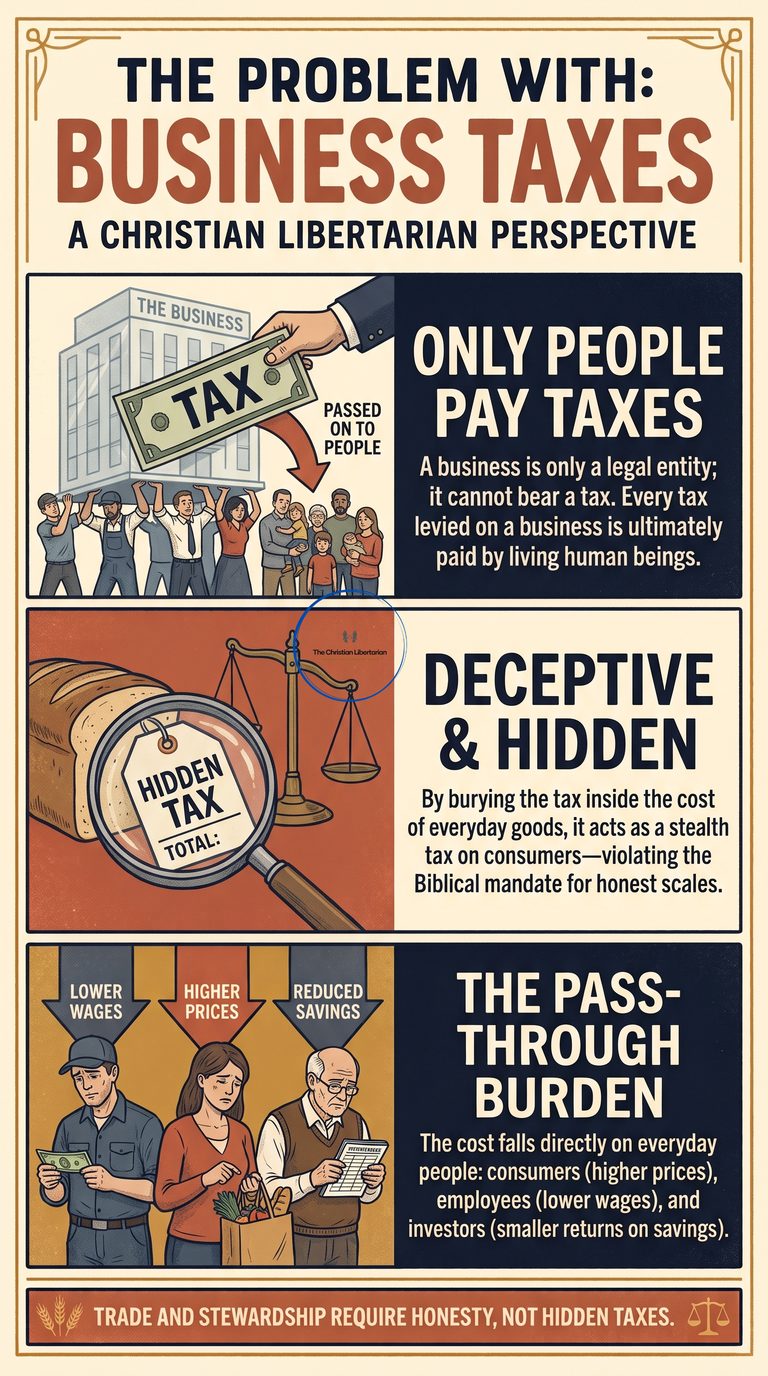
Beyond its political defenses, the mechanical structure of the property tax is an economic anomaly. Consider how we treat virtually every other asset in the economy: if you own shares of stock, gold bullion, tools, equipment, fine art, or a vintage vehicle, the government does not send an assessor to your house every few years to guess what your possessions might theoretically fetch at auction, only to demand an annual cash fee based on that speculative estimate. We recognize that taxing unrealized, speculative paper values on non-liquid assets is absurd. Yet that is precisely what local assessors do with real estate. Your home is not a liquid bank account. It produces no cash revenue simply by existing as your residence, yet the state demands liquid currency based on an arbitrary appraisal of what someone else might pay for it.
This speculative assessment model becomes predatory during periods of currency inflation. When the federal government and central bank expand the money supply, the purchasing power of the dollar drops, causing tangible hard assets like real estate to reprice drastically higher in nominal dollar terms. The physical house has not grown; its roof and walls provide the exact same utility they did a decade ago. Yet local tax assessors aggressively recalculate valuations upward to capture these paper gains.
For retirees, elderly couples, and multigenerational families living on fixed incomes, this dynamic is financially devastating. A couple may have scrimped and sacrificed for four decades to eliminate their mortgage so they could spend their final years secure in their family home. But because their broader neighborhood experienced an inflationary price surge, their property tax bill can double or triple in a few short years. Their fixed pensions and Social Security checks cannot keep pace. Unable to come up with thousands of dollars in sudden cash tribute for an unrealized gain on a home they have no intention of selling, they are taxed out of their neighborhoods. It is displacement by bureaucratic decree.
In a biblical framework, the preservation of family patrimony and secure tenure is central to human flourishing and civil liberty. The prophetic ideal of peace and freedom is described as a day when “they shall sit every man under his vine and under his fig tree; and none shall make them afraid” (Micah 4:4). Scripture treats ancestral land as a sacred trust meant to keep families rooted and independent from tyrannical rulers. When King Ahab pressured Naboth to surrender his family vineyard, Naboth rightly refused because civil magistrates have no moral authority to usurp family patrimony (1 Kings 21).
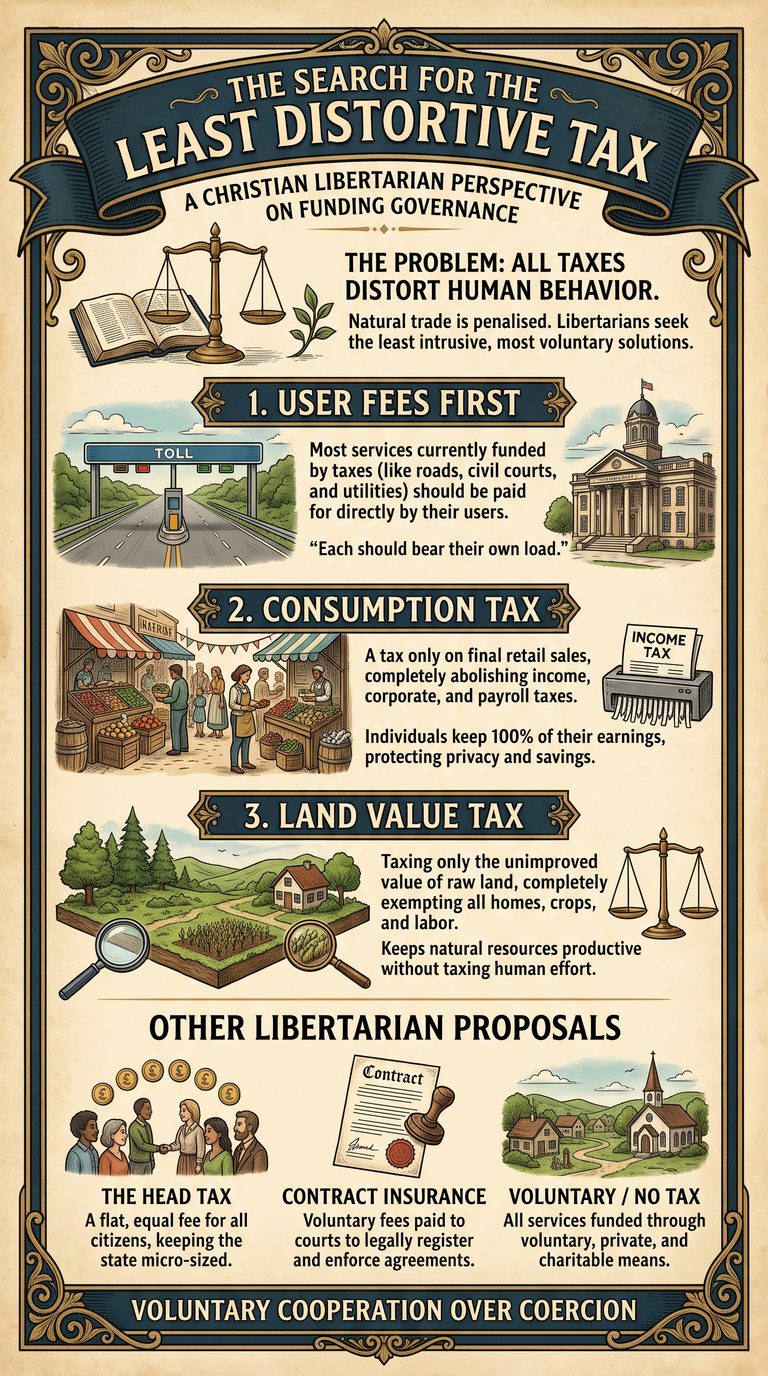
When the civil government can indefinitely bill you for occupying land and seize your family sanctuary if you cannot pay, private property ceases to exist. You are left with a conditional leasehold. True freedom requires the absolute security of the home. Abolishing property taxes is not merely an exercise in fiscal reform; it is a moral imperative to ensure that when a family buys and pays for their home, it actually belongs to them.
Sources & References:
- Lincoln Institute of Land Policy: A Good Tax? Legal and Policy Issues for the Property Tax in the United States and Property Tax Relief for Homeowners (analyzing the administrative and structural burdens of imposing charges on non-liquid assets and taxing unrealized property gains).
- Tax Foundation: Property Tax Relief & Reform and Limiting Property Tax Bill Increases (documenting how inflationary surges in assessed home values outpace household income and create severe burdens for fixed-income residents).
- Economic Theory: Murray N. Rothbard, Power and Market (critique of land taxation as a perpetual rent that abolishes absolute private property in favor of state supremacy); Hans-Hermann Hoppe, The Economics and Ethics of Private Property (on allodial ownership versus territorial expropriation).
- Scriptural Citations: Micah 4:4 & 1 Kings 4:25 (the blessing of unmolested, secure private property under one’s own vine and fig tree); 1 Kings 21:1–3 (Naboth’s defense of family inheritance against monarchical overreach); Leviticus 25:23–28 (the biblical protection of perpetual family land rights against permanent state dispossession).