
Let’s just give everyone “insurance” that pays less than the cost of care.
Whenever healthcare comes up, Christian political discourse usually degenerates into a shouting match between two deeply flawed orthodoxies. Progressives insist that Medicare for All is the only moral, Christlike path forward. Conservatives reflexively defend our current mess as if it were a sacred free-market triumph.
Both sides are fundamentally wrong.
The progressive vision sounds compassionate: heal the sick, care for the vulnerable, and make sure nobody goes bankrupt when they get cancer. Those are genuine Christian impulses. But when you look past the good intentions to the actual economics, the single-payer dream collapses under its own weight.
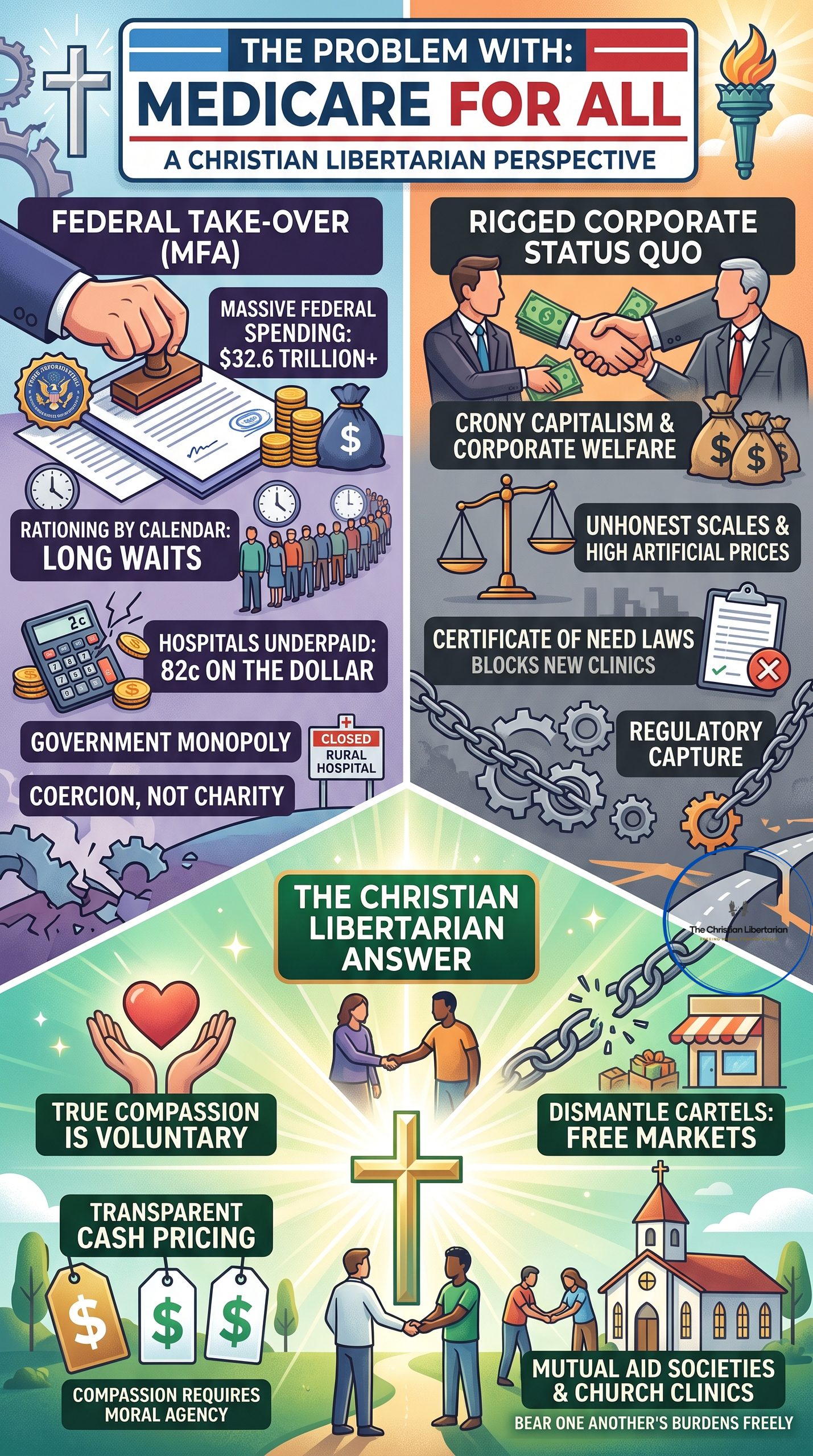
First, the fiscal math is staggering. Independent analyses, including studies by the Mercatus Center, estimate that Medicare for All would add at least $32.6 trillion in new federal spending over its first decade. To put that in perspective, doubling every single dollar of individual and corporate income taxes collected in the United States still wouldn’t pay for it.
Second, the structural math would wreck our medical infrastructure. Right now, the American Hospital Association reports that Medicare reimburses hospitals an average of just 82 cents for every dollar of actual care delivered. That created an underpayment shortfall of roughly $99 billion in a single year. The only reason hospitals keep their lights on is cost-shifting—charging private insurance higher rates to offset the government’s underpayment. Medicare for All bills propose slashing those private rates across the board down to Medicare levels. Wiping out that revenue would instantly push hundreds of community and rural hospitals into insolvency.
Third, when you make healthcare “free” at the point of use while simultaneously starving the supply side, basic economic reality doesn’t vanish; it just changes form. You don’t get abundance; you get rationing by the calendar. Look at Canada, where the Fraser Institute found the median wait time from a primary care referral to actual treatment stretched to over 28 weeks. That is more than six months of waiting in medical limbo.
From a Christian standpoint, outsourcing our duty to the state through coercion isn’t charity. Biblical generosity requires personal agency, voluntary sacrifice, and direct care for our neighbors. Confiscating wealth at gunpoint to fund a centralized bureaucratic monopoly that rations human care isn’t virtue—it is political control over life and death.
At the same time, conservatives need to stop defending the status quo. What we have right now is not a free market; it is an unholy corporate cartel protected by the government.
In dozens of states, Certificate of Need laws make it literally illegal for doctors to open a new imaging clinic, purchase an MRI, or build an outpatient surgical center unless they first prove a “need” to a state board—a board often dominated by the entrenched hospital chains they want to compete with. Add in government-granted pharmaceutical monopolies, opacity in billing, and tax codes that force workers into employer-tied insurance, and you get a rigged game. Defending this corporate cronyism in the name of “capitalism” is an embarrassment. It violates the biblical command for honest weights and scales, leaving families crushed under artificially inflated bills.
The solution is neither a federal takeover that bankrupts the nation nor the defense of an extortionate corporate syndicate.
A Christian libertarian approach calls for dismantling the cartels entirely: repealing Certificate of Need laws, unleashing direct primary care, mandating transparent upfront cash pricing, and stripping away corporate subsidies so that competition drives prices down into the realm of affordability. Alongside that, we must revive the voluntary mutual aid societies, fraternal funds, and church-driven clinics that built America’s hospital infrastructure long before Washington got involved.
We don’t have to choose between bureaucratic rationing and corporate monopolies. Real compassion doesn’t carry a badge or an IRS audit, and true healing begins when we break the cartels and freely bear one another’s burdens.
Sources:
Charles Blahous, “The Costs of a National Single-Payer Healthcare System,” Mercatus Center
American Hospital Association, “Fact Sheet: Underpayment by Medicare and Medicaid”
Fraser Institute, “Waiting Your Turn: Wait Times for Health Care in Canada”
David T. Beito, “From Mutual Aid to the Welfare State: Fraternal Societies and Social Services”
Cato Institute, “Overcoming the Health Care Cartel: How Federal Regulations Inflate Medical Costs”