
The Problem With: Capital Gains Taxes
Most people view the capital gains tax as an abstract policy debate that only affects Wall Street traders and private equity magnates. In popular discourse, it is framed simply as a tax on wealthy investors cashing in on windfall profits. But when you examine capital gains through the dual lens of sound economics and Christian stewardship, you uncover a far more predatory mechanism: a tax that systematically penalizes long-term savings, compounds the destruction of our money, and turns government-engineered inflation into a revenue stream for the state.
This reality challenges both the political Left and the political Right.
For progressives, hiking capital gains taxes is treated as a moral crusade against inequality. The common rallying cry is that investment income should be taxed at the exact same rate as labor, if not higher, to make the wealthy “pay their fair share.” But this ignores basic economic accounting. A capital gain on corporate stock or a business is already subject to multiple layers of taxation—the underlying company pays income taxes on its earnings before a single dollar of profit or dividend can flow through to equity value. More fundamentally, progressive ideology treats capital as if it were a static pile of hoarded loot rather than seed corn. Penalizing investment starves the economy of the equipment, technology, and facility expansions that make labor more productive and raise real wages for everyday workers. Punishing deferred gratification under the banner of equity does not help the poor; it destroys the capital formation necessary to lift them up.
Conservatives, meanwhile, frequently settle for superficial victories. Right-leaning politicians celebrate preferential capital gains tax rates as proof of their pro-growth credentials, treating a lower rate as a generous concession granted by the state. Yet conservatives routinely defend and vote for the trillions in deficit spending and central bank policies that debase the currency in the first place. They champion “free enterprise” while refusing to dismantle the fiat monetary engine that erodes the dollar’s value. By haggling over rate percentages while ignoring the systemic manipulation of the money supply, mainstream conservatism merely manages the terms of state extraction instead of challenging its legitimacy.
The deepest economic and moral injustice of the capital gains tax lies in its direct link to inflation.
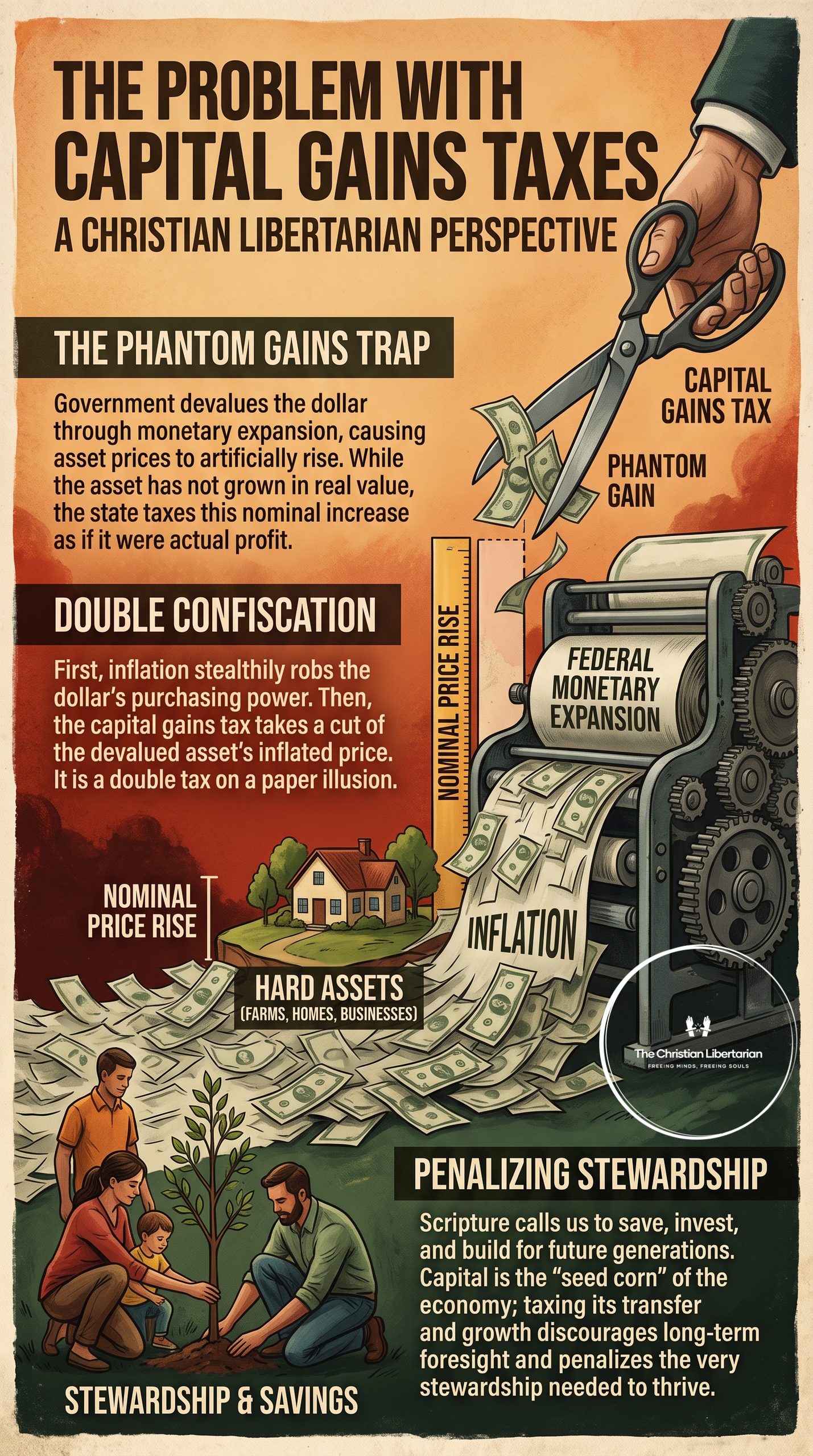
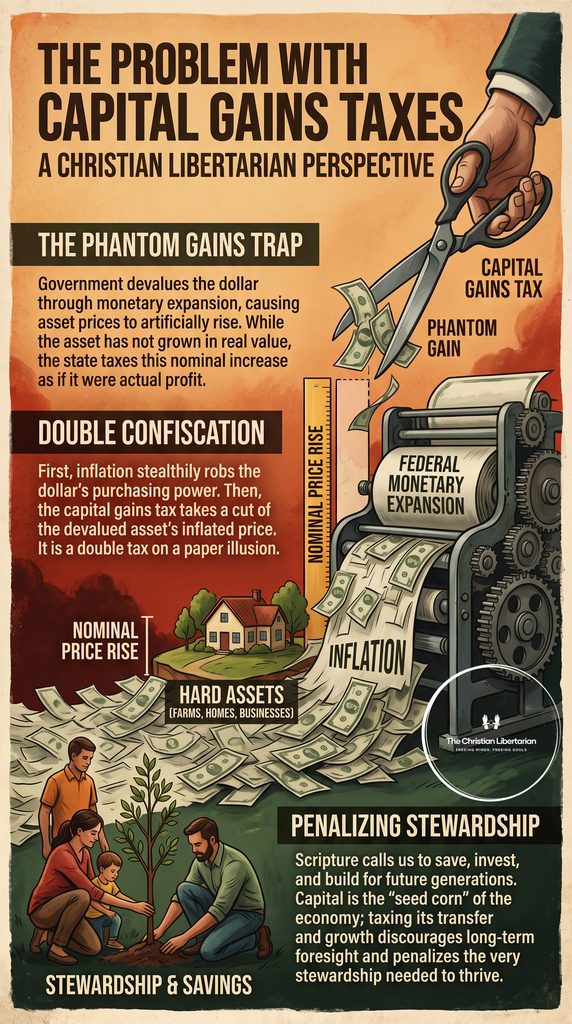
Whenever the federal government runs trillion-dollar deficits, the central bank accommodates that borrowing by expanding the money supply. When more currency units chase the same pool of real goods and productive assets, the purchasing power of each dollar diminishes. In response, hard assets—such as family homes, farmland, equipment, and shares of productive businesses—naturally reprice higher in nominal terms just to reflect the devalued currency.
The asset has not necessarily grown in real productivity or purchasing power; it simply takes more eroded dollars to purchase the same underlying piece of property. Yet because capital gains are not indexed to inflation, the Internal Revenue Service treats every nominal dollar increase as genuine taxable profit.
If you bought an asset decades ago for $100,000, and sustained inflation pushes its sale price to $200,000 today, your purchasing power may not have increased at all. You have made no real economic gain. Yet the government swoops in and levies a tax on that phantom $100,000 “gain”. In plain terms, the state debases the currency through monetary expansion, and then uses that very destruction of purchasing power as an excuse to expropriate a portion of your principal. It is a double confiscation: first through the stealth tax of inflation, and second through the capital gains tax on the resulting price adjustment.
From a Christian libertarian standpoint, this is an affront to basic biblical justice. Scripture repeatedly condemns dishonest scales, false balances, and the adulteration of money (Leviticus 19:35–36; Proverbs 20:10; Isaiah 1:22). Debasing the currency is institutional fraud. Taxing citizens on the fictitious gains generated by that debasement compounds fraud with extortion. Furthermore, believers are commanded to exercise prudent stewardship—to count the cost, save diligently, and leave an inheritance for their children’s children (Proverbs 13:22). By heavily taxing the transfer and growth of capital, the state discourages generational foresight and pushes society toward short-term consumption.
Real tax reform cannot begin and end with minor rate cuts. As long as the state inflates the currency and taxes the resulting phantom gains, capital gains taxes will remain a mechanism for confiscating real wealth under the illusion of taxing profit. True reform demands restoring honest money, recognizing that capital is the lifeblood of human flourishing, and ending the punitive extraction of the resources families need to build a stable future.
Sources & References:
- Tax Foundation:Getting “Real” by Indexing Capital Gains for Inflation and An Overview of Capital Gains Taxes (analyzing how unindexed cost bases cause the tax to fall on phantom inflationary gains rather than real wealth creation).
- Institute for Policy Innovation / Econlib: David R. Henderson, End the Tax on Phantom Gains (explaining how inflation turns neutral or negative real returns into net tax liabilities).
- Economic Theory: Ludwig von Mises, The Theory of Money and Credit and Human Action (analyzing monetary debasement, capital consumption, and the economic distortions of inflation).
- Scriptural Citations: Isaiah 1:22 (condemnation of debased silver and diluted wine); Proverbs 11:1 & 20:10 (prohibitions against false balances and differing weights); Proverbs 13:22 (the biblical virtue of multi-generational savings and inheritance).