
Let’s try the 3 C’s.
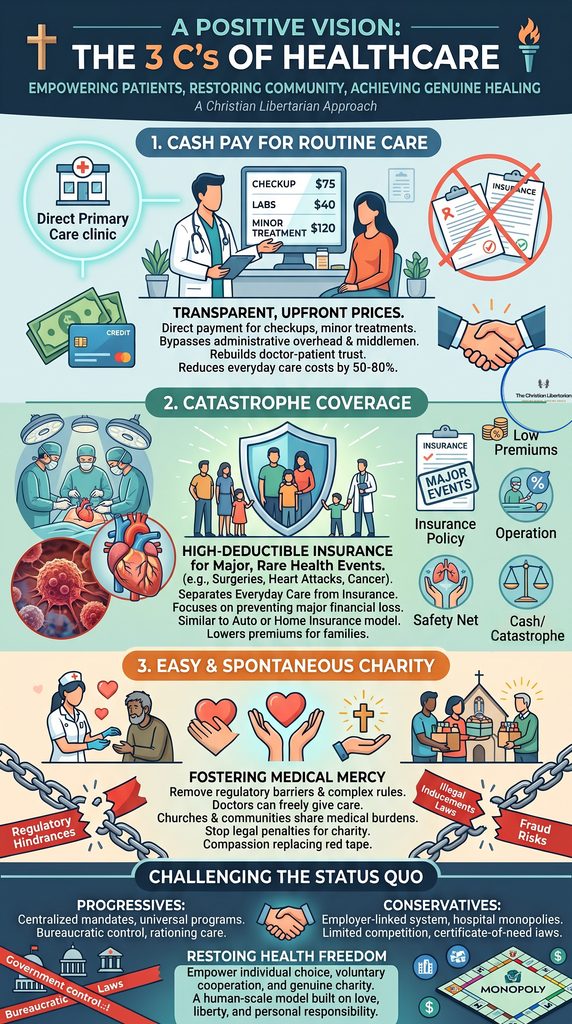
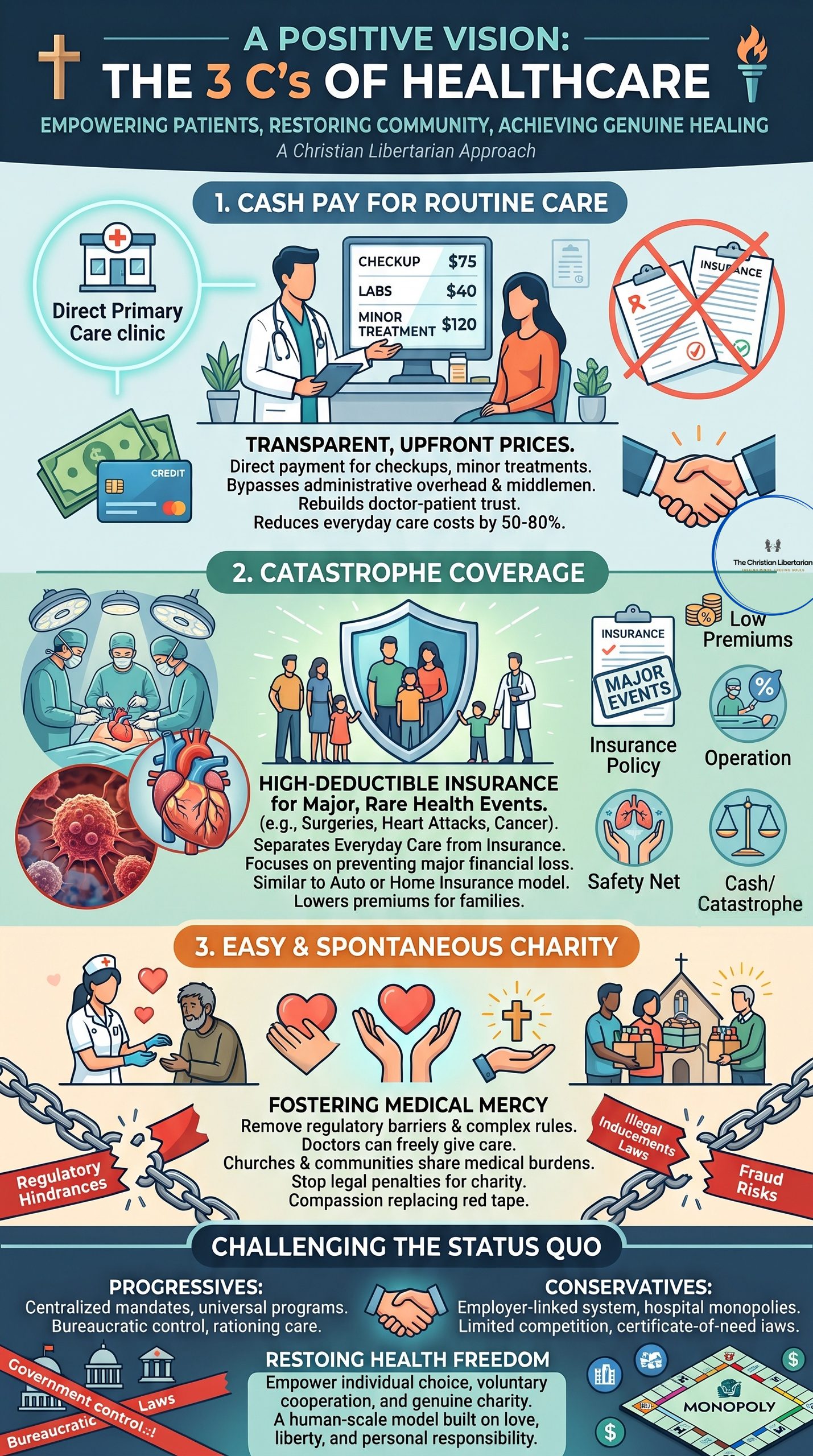
It is easy to point out how broken healthcare is in America, but complaining about the status quo without offering a coherent alternative leaves people feeling trapped between bureaucratic neglect and government takeover. A Christian libertarian vision of healthcare does not mean abandoning people to cold corporate systems or relying on state coercion. Instead, it offers a constructive, human-scale model built on personal agency, economic transparency, and neighborly love: the “3 C’s” framework—Cash, Catastrophe insurance, and Charity.
The first pillar is Cash for routine care, paired with upfront price clarity. When you buy groceries or get your car’s oil changed, you do not file an insurance claim through a third-party administrator who negotiates a hidden price months later. Routing routine checkups, blood tests, and minor stitches through complex insurance networks adds massive administrative overhead that inflates prices for everyone. Models like Direct Primary Care (DPC) and transparent cash-pay surgical centers prove that when doctors publish clear, flat fees upfront, routine care becomes dramatically cheaper—often 50% to 80% lower than traditional insurance rates—while restoring direct personal relationships between physicians and patients.
The second pillar is Catastrophe coverage. In every other area of life, insurance exists to protect against rare, unpredictable, high-cost emergencies like house fires or major car accidents. It is not designed to prepay for everyday maintenance. When federal and state mandates force health plans to cover every routine service, premiums explode into what feels like a second mortgage. Decoupling routine care from insurance and returning to true catastrophic coverage gives families an affordable financial shield against severe illness or injury, without stripping away their control over everyday medical decisions.
The third pillar is Easy Charity. Christians are called to care for the sick, bear one another’s burdens, and extend mercy to the vulnerable. Yet under our current regulatory regime, voluntary medical charity is heavily restricted and, in many cases, legally treated as fraud. Federal rules like the Anti-Kickback Statute and Civil Monetary Penalties Law, combined with commercial insurer contracts, often penalize physicians who want to offer free care or deep discounts to struggling neighbors, classifying those acts of mercy as improper “inducements” or billing fraud. Meanwhile, churches and community aid funds face legal red tape when trying to directly settle medical bills. Genuine compassion requires removing these regulatory handcuffs so clinics, churches, and families can freely practice biblical charity without fear of legal reprisal.
This positive vision challenges sacred cows on both sides of the political spectrum.
It challenges progressives who insist that universal government programs and centralized mandates are the only compassionate route. Turning healthcare into a state monopoly does not eliminate scarcity; it merely replaces patient-centered charity with bureaucratic rationing and political control.
It equally challenges conservatives who defend the current corporatist landscape—clinging to employer-linked tax carveouts, state certificate-of-need laws, and guild protections that shield entrenched hospital monopolies from honest competition. Defending managed-care cartels is not defending a free market.
True healthcare freedom is possible when we strip away the artificial distortions that make everyday care unaffordable and let transparent prices, catastrophic protection, and spontaneous Christian charity work together to heal our communities.
Sources:
- Hyman, David A., and Charles Silver. Overcharged: Why Americans Pay Too Much for Health Care. Cato Institute, 2018.
- Goodman, John C. Priceless: Curing the Healthcare Crisis. The Independent Institute, 2012.
- Twight, Charlotte. “Regulation of Medical Care: The Price of Government Paternalism.” The Independent Review, Vol. 3, No. 2, 1998, pp. 181–210.
- Department of Health and Human Services, Office of Inspector General (OIG). “Special Advisory Bulletin: Offering Gifts and Other Inducements to Beneficiaries.” Federal Register, 2002.
- Eskew, Philip M., and Kathleen Klink. “Direct Primary Care: Practice Distribution and Cost Analysis.” Journal of the American Board of Family Medicine, Vol. 28, No. 6, 2015, pp. 793–801.