
The Problem With: Sales Taxes
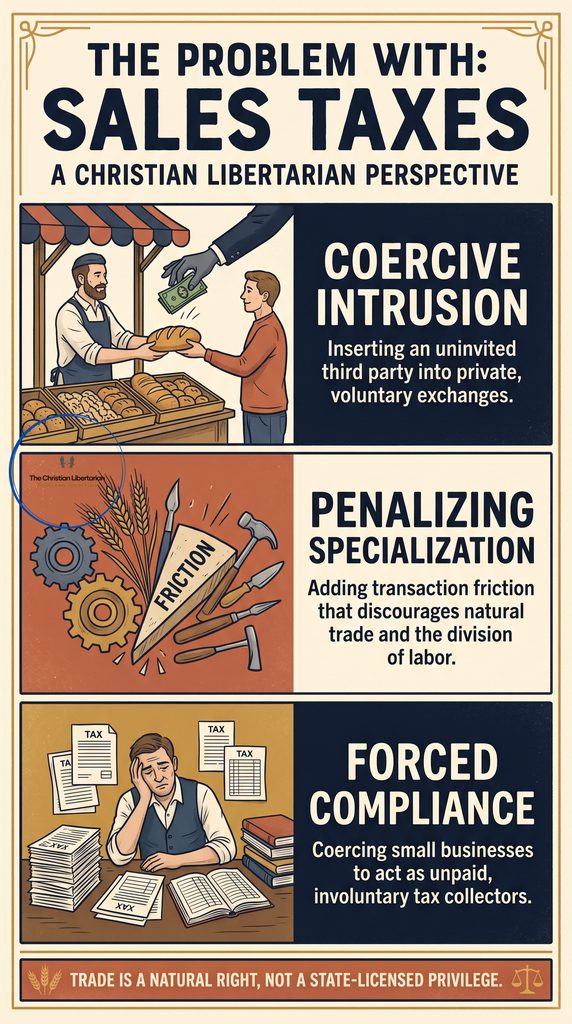
You walk into a local store, pick up a tool for your workshop, clothes for your children, or ingredients for dinner, and bring them to the register. You hand over money earned through your hard work, and the shopkeeper hands over goods they produced or procured. In a free society, this is the purest expression of peaceful human cooperation: a voluntary exchange where both parties walk away better off. Yet before the transaction can conclude, an uninvited third party steps in. The civil government thrusts its hand between buyer and seller, demanding an arbitrary percentage simply because goods changed hands.
Most citizens accept the retail sales tax without a second thought, viewing it as the simplest, least offensive way for state and local governments to raise revenue. But when analyzed through the dual lenses of sound economics and Christian stewardship, the sales tax reveals itself as a fundamentally coercive intervention. It establishes a state tollbooth over ordinary life, deputizes everyday merchants into unpaid tax collectors, and throws sand into the gears of voluntary human cooperation.
This reality challenges both the political Left and the political Right.
Progressives frequently acknowledge that general sales taxes are regressive, recognizing that flat percentage levies on consumption hit working-class families hardest because they must spend a much higher proportion of their income on immediate physical necessities. Yet progressives routinely turn around and champion the exact same mechanism through paternalistic “sin taxes.” They cheer on punitive excise taxes on fuel, sugary beverages, prepared foods, and tobacco, using the cash register as an instrument of social engineering to micromanage personal choices. Furthermore, progressive policymakers constantly look with envy at European-style Value Added Taxes (VATs) to fund sweeping administrative welfare states, conveniently ignoring that a VAT is merely a compounding, stealth sales tax baked into every single layer of the supply chain.
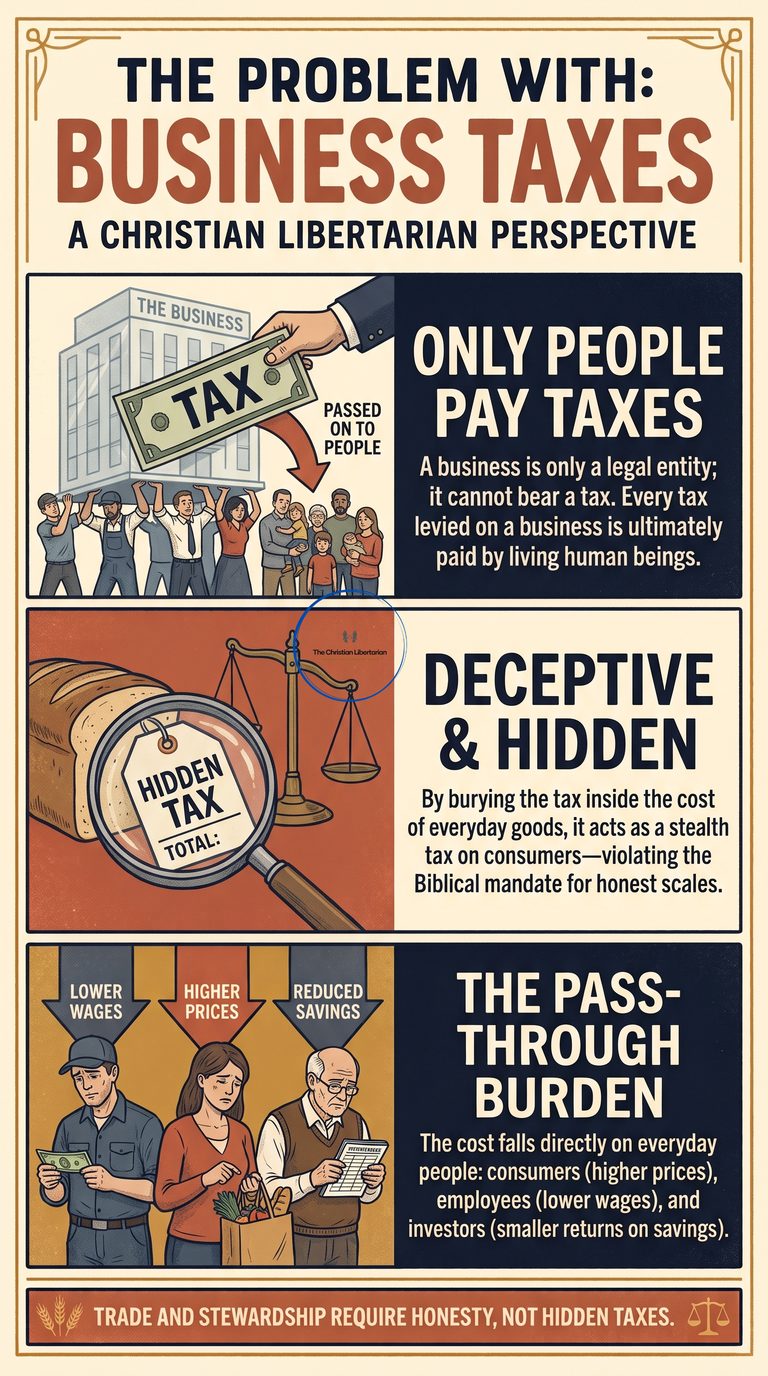
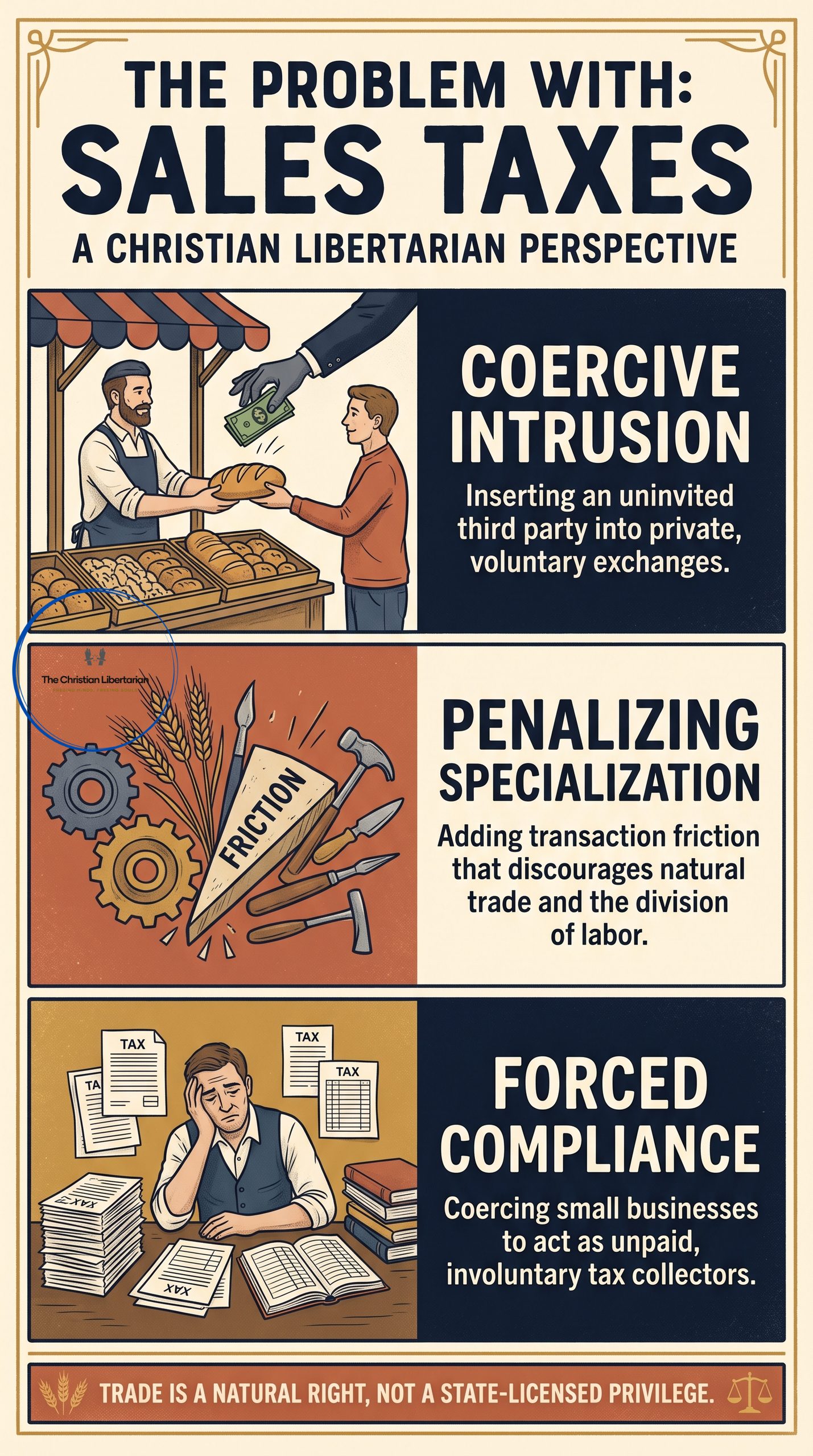
Conservatives, on the other hand, frequently praise consumption taxes as the ultimate free-market ideal. Championing proposals like the “FairTax” or a national retail sales tax to replace income taxes, right-leaning commentators celebrate consumption levies as “voluntary,” claiming that if you do not wish to pay the tax, you can simply choose not to buy the product. But this argument collapses under the weight of basic biology. Human beings cannot “choose” not to consume food, purchase clothing, repair a vehicle, or acquire heating fuel. Survival is not an elective luxury. Even worse, conservatives consistently ignore how sales taxes conscript small business owners. They force independent shopkeepers, contractors, and tradesmen to act as uncompensated tax enforcers for the government, threatening them with audits, crippling fines, and criminal penalties if they fail to police their customers on the state’s behalf.
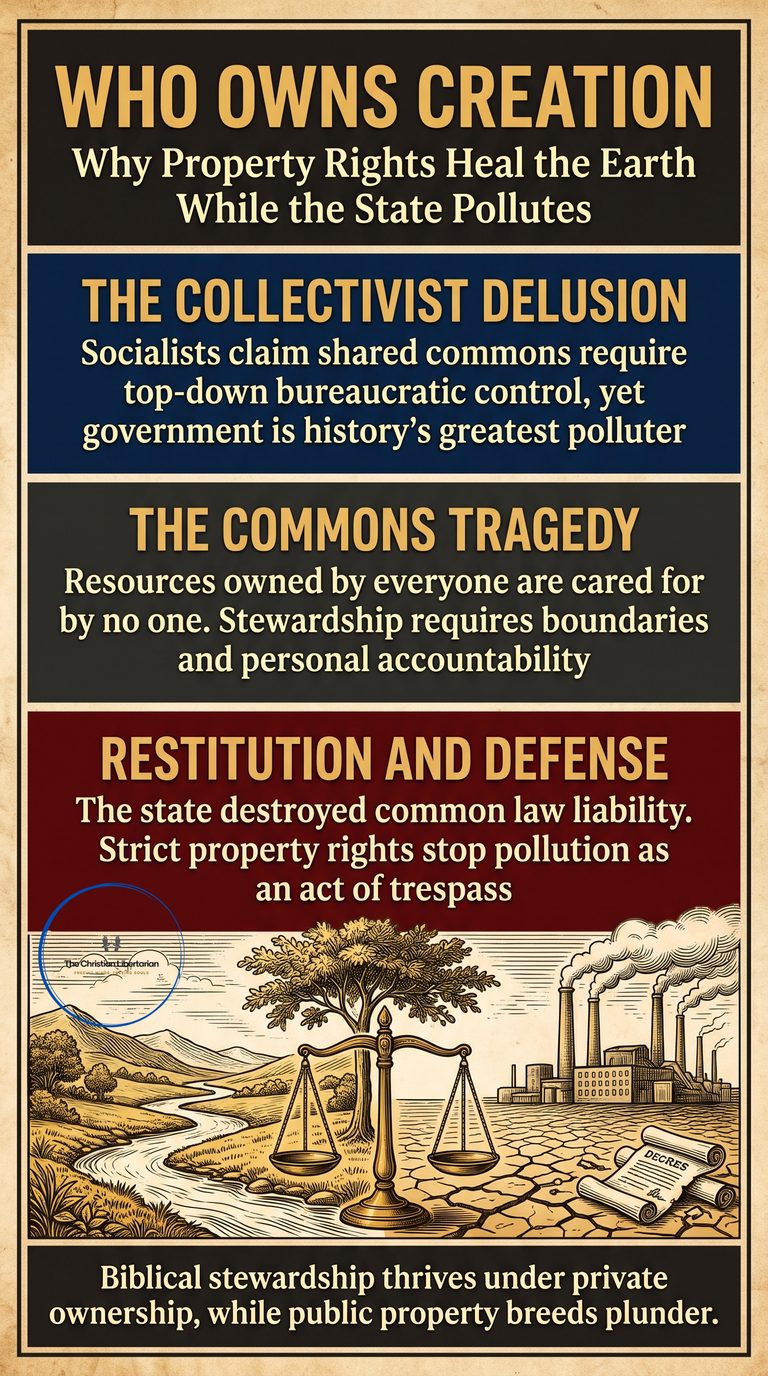
The deepest moral flaw of the sales tax is how it injects the coercive power of the state between otherwise private, peaceful transactions.
A commercial exchange requires no state involvement to be legitimate. One individual owns a good, another owns currency, and they agree upon mutually beneficial terms. The sales tax completely upends this natural right by treating trade not as an inherent liberty, but as a state-licensed privilege. It operates on the corrupt premise that the civil magistrate holds a perpetual lien on all commercial movement, asserting that no two citizens may exchange property without handing over tribute to the political class.
In biblical times, the publicans were among the most despised figures in society for this exact reason. They were not merely collecting an annual assessment; they set up physical tollbooths at town gates, market plazas, and crossroads, demanding a cut of fish, grain, and wares as merchants transported goods to market. They were state-sanctioned gatekeepers profiting off the natural movement of commerce.
Beyond violating the privacy of trade, sales taxes actively penalize economic specialization.
God did not create human beings as identical, self-contained units; He distributed unique gifts, talents, and skills across humanity so that we would serve and depend on one another (Romans 12:4–6). Human flourishing and rising living standards are driven directly by the division of labor. When people are free to specialize in what they do best—whether farming, carpentry, medicine, or manufacturing—and trade freely with others, society becomes vastly more productive, and poverty declines.
A sales tax directly taxes and penalizes the act of specialization. By placing an artificial financial penalty on every market exchange, it raises the cost of trading with a skilled neighbor relative to doing things yourself. An individual is economically nudged to spend ten frustrating hours doing mediocre plumbing or car repairs they are poorly equipped to handle, simply to avoid the sales tax toll of hiring a specialized craftsman.
In broader commerce, taxing sales also punishes small, specialized businesses while artificially favoring giant corporate conglomerates. A large corporation can afford to bring its legal, accounting, manufacturing, and distribution arms entirely in-house to avoid taxable point-of-sale events (vertical integration). Meanwhile, independent small businesses and local tradesmen who must buy parts, outsource services, and sell finished goods at distinct stages are hit with transaction frictions at every turn. By penalizing the point of exchange, the state discourages the very division of labor that allows small enterprises and everyday workers to thrive.
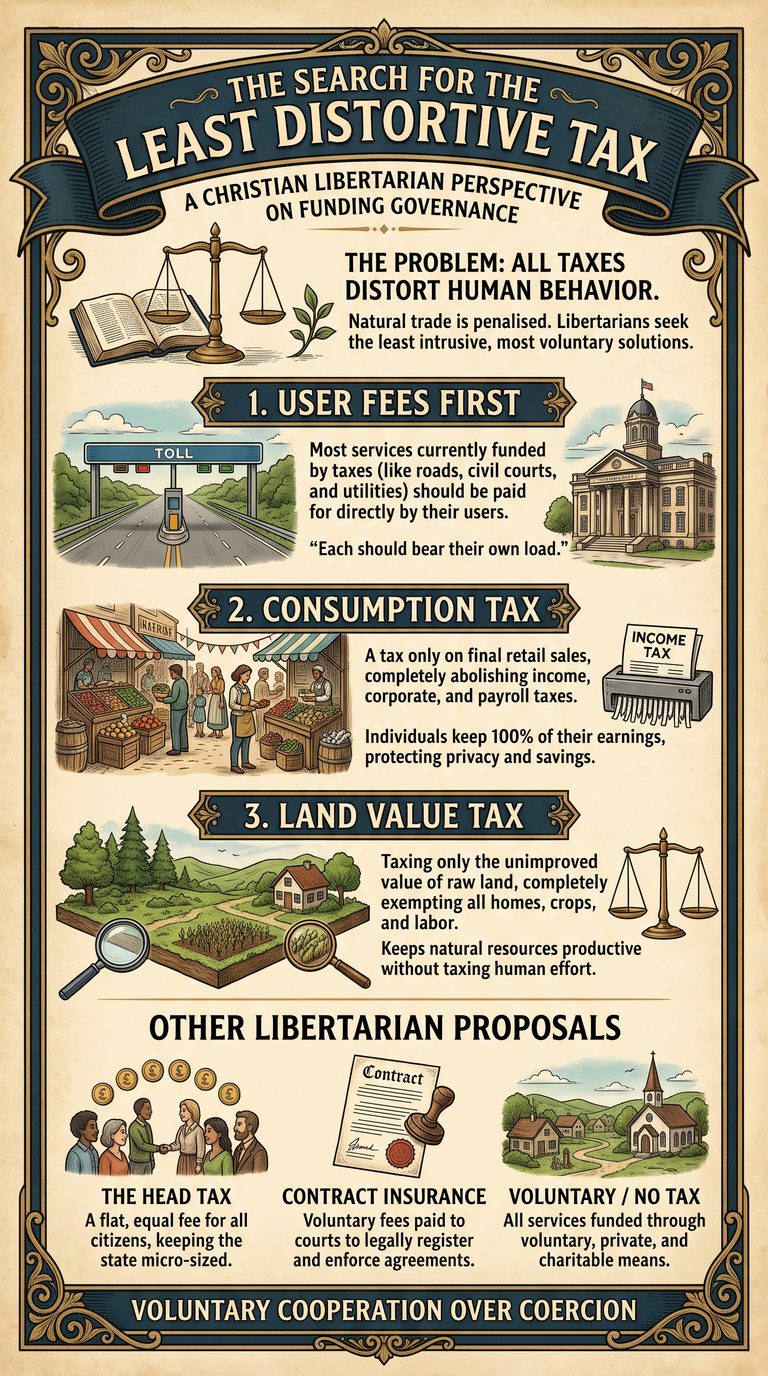
Trading the fruit of your labor for the goods and services you need to sustain your household is a natural right, not a government concession. Whenever the state inserts itself at the register and extracts a toll from peaceful exchange, it cheapens private property, distorts God-given specialization, and compromises economic freedom. A truly just society does not tax the everyday commerce that binds neighbors together; it leaves buyers and sellers free to trade in peace.
Sources & References:
- Economic Theory: Adam Smith, The Wealth of Nations (Book I, on the division of labor, specialization, and the extent of the market as the true drivers of wealth); Murray N. Rothbard, Power and Market: Government and the Economy (analyzing how sales taxes create deadweight loss, distort the structure of production, and disincentivize market exchange); Ludwig von Mises, Human Action (on catallactics, the natural harmony of voluntary exchange, and how state market interventions disrupt specialization).
- Tax Foundation: Sales Taxes in the States and The High Cost of Sales Tax Complexity (documenting the economic incidence, distortion of retail trade, and compliance burdens imposed on small businesses navigating thousands of overlapping taxing jurisdictions).
- Scriptural Citations: Romans 12:4–6 & 1 Corinthians 12:12–26 (the theological basis for diversity of gifts, mutual interdependence, and cooperative specialization); Luke 3:12–13 (John the Baptist warning toll collectors against predatory extraction at points of commerce); Matthew 20:13–15 (affirming the moral legitimacy and private sovereignty of voluntary economic agreements); Romans 13:3–4 (defining the legitimate, defensive role of civil governance as preserving peace rather than gatekeeping commerce).