
The Problem With: Inheritance (Death) Taxes
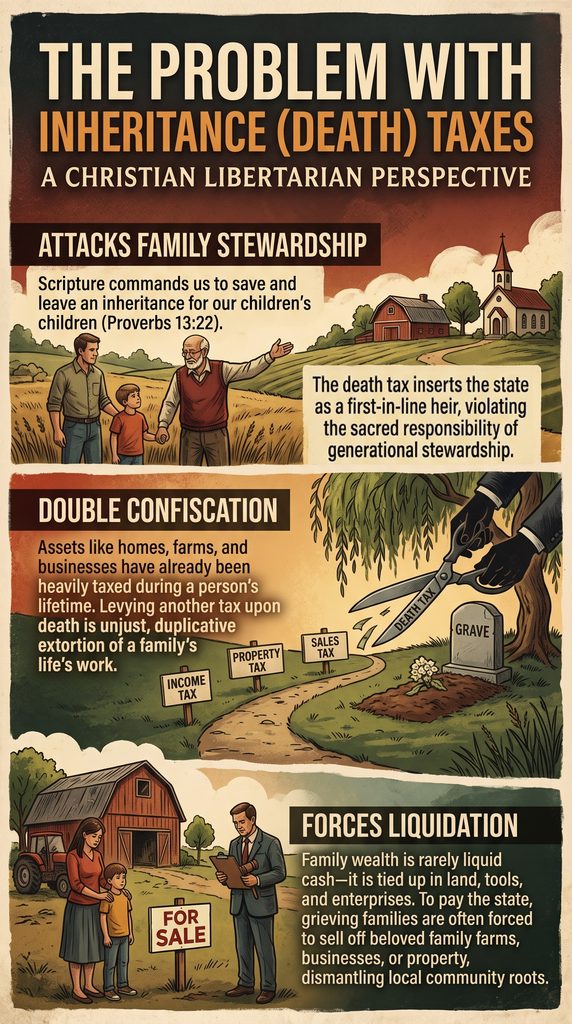
Few policies reveal the predatory nature of the modern state quite like the inheritance tax. Most taxes penalize you while you are actively earning, buying, or selling. The death tax is uniquely invasive: it places a state tollbooth at the entrance to the grave. It turns the death of a family member into a fiscal collection event, demanding that grief be accompanied by an accounting audit. But when you analyze this tax through the dual lenses of sound economics and Christian stewardship, the entire premise falls apart. The issue is not simply the dollar amount the state extracts; it is the moral presumption that civil government has a higher claim on family property than the family itself.
This reality disrupts conventional politics on both sides of the aisle.
For progressives, the estate tax is championed as a noble weapon against “dynastic wealth” and inequality. The popular narrative insists that allowing children to inherit substantial assets creates an unearned aristocracy, and that taxing estates levels the playing field for society. Yet this argument rests on an ideological hostility toward the family unit. Breaking up family capital does not lift up the poor; it simply transfers productive private assets into the hands of an unaccountable federal bureaucracy. Out of institutional envy, it punishes parents who exercised self-discipline and deferred gratification so their children could have a stronger economic foundation.
Conservatives, meanwhile, frequently treat the death tax as an accounting problem rather than a moral violation. Right-leaning politicians routinely celebrate raising exemption thresholds as a victory, leaving the underlying architecture intact so long as it only hits “the very wealthy.” They defend complex estate planning industries, stepped-up basis compromises, and legal loopholes that favor the well-connected, while failing to make the foundational case that the state has zero right to tax death in the first place. By haggling over exemptions instead of demanding full repeal, conservatism concedes the premise that property belongs conditionally to the state.
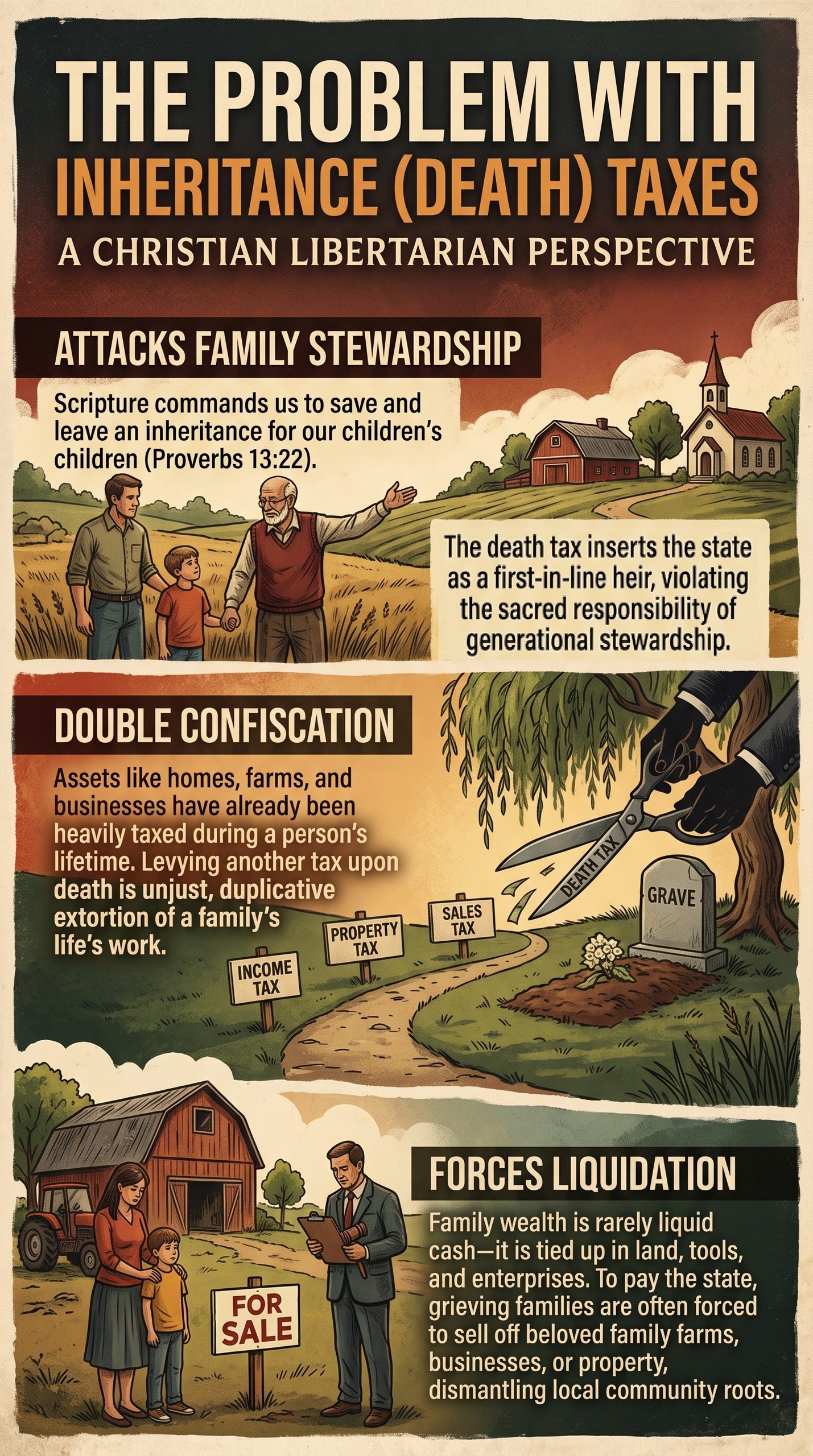
From a Christian perspective, the family was ordained long before the civil state, and scripture places intergenerational stewardship at the center of a faithful life. Proverbs 13:22 explicitly states, “A good man leaves an inheritance to his children’s children”, and the Apostle Paul reminds us that parents ought to store up for their children (2 Corinthians 12:14). Throughout the Old Testament, ancestral property was considered a sacred trust intended to preserve family independence and decentralize societal power. In 1 Kings 21, when King Ahab pressured Naboth to sell his ancestral vineyard, Naboth refused because civil rulers had no moral right to seize or disrupt family patrimony.
The inheritance tax fundamentally violates this biblical order by inserting the civil magistrate as the first-in-line heir. It operates on the totalizing assumption that all wealth is essentially state-owned property on loan to individuals during their lifetimes, and that death reverts that property back to the collective unless a ransom is paid.
Economically, the tax is both double confiscation and an engine of capital destruction. The assets that make up an estate—whether cash, equities, real estate, or business equipment—have already been taxed multiple times over a lifetime through income taxes, payroll taxes, corporate taxes, capital gains taxes, and annual local property taxes. To tax them again upon the owner’s death is sheer extortion.
Worse still, family wealth is rarely a pile of liquid cash sitting idle in a vault. It is almost always tied up in illiquid, productive capital: family farms, ranches, machinery, tools, and local businesses. When the state demands millions in cash taxes within months of an owner’s passing, families are routinely forced to sell off land, liquidate equipment, or sell out to private equity and corporate conglomerates just to pay the IRS. This destroys local community enterprises, penalizes long-term productive investment, and encourages high-spending consumerism over multi-generational thrift.
Death should never be a taxable event. The state has no divine authority to sever the transmission of property between parents and their children. True economic flourishing and human freedom depend on strong, independent families capable of building wealth that outlasts a single generation. Until we abolish the death tax entirely, we continue to endorse a dangerous legal falsehood: that our families exist to serve the state, rather than the state existing to protect the family.
Sources & References:
- Tax Foundation: Estate and Inheritance Taxes: Rates, Economic Implications, and State Comparisons (documenting how death taxes reduce domestic investment, destroy capital formation, and incur severe compliance costs).
- Family Firm Institute / Journal of Financial and Economic Studies: Joseph H. Astrachan and Roger Tutterow, The Effect of Estate Taxes on Family Business (finding that estate taxes distort long-term investment, trigger forced sales of family-owned assets, and lead to job losses).
- Economic Theory: Ludwig von Mises, Human Action (analysis of capital consumption, time preference, and how estate expropriation incentivizes short-term consumption over capital accumulation); Murray N. Rothbard, Power and Market (critique of inheritance taxation as an assault on private property and bequest rights).
- Scriptural Citations: Proverbs 13:22 (the righteous duty of multi-generational inheritance); 2 Corinthians 12:14 (parents storing up for children); 1 Kings 21:1–3 (Naboth’s defense of ancestral family property against civil confiscation); Numbers 36 (biblical protections guarding the integrity of tribal and family inheritance).