
Part 5: Honest Weights or Counterfeit Crowns: Why Hard Money Liberates and Fiat Exploits
Few Austrian proposals provoke as much fury from the political left as the demand for sound money. When Austrian economists advocate for one hundred percent reserve banking, the abolition of the Federal Reserve, and a return to gold, silver, or market chosen hard currency, critics dismiss the position as dangerous economic reactionism.
Modern socialists and advocates of Modern Monetary Theory view hard currency as an artificial straitjacket designed to protect wealthy creditors, bankers, and bondholders at the expense of working people. In their telling, the nineteenth century gold standard was an era of cruelty marked by recurring banking panics, farm foreclosures, and chronic deflation that crushed debt ridden farmers and industrial laborers. From the perspective of Keynesians and modern democratic socialists, sovereign fiat currency is a public monopoly that must be deployed for the common good. Why allow human needs to go unmet when a sovereign government can issue currency to guarantee full employment, fund universal healthcare, build public transit, and finance a clean energy transition? To the progressive mind, the Austrian insistence on commodity money strips democratically elected leaders of their monetary sovereignty, chaining society to arbitrary mineral scarcity and imposing cruel, permanent austerity on the public.
This argument holds immense appeal in a culture conditioned to believe that wealth comes from government spending. Yet when we examine sovereign fiat currency through biblical justice, the Nonaggression Principle, and Austrian monetary theory, the socialist narrative completely falls apart. Paper money does not abolish scarcity; it merely masks government plunder. Hard currency is not an engine of austerity, but the greatest defense ordinary workers have ever had against the hidden tyranny of state counterfeiting.
First Principles Analysis
The debate over money is not merely a technical question of monetary policy. It is a profound moral question of truth and justice.
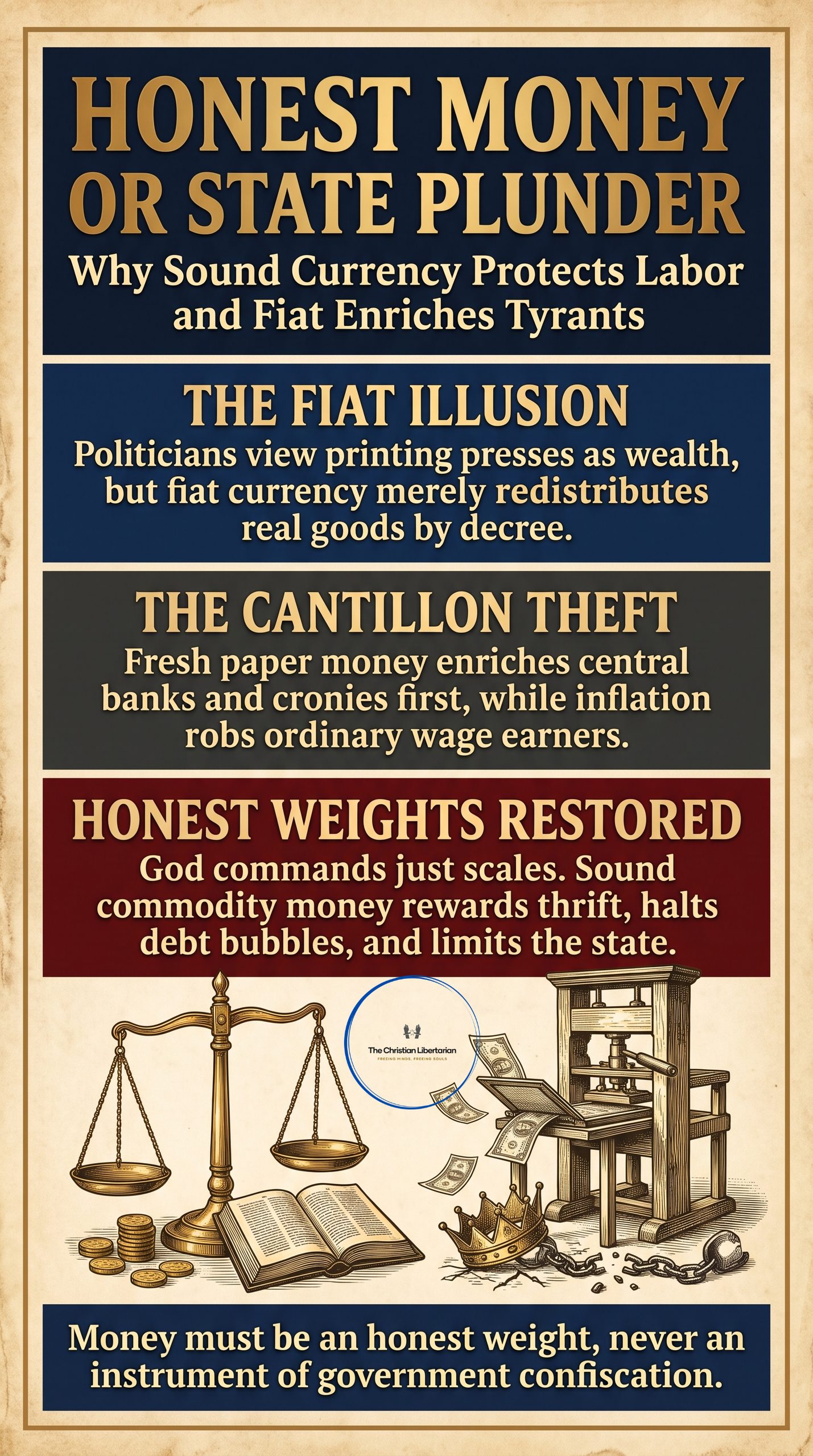
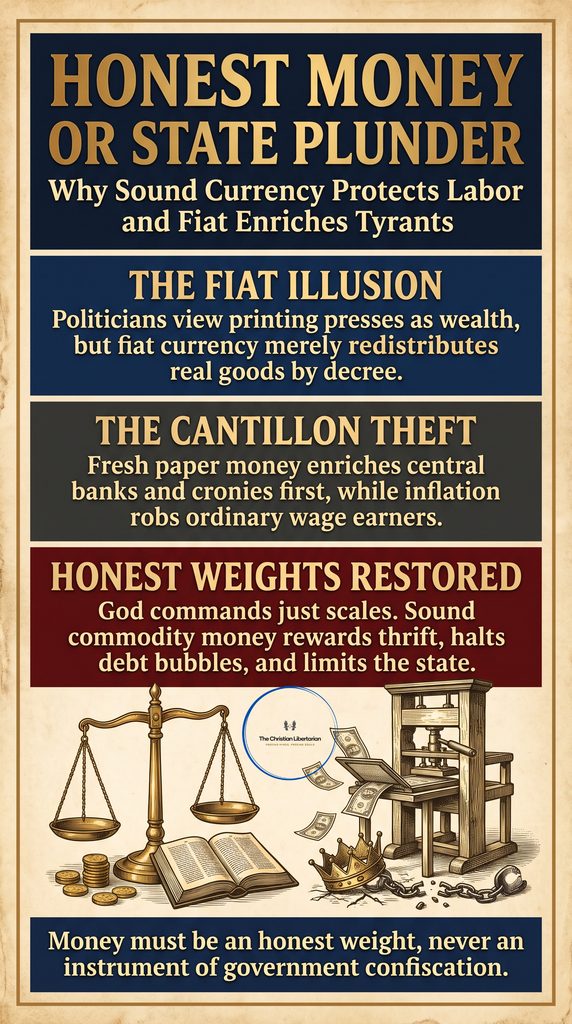
Scripture speaks directly and repeatedly about monetary integrity. In Proverbs 11:1, God declares that dishonest scales are an abomination to the Lord, but a just weight is His delight. In Leviticus 19:35 to 36, God commands His people to do no wrong in judgment, in measures of length, weight, or quantity, requiring just balances and just weights. When the prophet Isaiah pronounced judgment upon apostate Jerusalem in Isaiah 1:22, he singled out monetary debasement alongside moral corruption, declaring that their silver had become dross and their wine was diluted with water. In ancient times, corrupt kings diluted gold and silver coins with cheap base metals to expand their spending without raising visible taxes. Modern central banks do the exact same thing by creating digital fiat credits out of thin air. In the eyes of God, diluting the purchasing power of the currency through bureaucratic decree is theft, breaking the Eighth Commandment forbidding stealing and the Tenth Commandment forbidding coveting.
Furthermore, the doctrine of total depravity warns us never to grant fallen rulers unchecked power over the livelihoods of their subjects (Psalm 146:3, 1 Samuel 8). When a government claims the sovereign right to manufacture unlimited currency, it gives sinful politicians a power that belongs only to God: creating value out of nothing. This power inevitably corrupts the state and destroys the constitutional limits of the civil magistrate. As Romans 13:1 to 4 and 1 Peter 2:13 to 14 make clear, God ordained civil government solely to punish evildoers and protect the peaceful, not to act as a universal provider, industrial planner, or economic master.
Under the Principle of Nonaggression, the state maintains its paper monopoly through systemic violence. The government enforces legal tender laws that penalize citizens who try to trade or save in competing currencies, while imposing capital gains taxes on gold and silver to suppress market competition. Frédéric Bastiat identified this as the essence of legal plunder: when the law takes from some persons what belongs to them and gives it to other persons to whom it does not belong, using the coercive power of the police and courts.
Austrian economics explains the precise economic mechanics of this plunder through the Cantillon Effect, discovered by Richard Cantillon and developed by Ludwig von Mises and Murray Rothbard. Money is not neutral. When a central bank expands the money supply, the newly created cash does not land evenly across the economy like gentle morning dew. It enters at specific geographic and institutional points: government agencies, massive defense contractors, Wall Street banks, and politically connected corporations. These early receivers spend the new dollars before prices have risen, purchasing real land, labor, and capital at pre inflation prices.
By the time the new money ripples outward to local retail markets, prices have already climbed across the board. The late receivers, who are ordinary hourly wage earners, small business owners, pensioners, and the working poor, discover that their weekly paychecks buy less food, less fuel, and less housing. Inflation is not a mysterious act of nature; it is a hidden, regressive redistribution of real wealth from the productive working class to the political elite and financial cartels.
What about the socialist charge that the gold standard caused the economic panics and farm foreclosures of the nineteenth century? This claim gets economic history completely wrong by confusing a genuine commodity standard with fractional reserve banking privileges granted by the state. During the nineteenth century, western governments repeatedly allowed chartered private banks to issue unbacked paper banknotes far in excess of the physical gold and silver in their vaults. When these banks engaged in artificial credit expansion, they triggered artificial booms that ended in inevitable liquidity panics. The gold standard was not the disease; it was the biological cure that repeatedly arrested state chartered banking bubbles and forced financial institutions back to fiscal reality.
Equally flawed is the progressive terror of deflation. Under an unhampered market with sound money, technological innovation and capital accumulation cause productivity to expand faster than the money supply. As a result, the general price level gently falls over time. This growth deflation is a massive blessing to ordinary people. When prices fall, a factory worker, a mechanic, or a retail clerk enjoys a rising standard of living every year without having to beg a boss or a union boss for a raise. Their saved dollars gain purchasing power over time, rewarding thrift, encouraging family savings, and protecting generational inheritance, as commended in Proverbs 13:22. Sovereign fiat currency turns this moral order upside down by punishing savers, forcing families to gamble in volatile stock markets just to protect their purchasing power, and rewarding reckless debt.
Concrete Illustration and Case Study
In this hypothetical scenario, consider a secluded agricultural valley where twenty farming families use pure silver coins as their medium of exchange. Because silver requires intense labor to mine and refine, the money supply is stable, disciplined by honest physical reality. Every year, local carpenters and farmers build better plows and irrigation canals, producing more wheat and apples with less effort. As a result, the price of a loaf of bread gradually falls from two silver grams to one silver gram. Every working family sees their wages purchase more bread and warm clothes each winter, while elders live comfortably on their modest silver savings.
One summer, a newly appointed town council declares that hauling heavy silver is obsolete and announces the creation of the Valley Prosperity Bank. The council locks all the silver in a municipal vault and prints paper certificates, promising that sovereign monetary planning will guarantee full employment and build free town halls. Within five years, the council prints triple the original paper supply to fund ambitious community projects and pay municipal salaries. The local government officials and contractors buy up choice farmland and timber plots with the fresh paper. Soon, the price of a loaf of bread climbs from one paper dollar to six paper dollars. The elderly widows find their life savings ruined, and young farmhands work twelve hour days just to afford dinner. When the townspeople protest, the council president blames greedy private bakers and demands total emergency authority to fix prices. The council did not liberate the valley from scarcity; it used paper money to confiscate the valley’s wealth without ever passing a visible tax.
This fictional dynamic matches the real world transformation of the United States after 1971. In August 1971, President Richard Nixon severed the final link between the United States dollar and gold, ending the Bretton Woods system and inaugurating the modern era of pure global fiat money. Politicians and Keynesian economists promised that abandoning the gold standard would give technocrats the flexibility to eliminate recessions, guarantee stable employment, and manage the national economy with scientific precision. The actual result was an explosion of federal debt, chronic currency debasement, and systemic economic fragility.
Empirical Evidence and Policy Impact
The empirical track record of unbacked sovereign fiat currency stands as an indictment of the modern welfare and warfare state:
- The Devastation of Purchasing Power: According to data from the United States Bureau of Labor Statistics, since the creation of the Federal Reserve System in 1913, the United States dollar has lost more than ninety seven percent of its purchasing power. What required one dollar to purchase in 1913 required more than thirty one dollars by 2024.
- The 1971 Decoupling of Wages and Asset Prices: Following the closure of the gold window in 1971, the economic fortunes of ordinary wage earners and financial elites diverged dramatically. Historical datasets compiled by the Federal Reserve Bank of St. Louis show that while real hourly wages grew in lockstep with labor productivity between 1948 and 1971, productivity continued to rise while real median hourly wage growth stagnated after 1971. Concurrently, unbacked monetary expansion fueled massive stock, corporate bond, and residential real estate inflation, enriching asset owners while pricing young working families out of homeownership.
- Nineteenth Century Productivity Under Sound Money: During the classical gold standard era between 1870 and 1900 in the United States, often called the Great Deflation, the Consumer Price Index fell by roughly one to two percent annually. Rather than causing economic collapse, real Gross Domestic Product grew at an astonishing rate of over four percent per year, while real wages for industrial laborers rose by more than fifty percent as technological advances made goods cheaper for ordinary consumers.
- Financing the Warfare State and Federal Debt: Without the discipline of sound money, the United States national debt exploded from roughly 398 billion dollars in 1971 to over 34 trillion dollars by 2024. Sovereign fiat money allowed the federal government to finance endless foreign interventions, overseas military occupations, and massive corporate bailouts without having to seek the direct, transparent consent of the public through explicit tax hikes.
The Free and Moral Alternative
True economic justice and working class prosperity will never be achieved by giving the state an infinite digital printing press. A biblical and Austrian monetary framework replaces coercive debasement with honesty, accountability, and freedom:
- Abolish Central Banking and Legal Tender Laws: End the Federal Reserve monopoly and repeal coercive legal tender statutes, allowing gold, silver, foreign currencies, and decentralized digital assets to compete freely in the open marketplace.
- Enforce Honest Scales Through One Hundred Percent Reserves: Treat banking like any other business under the rule of law. A bank warehouse certificate must correspond to real, physical reserves, ending the legal fiction of fractional reserve banking and preventing artificial credit cycles.
- Eliminate Capital Gains Taxes on Precious Metals: Remove all federal and state sales and capital gains taxes on physical gold and silver, recognizing that exchanging fiat paper for honest constitutional money is not speculative income, but the exercise of an essential property right.
- Rebuild Generational Independence: Sound, non inflationary money protects the savings of working families, prevents the stealth taxation of inflation, and restores the cultural incentive to save, build family wealth, and practice voluntary Christian generosity without state dependency.
Sources and References
- Holy Bible: Genesis 1:26 to 27, Leviticus 19:35 to 36, Deuteronomy 25:13 to 15, 1 Samuel 8:10 to 18, Psalm 146:3, Proverbs 11:1, Proverbs 13:22, Proverbs 20:10, Isaiah 1:22, Romans 13:1 to 4, 1 Peter 2:13 to 14.
- Ludwig von Mises, The Theory of Money and Credit (1912) and Human Action: A Treatise on Economics (1949).
- Murray N. Rothbard, What Has Government Done to Our Money? (1963) and The Mystery of Banking (1983).
- Richard Cantillon, An Essay on Economic Theory (1755), foundational formulation of the Cantillon Effect.
- Frédéric Bastiat, The Law (1850), defining legal plunder and the limits of civil law.
- Ron Paul, End the Fed (2009) and The Case for Gold (1982, with Lewis Lehrman).
- Milton Friedman and Anna J. Schwartz, A Monetary History of the United States, 1867 to 1960 (1963), documenting historical price deflation and output growth during the late nineteenth century gold standard.
- United States Bureau of Labor Statistics, Consumer Price Index for All Urban Consumers (CPIAUCSL), historical data series covering 1913 to 2024.
- Federal Reserve Economic Data (FRED), Federal Reserve Bank of St. Louis: Real Median Household Income in the United States (MEHOINUSA672N) and Total Public Debt (GFDEBTN).