
Part 3: Silicon Leviathan: Why Central Planning Fails Even in the Age of Supercomputers
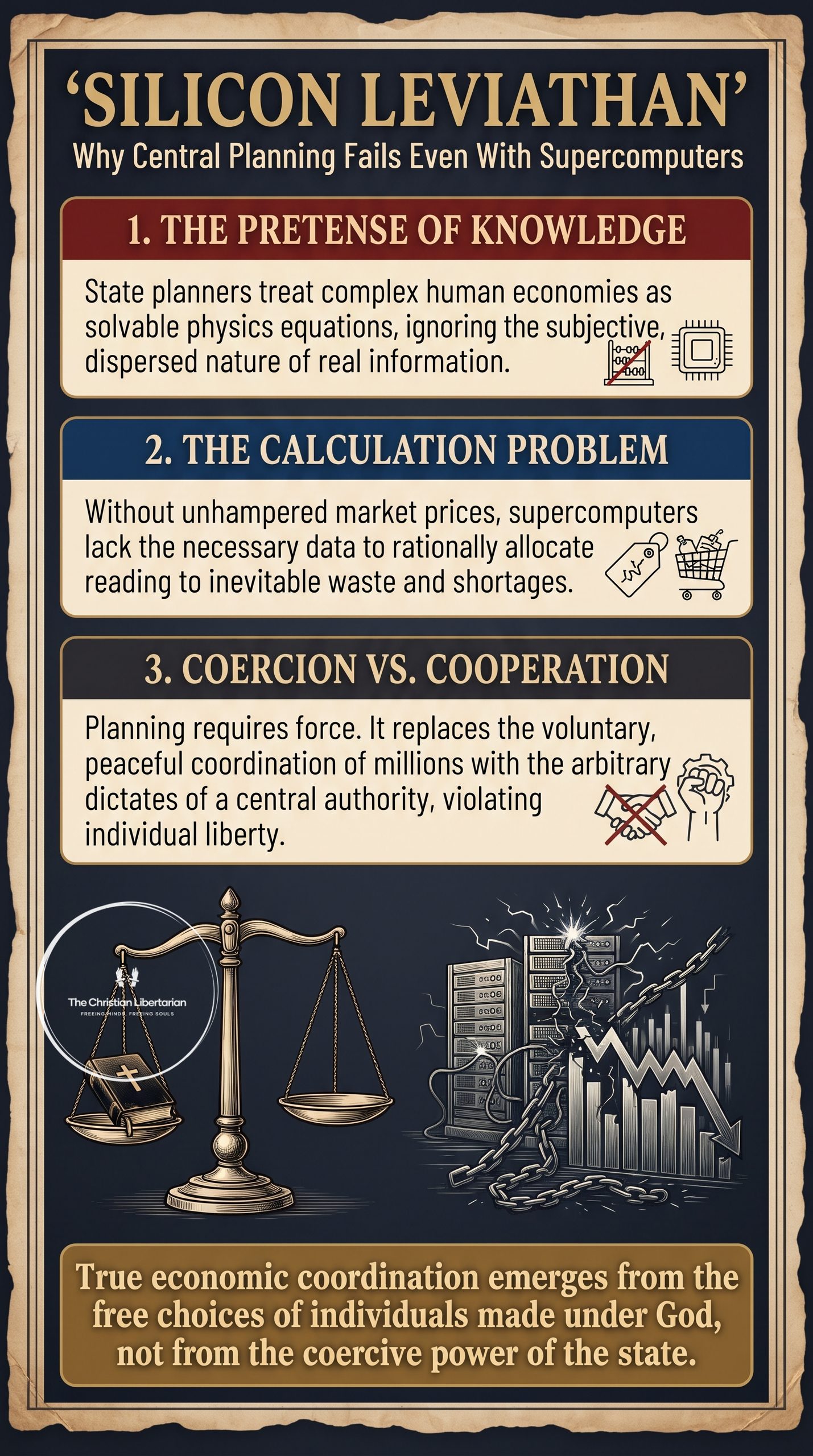
For nearly a century, the Austrian school of economics has stood on a bedrock truth established by Ludwig von Mises and Friedrich Hayek: without private property and free markets, rational economic calculation is impossible. Mises demonstrated in 1920, and Hayek expanded upon in 1945, that market prices are not arbitrary numbers set by greedy merchants. They are vital, spontaneous signals that condense the dispersed, decentralized knowledge of millions of individuals into a single metric. Without these prices, a central planner is like a blindfolded pilot flying without instruments, utterly unable to know whether a scarce ton of steel is better used to build apartment buildings, hospitals, bridges, or toy factories.
Yet modern democratic socialists and cyber Marxists argue that this foundational objection has expired. Writers like Paul Cockshott, Allin Cottrell, and Leigh Phillips insist that Mises and Hayek were merely describing the clunky paper-shuffling bureaucracy of 1930s state planning, not the intrinsic limits of human coordination. They point to real-time supply chain algorithms, supercomputing power, input-output linear programming, and big-data predictive modeling. They observe that corporate giants like Amazon and Walmart already run massive, centrally managed internal economies that rival the output of mid-sized nations, moving millions of SKUs across global networks without internal price mechanisms. To the modern left, technological acceleration has finally made computer-assisted, non-market central planning feasible, rendering the Economic Calculation Debate obsolete.
This techno-socialist vision appeals powerfully to an age infatuated with artificial intelligence and digital efficiency. Yet when we examine the claim through first principles, we discover that it confuses the routine management of a single enterprise with the impossible task of directing an entire society. Supercomputers can crunch data, but they cannot replace human volition, and they certainly cannot escape the moral boundaries set by God.
First Principles Analysis
To understand why the digital centralization of an economy remains a fatal delusion, we must begin with a biblical view of human nature. Scripture teaches in Genesis 1:26 to 27 that human beings are created in the image of God, endowed with rational minds, creative agency, and personal conscience. Because humans bear the Imago Dei, our desires, subjective preferences, and creative entrepreneurial insights are inherently dynamic and unquantifiable. Furthermore, the doctrine of total depravity reminds us that human nature is fallen (Psalm 146:3, 1 Samuel 8). When political rulers or corporate technocrats arrogate to themselves the power to plan the economic life of millions, they act out of pride, assuming they can compress the living choices of image-bearers into a digital algorithm.
This hubris directly violates the boundaries of the civil magistrate established in Scripture. Romans 13:1 to 4 and 1 Peter 2:13 to 14 restrict the state to a strictly defensive ministry: punishing evildoers and protecting the peaceful. God never delegated to human rulers or their algorithmic proxies the authority to manage the production, distribution, or consumption of society’s wealth. Furthermore, the Eighth Commandment (“Thou shalt not steal”) and the Tenth Commandment (“Thou shalt not covet”) forbid taking the property of neighbors. When a central planning board dictates what factories produce and what consumers buy, it bypasses voluntary exchange and substitutes force, committing legal plunder under a digital veneer.
From an economic perspective, the socialist error stems from a fundamental misunderstanding of what market prices actually do. As Friedrich Hayek explained, the vital knowledge of society does not exist anywhere in a consolidated form. It is scattered across the minds of billions of individuals: a farmer knowing the current moisture of his soil, a mechanic noticing a shortage of specific washers, a mother prioritizing her family’s nutritional needs this week over next month. This knowledge is subjective, tacit, and constantly changing.
Critics who point to Amazon and Walmart as proof of successful internal planning commit a category error. Amazon and Walmart do not operate in a vacuum; they function within a vast, unhampered market economy. They rely entirely on external, market-generated price signals for steel, electricity, fuel, software, and wholesale goods to calculate whether their internal logistics are profitable or wasteful. If Amazon’s internal warehouse managers make a massive calculation error and lose billions of dollars, the firm absorbs the loss and corrects course because real market prices anchored outside the firm provide a reality check. A socialist state encompassing an entire nation has no external price benchmarks. Without market prices for capital goods, land, and intermediate inputs, an economy wide planning board is flying entirely blind. Adding more server racks and GPUs to a central planning office does not solve the calculation problem; it merely accelerates the speed at which errors can be compounded across society.
Concrete Illustration and Case Study
In this hypothetical scenario, imagine a futuristic democratic socialist republic that replaces the market entirely with a state supercomputer named the People’s Economic Optimizer. Citizens input their desired shoes, groceries, and housing specifications into a national app, and the supercomputer uses linear programming to calculate production quotas for every factory, mine, and farm in the country. At first, the system hums along efficiently, distributing standard loaves of bread and basic cotton shirts to the populace.
Within two years, however, reality intrudes. A sudden drought hits the southern agricultural districts, while a breakthrough in solar technology creates an unexpected surge in demand for specialized micro-inverters. In a free market, rising prices would instantly signal entrepreneurs to divert copper and silicon toward solar panels while consumers voluntarily conserve electricity. But the People’s Economic Optimizer has no price signals; it only has pre-programmed algorithms and static optimization targets. The planning committee spends six months debating whether to reprogram the allocation algorithms. Meanwhile, factories sit idle waiting for raw materials that were shipped to the wrong provinces, and citizens face endless waiting lists for replacement parts. Because the computer treated human beings as passive data points rather than acting agents, digital central planning produces widespread scarcity and economic paralysis.
We do not have to rely solely on futuristic parables to see this dynamic in action. Consider the historical tragedy of Chile’s Project Cybersyn in the early 1970s. Under President Salvador Allende, the socialist government attempted to coordinate the nation’s industrial sector in real time using a network of telex machines linked to a central operations room in Santiago, aided by British cybernetician Stafford Beer. Cybersyn was celebrated as the dawn of cybernetic socialism, an early proof that computers could replace the chaotic anarchy of market prices. Yet when a massive nationwide strike paralyzed private transportation and small businesses in October 1972, the centralized telex network proved utterly useless. Bureaucrats staring at flashing lights on fiberglass command panels could not magically conjure spare truck parts, resolve local labor disputes, or replace the decentralized, spontaneous adjustments made by thousands of independent owner-operators. The project collapsed into chaos alongside the broader socialist economic disintegration that preceded the 1973 coup.
Empirical Evidence and Policy Impact
The historical and empirical record demonstrates that attempts to bypass market prices through administrative planning—whether using ledger books, mainframe computers, or modern cloud algorithms—inevitably fail:
- The Soviet Gosplan Failure: The Soviet Union’s State Planning Committee (Gosplan) attempted to use input-output balances and early mainframe computing from the 1960s through the 1980s to manage millions of product prices and quotas. Despite employing hundreds of thousands of top-tier mathematicians and engineers, Gosplan consistently failed to calculate basic consumer goods requirements, resulting in the infamous chronic shortages, long queues, and subterranean black markets that ultimately broke the Soviet economy.
- The Fatal Conceit of Corporate Analogy: Economic historians note that even the largest multinational firms face strict internal limits to planning. When business units grow too large and bureaucratic, they suffer from internal calculation problems identical to socialism, which is why corporations constantly divest, spin off subsidiaries, and rely on external market contracting rather than internal command structures.
- The Knowledge Problem in Real-Time Logistics: Empirical studies of modern supply chains show that resilience comes from decentralized autonomy, not central control. During global supply disruptions, centralized corporate directives frequently failed because they lacked local context, whereas decentralized networks of independent suppliers using fluctuating market prices rapidly rerouted goods to where they were most urgently needed.
Public Choice theory explains why technocratic elites continually resurrect the dream of central planning. Bureaucrats and software engineers gain immense power, funding, and prestige when society is treated as a complex engineering problem to be managed from above. Admitting the truth—that human society is too wonderfully complex for any central authority to master—would strip technocrats of their authority and return sovereignty to individual families and free markets.
The Free and Moral Alternative
Overcoming the false promises of digital central planning requires anchoring our economic life in humility, individual moral agency, and biblical boundaries:
- Respecting Sphere Sovereignty: We must reject the creeping totalitarianism of state-directed industrial policy and digital surveillance currencies, ensuring the civil magistrate stays within its limited, defensive mandate (Romans 13:1 to 4).
- Defending Unhampered Market Prices: Protecting private property and free exchange allows the spontaneous mechanism of market prices to coordinate human action efficiently and peacefully without coercion.
- Fostering Decentralized Stewardship: Empowering local communities, voluntary mutual aid, and independent entrepreneurship honors human dignity as the Imago Dei, fostering genuine flourishing far beyond the reach of any supercomputer.
Sources and References
- Holy Bible: Genesis 1:26 to 27, 1 Samuel 8:10 to 18, Psalm 146:3, Proverbs 11:1, Romans 13:1 to 4, 1 Peter 2:13 to 14.
- Ludwig von Mises, Economic Calculation in the Socialist Commonwealth (1920) and Human Action: A Treatise on Economics (1949).
- Friedrich A. Hayek, The Use of Knowledge in Society (1945) and The Fatal Conceit: The Errors of Socialism (1988).
- Paul Cockshott and Allin Cottrell, Towards a New Socialism (1993).
- Stafford Beer, Brain of the Firm (1972) and historical documentation on Chile’s Project Cybersyn.
- Murray N. Rothbard, Man, Economy, and State (1962).