
What if there isn’t actually a gap?
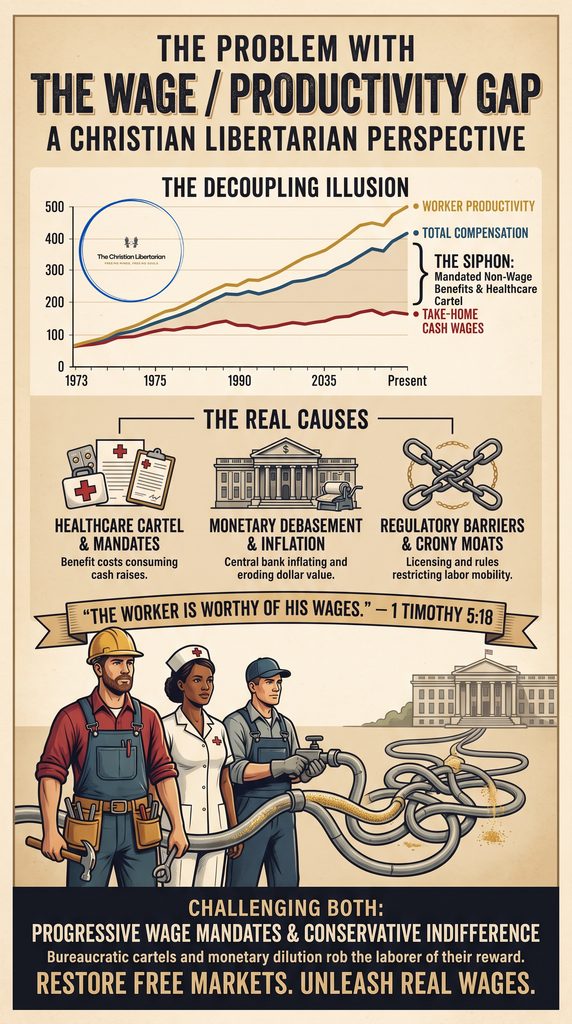
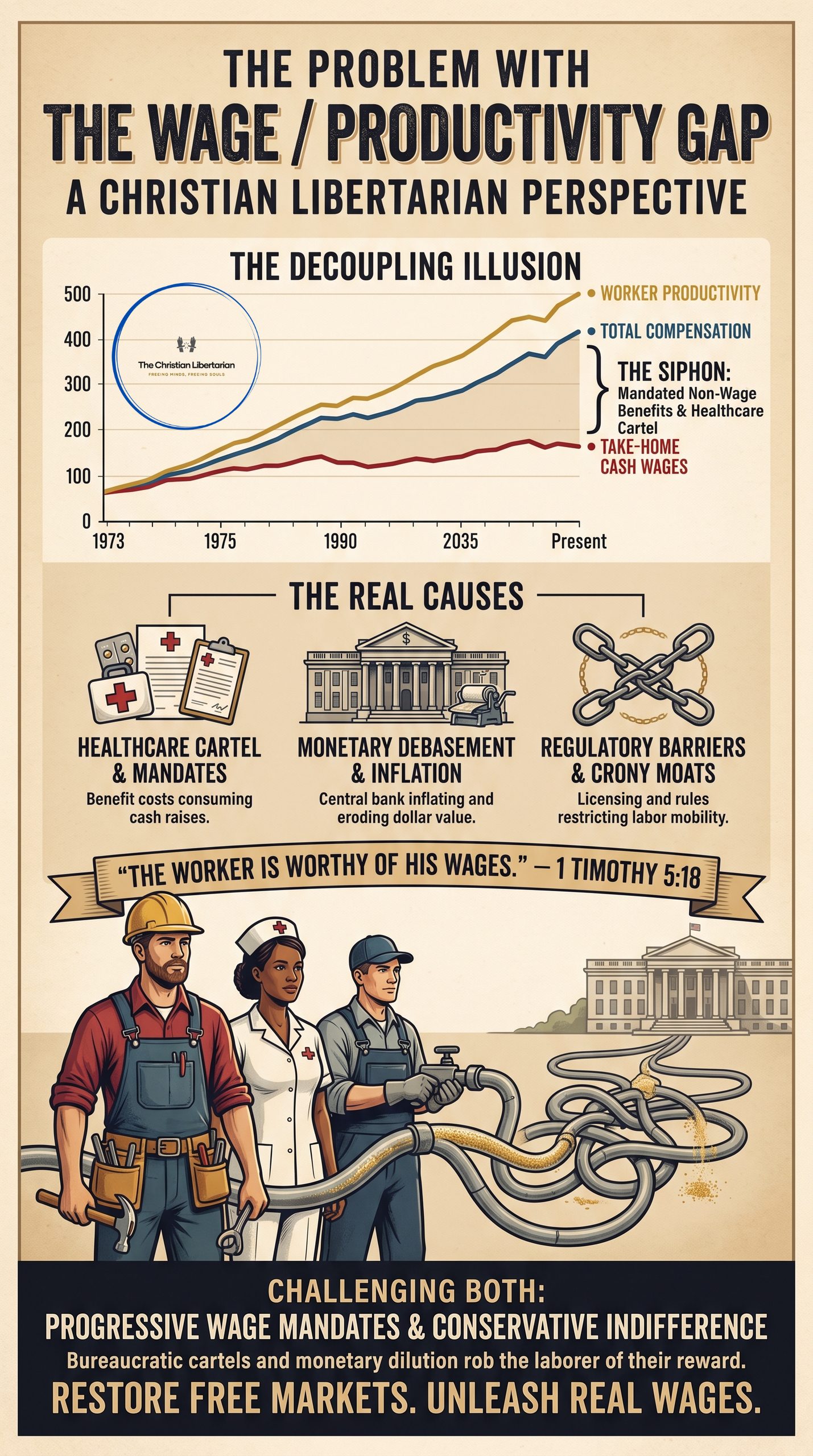
Few economic charts circulate with more indignation than the famous “wedge” graph: the line showing worker productivity climbing steadily upward since the early 1970s while average wages appear to flatline. For millions of hardworking Americans, that image confirms a visceral daily reality. Families are working longer hours, producing more value than at any point in human history, and yet finding it harder to buy a home, raise children on a single income, or build generational savings. But while the pain is real, the political diagnosis on both sides is fundamentally broken.
The progressive story attributes this gap to raw capitalist exploitation—arguing that employers simply decided in 1973 to stop sharing profits with workers, and that the only remedy is state-mandated wage floors, compulsory unionization, and heavier labor regulations. But this ignores basic economic accounting. Much of the statistical “gap” is an artifact of bad math and government distortion. First, progressive charts compare productivity (deflated by the IPD, which measures what businesses produce) against wages deflated by the CPI (which measures consumer prices). When you measure both with the same price deflator, a huge portion of the gap closes. Second, it looks only at take-home wages rather than total compensation.
Employers actually have paid workers significantly more for their increased productivity—it just never reached the worker’s paycheck. Where did it go? It was consumed by astronomical non-wage benefits, overwhelmingly driven by government-distorted employer-sponsored healthcare. Thanks to World War II wage-control tax exemptions and decades of regulatory mandates, American workers have seen their productivity gains swallowed whole by the administrative healthcare cartel. Progressive policies did not fix labor compensation; their regulatory regime simply diverted cash wages into third-party bureaucratic sinkholes.
Yet the conventional conservative reaction is equally shallow and unhelpful. Conservative pundits often look at the statistical deflator corrections and dismiss the issue entirely, lecturing families that “compensation has tracked productivity, so there is no problem.” This ignores the profound economic and moral catastrophe facing working households. Telling a machinist or a nurse that their total compensation has technically grown because their employer now pays $22,000 a year for an inflated, high-deductible health insurance policy does nothing to help them buy groceries, pay for a mortgage, or afford a reliable vehicle. The worker cannot spend their employer’s administrative compliance costs or hospital-network overhead at the checkout line.
Furthermore, conservative cheerleading for the status quo ignores how crony capitalism systematically suppresses labor’s bargaining power. Through restrictive occupational licensing, artificial patent monopolies, local zoning restrictions that inflate the cost of living, and corporate bailouts that insulate entrenched incumbents from dynamic startup competition, the state actively prevents ordinary workers from capitalizing on their own productive energy.
From a Christian libertarian perspective, labor is not an abstract factor of production or a commodity to be manipulated by social planners; it is the physical expression of the image of God in man. Scripture warns sternly against withholding the rightful fruit of an honest worker’s toil: “Behold, the pay of the laborers who mowed your fields, and with which you have kept back by fraud, cries out against you; and the cries of the harvesters have reached the ears of the Lord of Sabaoth” (James 5:4). When government intervention inflates the cost of living, taxes payrolls, debases the currency through central bank manipulation, and traps compensation inside mandated bureaucratic benefits, the state is actively robbing the laborer of their due reward.
The solution is neither state-mandated wage decrees nor conservative indifference. True justice for the American worker requires dismantling the structural distortions that rob labor of its purchasing power: separating healthcare from employment through true free-market cash pricing, ending the monetary debasement that destroys real wage gains, and clearing away the regulatory gatekeepers that prevent workers from freely trading their skills.
Immediate Structural Reform Checklist
- Equalize the Healthcare Tax Deduction for Individuals
Repeal the preferential tax exemption for employer-sponsored health insurance and extend identical pre-tax status directly to individual, portable health savings accounts (HSAs), converting trapped benefit costs back into direct, take-home cash wages. - Dismantle Anti-Competitive Occupational Licensure
Enact statewide universal recognition and outright repeal of non-safety occupational licenses, expanding independent contracting opportunities and enabling workers to capture full market value for their labor without bureaucratic tolls. - Abolish Inflation-Inducing Corporate Subsidies and Regulatory Moats
Eliminate federal industrial subsidies, regulatory compliance exemptions for megacorporations, and restrictive patent evergreening that suppress competitive wage bidding among mid-sized and startup firms. - Halt Monetary Dilution of Real Wages
Enforce sound money disciplines on the Federal Reserve to end the perpetual inflation tax that silently depreciates hourly wage rates before paychecks are even cashed.
Sources and Documentation
- Biblical Ethics on Labor and Just Compensation: James 5:4; 1 Timothy 5:18; Deuteronomy 24:14–15 (prohibitions against withholding wages and defrauding laborers of their rightful return).
- Statistical Analysis of the Compensation Wedge: Martin Feldstein, “Did Wages Reflect Productivity Growth in the United States?” National Bureau of Economic Research (NBER Working Paper No. 13953, 2008), documenting how using identical price deflators (IPD vs. CPI) and total compensation accounts for the statistical divergence.
- Non-Wage Benefits and Healthcare Cost Drivers: James Sherk, “Salaries Stagnant? Try Paying for Expensive Health Care,” The Heritage Foundation (Backgrounder No. 2824, 2013), detailing the diversion of cash wage growth into employer-provided health insurance premiums.
- Critique of the Productivity-Pay Decoupling: Lawrence Mishel & Josh Bivens, “Understanding the Historic Divergence Between Productivity and a Typical Worker’s Pay,” Economic Policy Institute (2015), representing the progressive institutional thesis on wage decoupling.
- Austrian Perspective on Labor Valuation: Ludwig von Mises, Human Action: A Treatise on Economics (1949, Ch. XXI: Work and Wages), explaining marginal productivity theory and how state interventions distort market clearing wages.