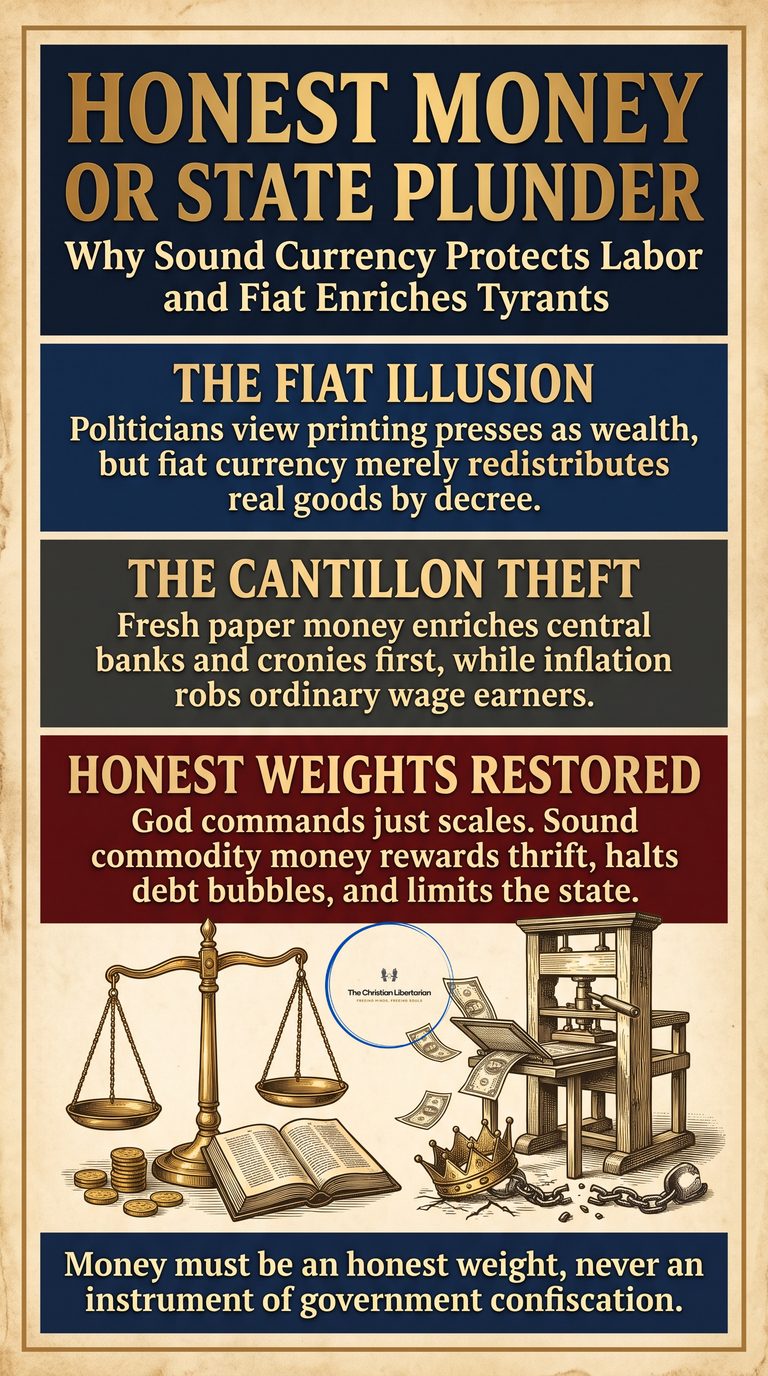

If we change the unit of measure…
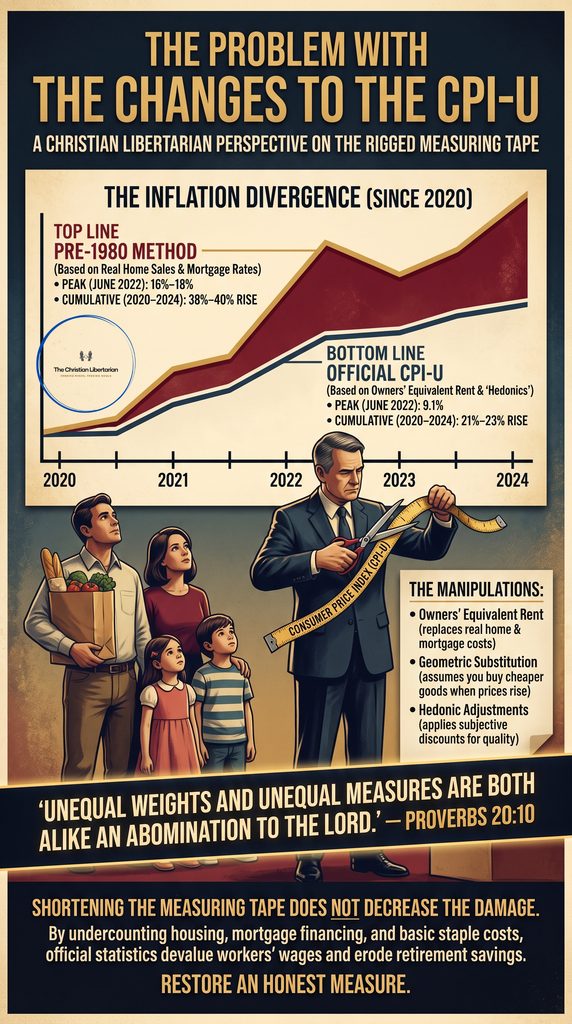
If you walk through a grocery store or look at current mortgage rates and feel like Washington’s official inflation numbers bear zero resemblance to your monthly bank statement, you are not losing your mind. The Bureau of Labor Statistics will tell you that annual inflation has moderated, yet everyday household expenses feel relentlessly punishing compared to 2020. That widening chasm between official statistics and lived reality is not an accident. It is the result of four decades of bureaucratic adjustments that quietly altered the nation’s economic measuring tape.
To understand how we got here, you have to look at how inflation was measured during the Jimmy Carter and early Reagan years compared to today. Throughout the 1970s, the Consumer Price Index (CPI) operated primarily as a fixed-weight, Laspeyres basket of goods. It measured the straightforward out-of-pocket cost to maintain a constant standard of living. Most importantly, it measured housing directly: the index tracked actual home purchase prices, prevailing mortgage interest rates, property taxes, insurance, and maintenance costs. If a house cost $45,000 and a 30-year mortgage jumped from 8 percent to 12 percent, that surge was recorded directly into the index.
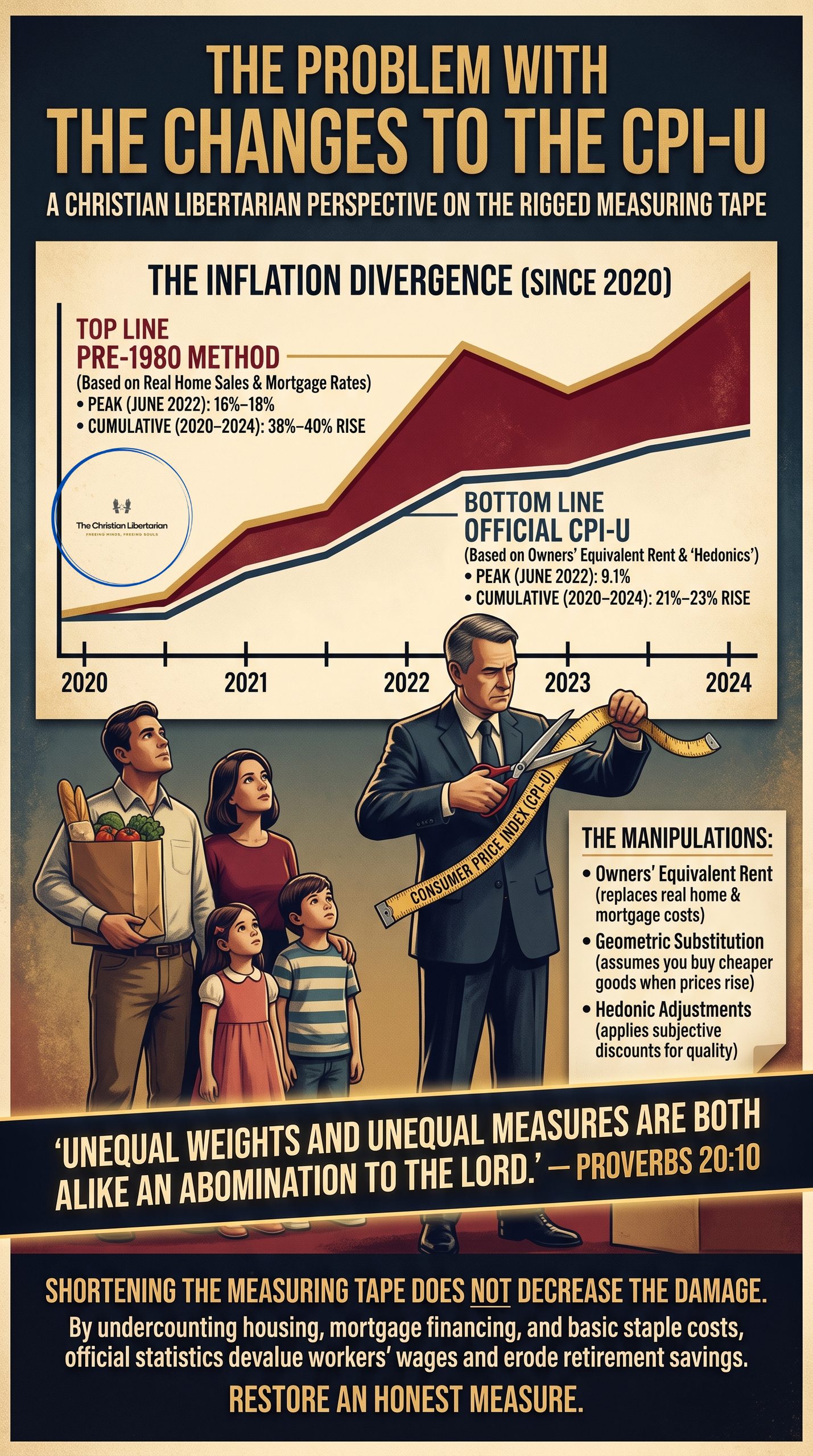
Starting in 1983, the BLS discarded direct home purchases and mortgage costs in favor of “Owners’ Equivalent Rent” (OER). Instead of measuring what it actually costs to buy and finance a house, the government began surveying homeowners to ask what they hypothetically think their home would rent for, or imputing rental market proxies. Then, following the 1996 Boskin Commission report, the BLS introduced two major conceptual tools: geometric weighting to account for “substitution bias” and “hedonic adjustments” for quality improvements.
To be fair, these changes were not born out of pure malice; academic economists had legitimate theoretical arguments. A house is a durable capital asset with investment value, not an apple you consume in a week, so economists wanted to separate shelter services from real estate equity. Similarly, consumers genuinely do adapt when beef spikes by buying more chicken, and a 2026 automobile or laptop undeniably offers safety and computing features that did not exist in 1975.
However, while the academic justifications sound sophisticated, the practical application has functioned as an institutionalized lie.
When the price of steak doubles and a working mother is forced to buy ground poultry or canned beans to stay on budget, her standard of living has declined. Yet the modern chained CPI treats that downward substitution as an optimization of consumer efficiency, muting the recorded inflation rate. When hedonic modeling claims that a $1,000 appliance only “increased” by $50 because it has a digital screen and better energy efficiency, the consumer still has to hand over $1,000 of real cash—you cannot pay the cashier in theoretical quality points. Most egregiously, replacing real home prices and mortgage interest with Owners’ Equivalent Rent detached the index from the largest single expenditure in American life.
The divergence since 2020 illustrates the sheer scale of this statistical suppression. When official CPI-U peaked at 9.1 percent in June 2022, recalculations using the pre-1980 methodology—which factors in real home sale prices, 30-year fixed mortgage rates, and fixed consumption weights—showed actual inflation peaking between 16 and 18 percent. Between 2020 and 2024, median home prices spiked by over 40 percent and mortgage interest rates surged from 3 percent to over 7 percent, effectively doubling the monthly payment required to buy a median home. Yet because OER lags and ignores asset financing costs, official cumulative CPI-U reported an increase of roughly 21 to 23 percent over that window, while the lived cost of maintaining an uncompromised 1970s-style fixed standard of living climbed well beyond 38 to 40 percent.
From a Christian libertarian perspective, tampering with the economic measure is a moral violation. Proverbs 20:10 states plainly: “Unequal weights and unequal measures are both alike an abomination to the Lord.” Leviticus 19:35–36 commands absolute integrity: “You shall do no wrong in judgment, in measures of length or weight or quantity. You shall have just balances, just weights.” Shortening the length of the financial ruler while measuring the damage done by the central bank’s printing press is bearing false witness against the public (Exodus 20:16). It defrauds retirees whose Social Security Cost-of-Living Adjustments (COLAs) are calculated using these suppressed numbers, robs workers whose wage negotiations depend on official data, and triggers silent “bracket creep” by pushing taxpayers into higher tax brackets before their real purchasing power has grown.
Both sides of the political spectrum are thoroughly invested in this deception.
Progressives routinely dismiss the pain of working-class families as “economic misinformation” or “bad vibes,” pointing to cooling official CPI numbers while celebrating the administrative expertise of federal agencies. They champion further adjustments like the Chained-CPI to quietly trim entitlement liabilities without having to vote on benefit cuts. But progressive policies of massive federal stimulus and monetary expansion disproportionately crush the working poor, and relying on hedonic math to tell a struggling family that their life is cheap is patronizing bureaucratic gaslighting.
Conservatives, meanwhile, eagerly exploit inflation to score points against their opponents, yet historically they bear substantial responsibility for rigging the index in the first place. The Boskin Commission was established by a Republican-led Senate Finance Committee in 1995. Conservative leaders, advised by figures like Alan Greenspan, enthusiastically embraced the new methodology because artificially reducing the CPI offered a politically covert way to slow the growth of Social Security and military pensions without requiring lawmakers to take an unpopular floor vote. Preaching fiscal transparency while preserving rigged statistical baselines to hide the true cost of debt and easy money is cowardice, not conservatism.
A society that normalizes dishonest measures will eventually normalize dishonest government. Restoring integrity to the economy requires facing the real damage of monetary debasement rather than redefining the words and metrics we use to describe it.
Regulatory and Measurement Verification Checklist
- Mandate Parallel Reporting of the 1972–1982 Fixed Laspeyres CPI
Introduce legislation requiring the Bureau of Labor Statistics to publish an unadjusted, fixed-basket price index alongside the CPI-U that tracks direct home sale prices, prevailing mortgage interest rates, and constant consumer goods without hedonic discounts or geometric substitution. - Audit Social Security COLA Calculations Against Non-Discretionary Expenses
Require the Government Accountability Office (GAO) to benchmark annual Social Security cost-of-living increases against an index limited strictly to non-substitutable essentials: housing payments, utility rates, food staples, and out-of-pocket medical care. - Eliminate Subjective Hedonic Pricing Deductions on Consumer Staples
Strip hedonic quality regressions from all non-technological consumer expenditure categories in federal statistical reporting, ensuring quoted prices reflect actual register transaction totals. - Index Federal Income Tax Brackets to Unaltered Cost-of-Living Baselines
Adjust Internal Revenue Code tax bracket thresholds to a sound, fixed-basket measure to eliminate hidden tax increases generated by statistical undercounting of inflation.
Sources and Documentation
- Biblical Foundations: Proverbs 20:10; Leviticus 19:35–36; Exodus 20:16 (injunctions against unequal measures, fraudulent accounting, and false witness).
- The Boskin Commission Report: U.S. Senate Finance Committee, Toward a More Accurate Measure of the Cost of Living, Advisory Commission to Study the Consumer Price Index (1996), recommending geometric weighting for substitution and expanded hedonic quality adjustments.
- Bureau of Labor Statistics Historical Documentation: U.S. Bureau of Labor Statistics, Owners’ Equivalent Rent and the Consumer Price Index: 30 Years and Counting (2013), detailing the 1983 transition away from direct home prices and mortgage interest rates.
- Historical Methodology Comparisons: John Williams, Shadow Government Statistics: Alternate Inflation Charts (tracking pre-1980 and pre-1990 BLS measurement techniques against official CPI-U); Federal Reserve Bank of St. Louis (FRED), Consumer Price Index for All Urban Consumers vs. Median Sales Price of Houses Sold in the United States (2020–2024).