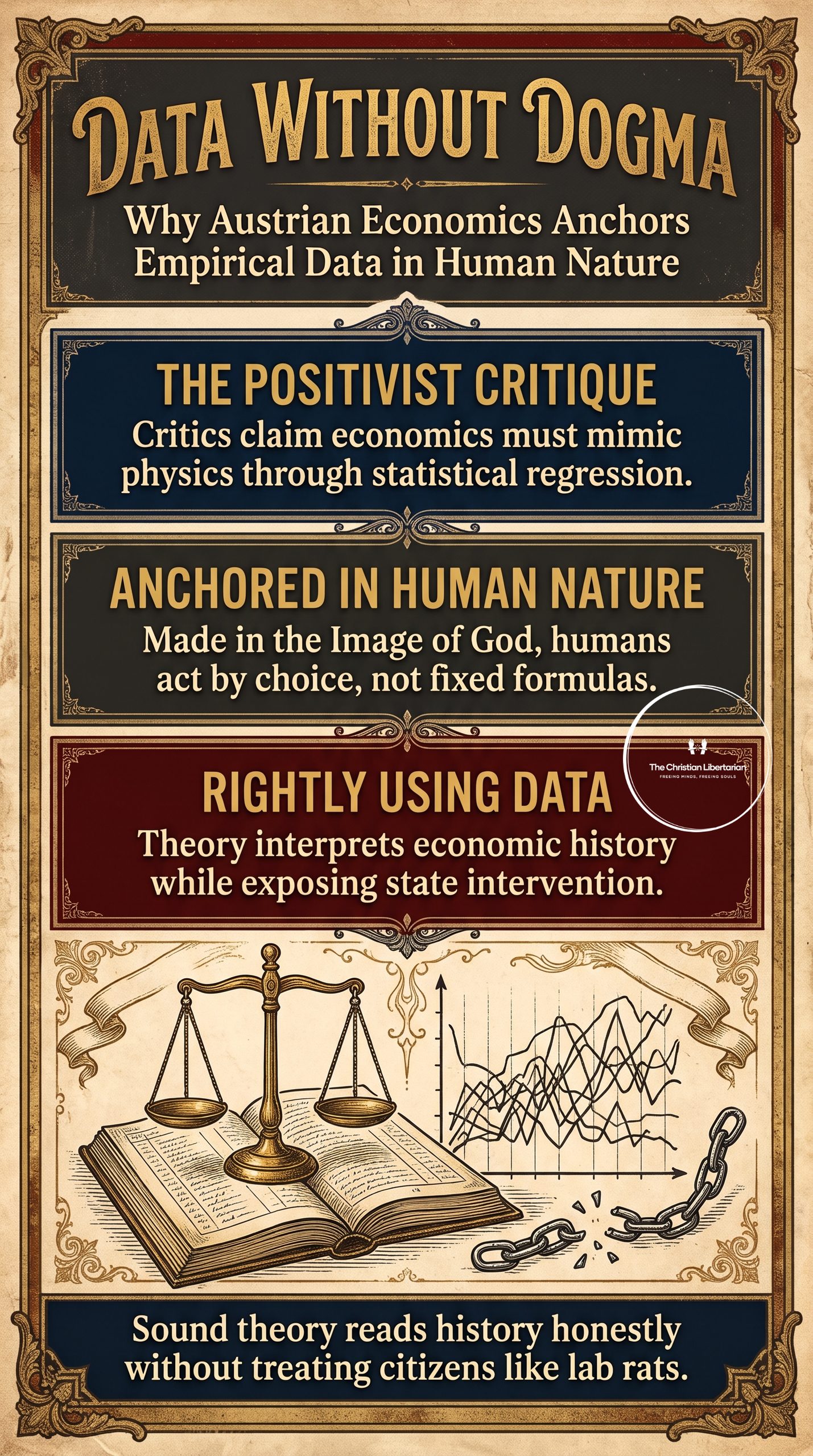

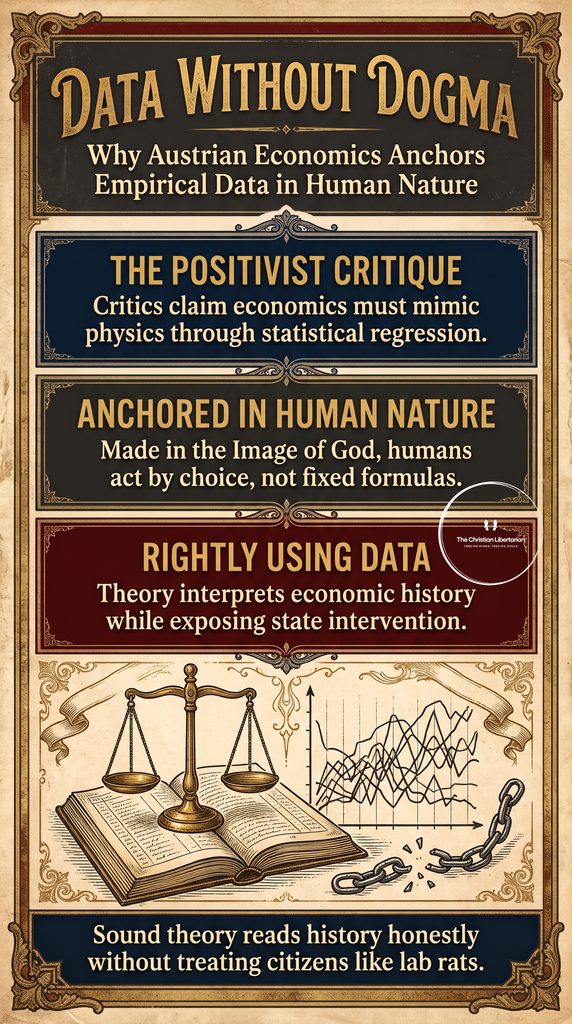
Part 1: Data Without Dogma: Why Austrian Economics Anchors Empirical Data in Human Nature
Walk into almost any university economics department or central bank research office today and bring up the Austrian school of economics. Within minutes, you will hear the same dismissive accusation: Austrian economics is not empirical, it ignores data, and it amounts to little more than dogmatic armchair philosophy. Critics claim that because Austrians do not build mathematical regression models to test and falsify their foundational economic laws, the entire tradition is unscientific.
To understand why this accusation is so widespread, we have to look at who makes it and what they gain from it. The charge comes from two main camps that otherwise pretend to be rivals: mainstream neoclassical positivists and Keynesian interventionists. On one side, Chicago school positivists following Milton Friedman and his famous 1953 essay The Methodology of Positive Economics, alongside modern neoclassical critics like Bryan Caplan, argue that economics must operate just like laboratory physics. In their view, realistic assumptions about human nature do not matter at all; the only thing that matters is whether a mathematical formula can plug in yesterday’s statistics and predict tomorrow’s numbers. On the other side, Keynesian academics like Paul Krugman and the thousands of econometricians employed by the Federal Reserve and the Treasury rely on statistical aggregates to justify managing the macroeconomy.
Why do both groups insist that empirical modeling is the only legitimate form of science? Intellectually, modern social science suffers from a deep envy of the natural sciences, adopting the positivist belief that truth only exists where numbers can be measured and fed into equations. Politically, however, Public Choice theory reveals a much deeper motive. State planners and central bankers need econometrics to justify their own power. If the economy is just a giant mechanical engine governed by numerical ratios, then society desperately needs a credentialed priesthood of state engineers to pull the levers, tune interest rates, and redistribute wealth. If, on the other hand, economic laws are unbreakable truths rooted in human nature and property rights, the state loses its excuse to meddle.
First Principles Analysis
Austrians do not reject empirical data. What Austrians reject is empiricism, the philosophical error of trying to derive universal laws of human behavior from shifting historical statistics as if people were mindless atoms in a test tube. Instead of anchoring economic theory in noisy data, Austrian economics anchors its theory in human nature and uses that theory to interpret the data honestly.
For the Christian libertarian, this methodological divide goes straight to the Book of Genesis. Scripture teaches in Genesis 1:26 to 27 that God created human beings in His own image, the Imago Dei. Unlike rocks, water molecules, or gas particles, men and women possess rational minds, consciences, creativity, and moral agency. In a physics laboratory, a scientist can run a controlled experiment because physical matter obeys fixed numerical constants and never chooses to change its mind. Human beings, by contrast, act purposefully. We learn from the past, alter our preferences, repent of mistakes, and imagine new futures. Because we bear the image of our Creator, there are no fixed mathematical constants in human choice, and history never repeats itself under identical laboratory conditions.
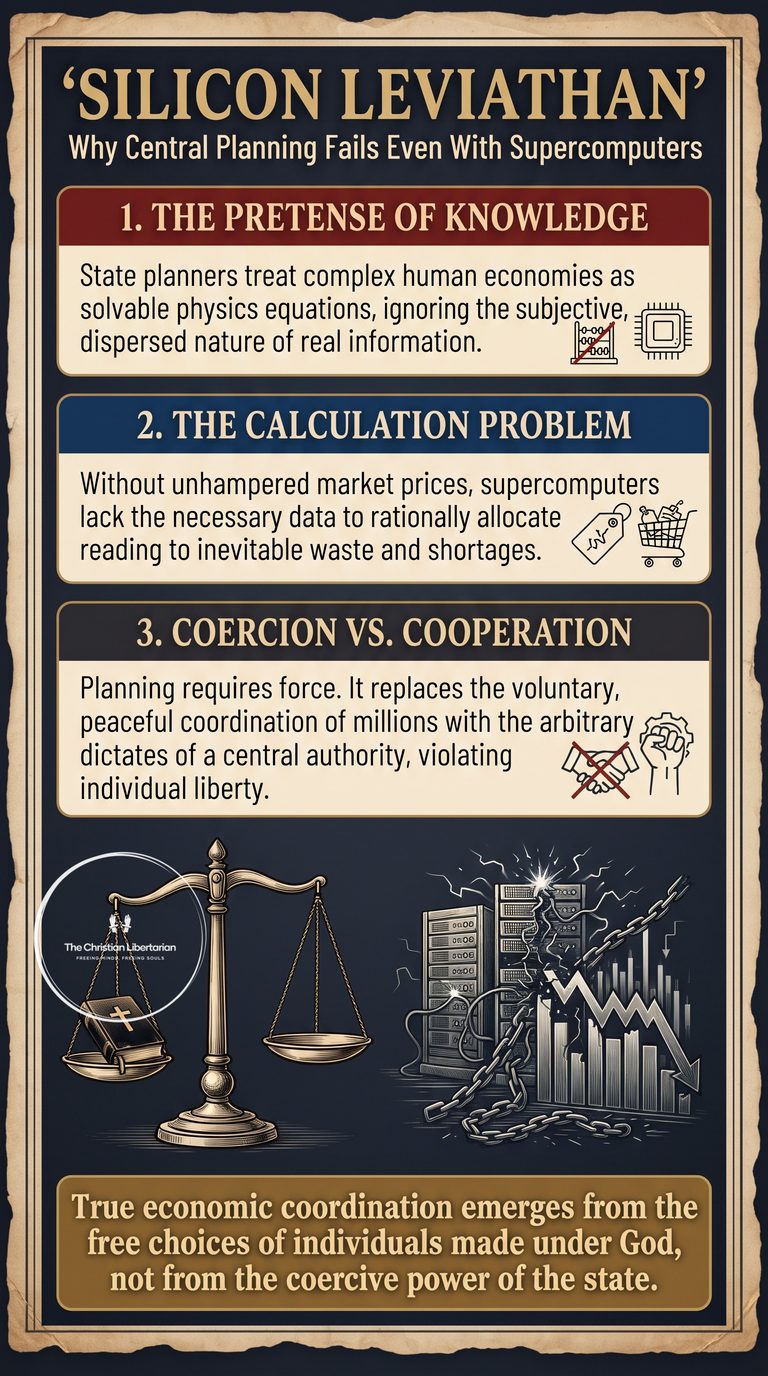
Furthermore, the biblical doctrine of total depravity warns us that human hearts are fallen and easily corrupted by power, as seen in 1 Samuel 8 and Psalm 146:3. When state econometricians claim their statistical models allow them to fine tune the livelihoods of millions, they are not practicing neutral science. They are indulging in the pretense of knowledge while providing mathematical cover for legal plunder. Every econometric intervention, whether through price controls, tax schemes, or credit manipulation, requires initiating physical coercion against peaceful citizens and their justly acquired property. This violates the Principle of Nonaggression, breaks the Eighth and Tenth Commandments against theft and covetousness, and pushes civil government far beyond its strictly defensive biblical mandate in Romans 13:1 to 4 and 1 Peter 2:13 to 14.
Because humans are purposeful agents rather than predictable molecules, Ludwig von Mises and Murray Rothbard grounded economic theory in praxeology, the logical implications of the undeniable fact that humans act purposefully under conditions of scarcity. From this reality of human nature, we deduce core laws like subjective value, marginal utility, and the law of supply and demand.
Where, then, do empirical facts and statistics fit into Austrian economics? Austrians use empirical data constantly, not to invent or falsify universal laws of human nature, but to practice economic history and applied forensic analysis. Anyone who has read Murray Rothbard’s America’s Great Depression, which painstakingly tracks money supply aggregates, wage rates, and industrial output across the 1920s, or Robert Higgs’s empirical work in Crisis and Leviathan dismantling the myth of wartime prosperity, knows that Austrians take data very seriously.
The difference is the order of operations. You cannot understand raw data without a sound theory anchored in human nature first, because historical statistics are always the complex outcome of thousands of variables moving at the same time. If a minimum wage hike happens during an oil boom and local employment still rises by two percent, a naive empiricist looking only at the regression chart will declare that minimum wage laws do not destroy jobs. An Austrian economist, anchored in the logic of human choice, knows that artificially raising the price of labor always destroys marginal opportunities. Armed with sound theory, the Austrian uses empirical data properly to uncover the unseen reality: how employment would have grown even faster without the state mandate, and how employers quietly cut work hours, training, and fringe benefits to survive the intervention.
Concrete Illustration and Historical Case Study
In this hypothetical scenario, imagine an econometrician who decides to test the law of human self preservation by collecting thirty years of empirical data on umbrellas and street puddles in Seattle. Looking purely at the statistical correlation, his computer model discovers that whenever thousands of people open umbrellas on the sidewalk, the pavement gets soaked and traffic accidents increase. Relying on pure positivist empiricism without an understanding of human purpose, he presents his findings to the city council and proves mathematically that umbrellas cause rain and car crashes. The council promptly bans umbrellas to improve public safety. A week later, the next storm arrives, and citizens are drenched while accidents still climb. The statistician had plenty of accurate empirical data, but because he detached his numbers from the basic reality of purposeful human action, he got cause and effect completely backward.
In the real world, this exact blindness produced the collapse of the Keynesian Phillips Curve in the 1970s. Throughout the 1960s, leading positivists and Keynesian econometricians pointed to decades of empirical charts showing a smooth historical tradeoff between inflation and unemployment. They assured Washington that if the Federal Reserve wanted lower unemployment, it simply had to print more fiat money and tolerate slightly higher consumer prices. Austrians like Mises and Friedrich Hayek warned that this statistical correlation was an illusion that ignored how real human beings react to currency debasement. When central planners aggressively expanded the money supply in the 1970s, workers and business owners did not behave like passive numbers in a formula. Recognizing that their purchasing power was being stolen, they began pricing future inflation directly into their wage demands and contracts. The econometric models shattered overnight, plunging the nation into stagflation, where both inflation and unemployment surged together.
Empirical Evidence and Policy Impact
When Austrian economists apply sound theory to empirical data, the statistics become a powerful tool for exposing the destructive results of state intervention and central bank dishonesty:
- The 1970s Stagflation Failure: While mainstream econometric models promised that monetary expansion would hold unemployment below 4 percent, the Consumer Price Index climbed to 11.1 percent in 1974 and reached 13.5 percent in 1980, while US unemployment simultaneously rose to 7.1 percent in 1980 and hit 10.8 percent by late 1982.
- Rothbard’s Monetary Forensics of the 1920s: Mainstream historians long blamed the 1929 crash on wild free market speculation because retail price indices looked flat during the Roaring Twenties. Using empirical banking data guided by Austrian business cycle theory, Murray Rothbard demonstrated that the Federal Reserve actually inflated the total money supply by 61.8 percent between 1921 and 1929, from 45.3 billion dollars to 73.2 billion dollars, fueling the exact malinvestment in stocks and real estate that made the Great Depression inevitable.
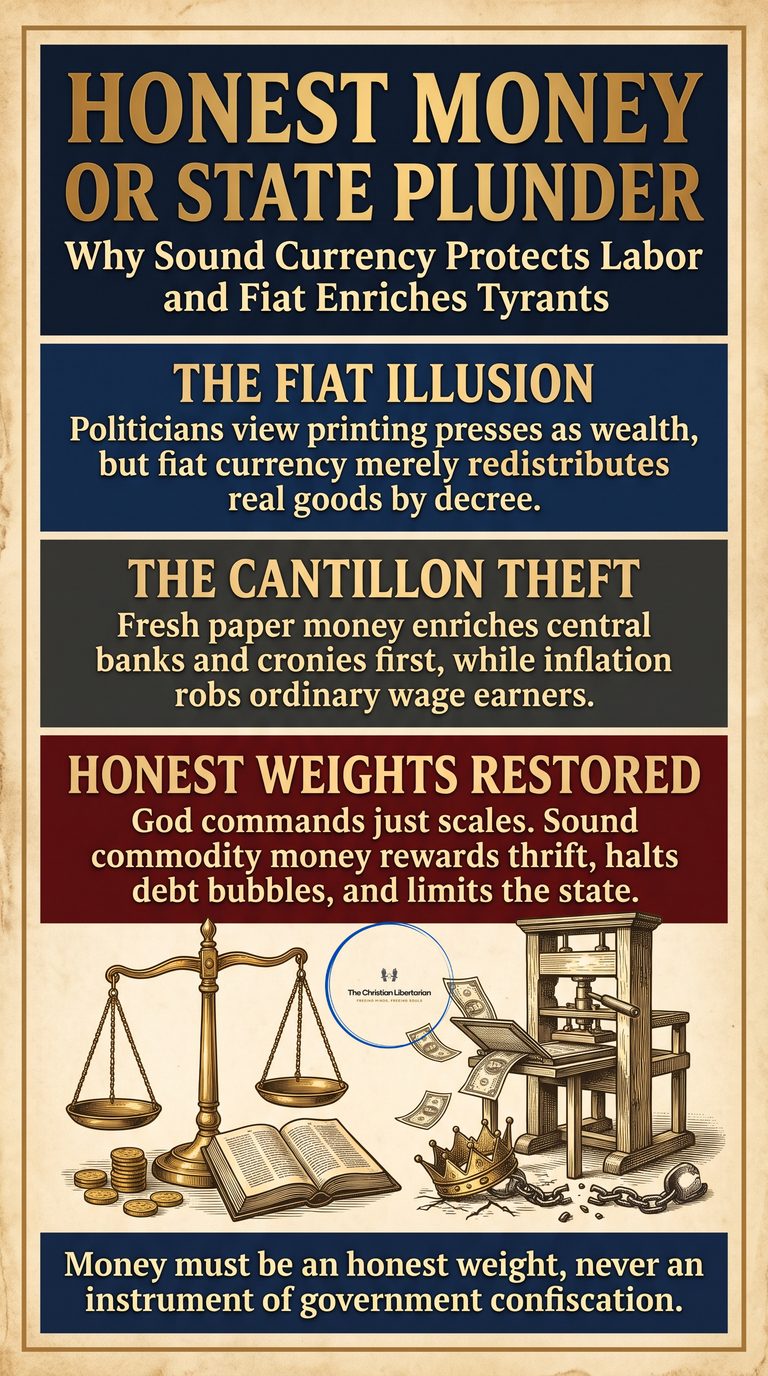
- The 2020 to 2022 Fiat Expansion: Between February 2020 and April 2022, the Federal Reserve increased the M2 money stock from 15.4 trillion dollars to 21.7 trillion dollars, a massive 41 percent expansion. While Federal Reserve econometricians relied on flawed Phillips Curve variations to assure the public that inflation was transitory, Austrians used the empirical money supply data and the logic of subjective value to warn that a massive loss of purchasing power was locked in. Sure enough, the Consumer Price Index surged to a forty year high of 9.1 percent by June 2022, functioning as a cruel, hidden tax on working families in direct violation of the biblical command for honest weights and measures in Proverbs 11:1.
The Free and Moral Alternative
Restoring integrity to both economic science and public life requires putting empirical data back in its proper place as the servant of truth rather than the tool of social engineers:
- Theory Anchored in Moral Agency: Economists and citizens must recognize that economic laws flow from the God given reality of purposeful human choice and private property, which no state bureau has the authority or ability to override.
- Forensic Transparency Over Central Planning: Instead of funding central bank econometricians to manipulate interest rates and credit, empirical data should be used to audit government spending, expose the hidden tax of fiat inflation, and hold the state accountable.
- Honest Scales and Voluntary Order: By abolishing central bank monopolies in favor of sound, market chosen money and restricting civil government to the punishment of force and fraud, free prices can coordinate human flourishing while families, churches, and communities care for their neighbors voluntarily.
Sources and References:
- Genesis 1:26 to 27, 1 Samuel 8:10 to 18, Psalm 146:3, Proverbs 11:1, Romans 13:1 to 4, 1 Peter 2:13 to 14 (Holy Bible, Reformed theological foundations on the Imago Dei, total depravity, honest scales, and sphere sovereignty).
- Ludwig von Mises, Human Action: A Treatise on Economics (1949) and Theory and History: An Interpretation of Social and Economic Evolution (1957), explaining the exact relationship between deductive praxeology and empirical economic history.
- Murray N. Rothbard, America’s Great Depression (1963) and The Mantle of Science (1960), demonstrating how Austrian theory uses empirical data to expose central bank malinvestment while refuting positivist scientism.
- Friedrich A. Hayek, The Pretense of Knowledge (1974 Nobel Memorial Lecture), critiquing false mathematical certainty in macroeconomics.
- Milton Friedman, Essays in Positive Economics (1953), the foundational neoclassical text arguing for positivist prediction over realistic assumptions of human action.
- Robert Higgs, Crisis and Leviathan: Critical Episodes in the Growth of American Government (1987) and Depression, War, and Cold War (2006), empirical Austrian analysis dismantling mainstream Gross Domestic Product distortions.
- Frédéric Bastiat, The Law (1850), on natural property rights, legal plunder, and the unseen consequences of intervention.
- Federal Reserve Economic Data (FRED), Federal Reserve Bank of St. Louis: M2 Money Stock (M2SL), Consumer Price Index for All Urban Consumers (CPIAUCSL), and Unemployment Rate (UNRATE), historical series covering 1970 to 2023.