
Let’s pay everyone, and then collect enough taxes from the productive for it. What could go wrong?
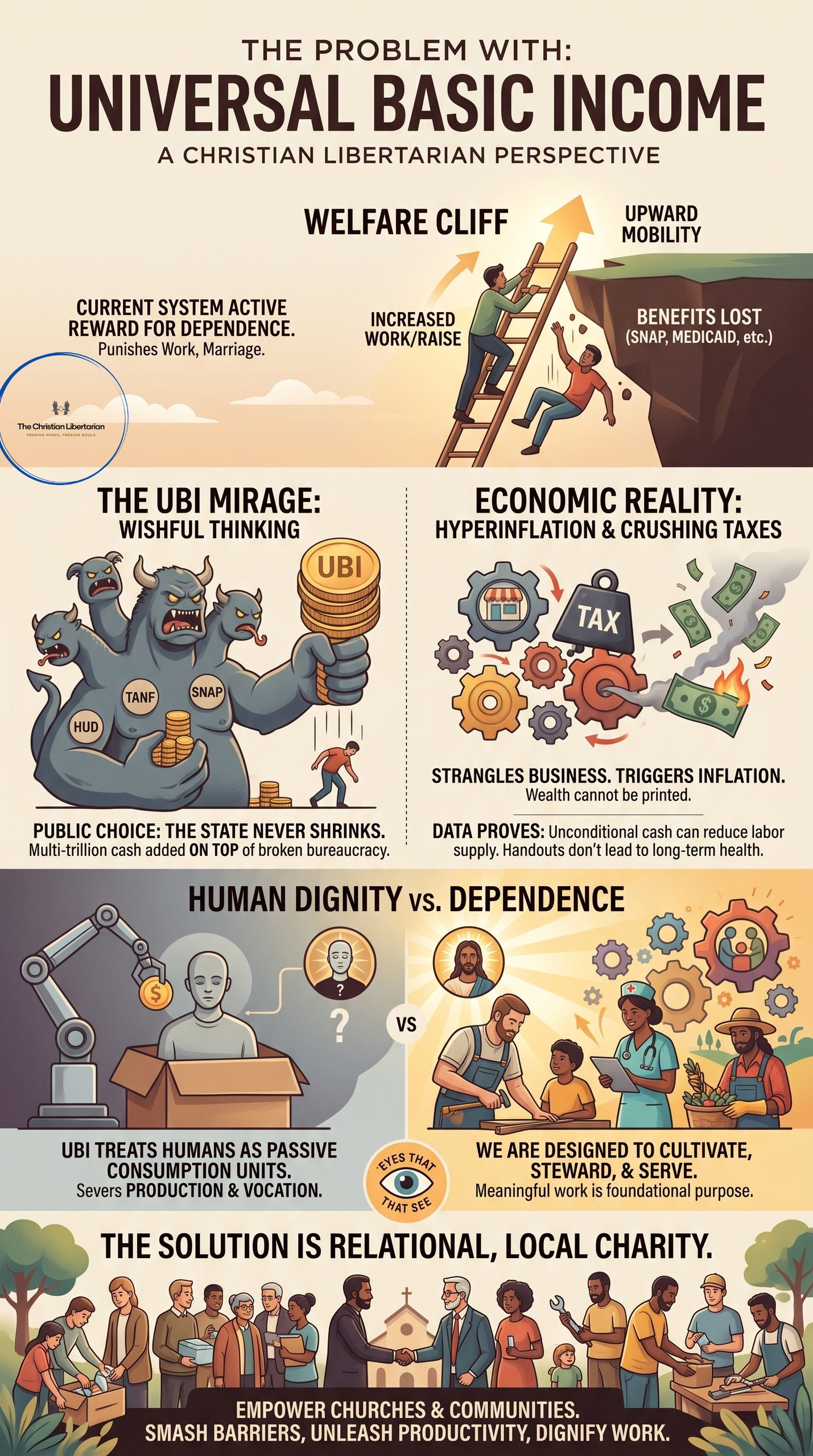
Anyone who has spent ten minutes looking at the American safety net knows it is completely broken. Right now, the federal government runs roughly 80 different overlapping, means-tested welfare programs—from SNAP and TANF to Section 8 housing vouchers and Medicaid—costing taxpayers well over $1 trillion every single year. Worse than the waste is the cruelty of the “welfare cliff.” If a single mother working an entry-level job gets a $1.50 raise, she can abruptly lose thousands of dollars in childcare or food subsidies, facing an effective marginal tax rate exceeding 80% or even 100%. The system actively punishes the exact habits—work, marriage, and upward mobility—that pull people out of poverty.
Because of this disaster, Universal Basic Income (UBI) has exploded in popularity as the supposed silver bullet. The pitch sounds brilliant across the ideological aisle: scrap the whole bloated bureaucratic nightmare, fire the caseworkers, and just write every citizen an unconditional monthly check. No paperwork, no surveillance, no welfare trap.
It sounds clean and compassionate on paper, but UBI is an economic and moral mirage.
Progressives love UBI because they view unconditional cash as liberation from the “coercion” of work, trusting it will eradicate poverty without consequence. Conservatives and libertarians who flirt with the idea—often channeling Milton Friedman’s negative income tax or Charles Murray’s technocratic cash replacement—convince themselves that the state will voluntarily dismantle its own apparatus in exchange for a clean payment.
Both sides are indulging in dangerous wishful thinking.
To the conservative fantasy: public choice economics guarantees that the state never surrenders ground. If you think federal public employee unions, healthcare lobbies, and housing administrators will quietly agree to shut down HUD, the Department of Agriculture’s nutrition division, and HHS just because everyone gets a deposit in their checking account, you haven’t watched how Washington works. In reality, politicians will never eliminate existing programs; they will simply slap a multi-trillion-dollar unconditional cash transfer directly on top of the existing bureaucratic labyrinth.
And to the progressive belief that giving everyone unconditional money builds enduring human flourishing: economic reality tells a very different story.
A few years ago, a friend of mine named Aaron found himself trapped in this cycle. After an injury, he was living on disability and supplemental benefits in an apartment complex where half the residents were on assistance. The system treated Aaron like a pet—fed, housed, and strictly forbidden from improving his situation without having his support revoked. But Aaron didn’t need an unearned direct deposit from an algorithm. What actually saved him wasn’t an impersonal check; it was an older carpenter from our church who hired him part-time under the table to sweep sawdust, mentored him, taught him how to work wood, held him accountable to show up on time, and eventually helped him launch an independent deck-building trade.
Aaron found dignity because he was needed. He had skin in the game. He was participating in creation.
UBI does the exact opposite: it treats human beings as passive consumption units who merely need calories and rent deposited into their accounts. Scripturally and philosophically, humans are made in the image of God (Imago Dei). We are hardwired to cultivate, steward, solve problems, and serve our neighbors through productive vocation. Genesis places work in the garden before the Fall; meaningful labor is not a curse to be automated away, but a foundational vehicle for human purpose.
When governments try to sever the connection between production and consumption, the data proves that human flourishing decays.
Consider the sheer arithmetic: paying a modest $1,000 a month to the roughly 260 million adult Americans costs over $3.1 trillion annually. For perspective, total annual federal tax collections hover around $4.5 to $5 trillion. Funding UBI requires either doubling taxes across the productive economy—strangling capital investment and small business formation—or running the Federal Reserve’s printing press around the clock. But as Austrian economists have pointed out for a century, money is merely a claim check on real goods and services. If you print trillions of new claim checks without producing any new goods, you don’t generate wealth; you trigger monetary inflation that eats away the purchasing power of the poor before anyone else.
Moreover, the real-world behavioral results of free cash have consistently failed the hype. In July 2024, OpenResearch published the findings of the largest, most rigorous unconditional cash transfer study in U.S. history—funded by tech billionaire Sam Altman. For three years, researchers handed $1,000 per month in unconditional cash to low-income participants across two states.
The results were telling. Recipients did not use the cash to start thriving businesses or dramatically upskill. Instead, labor supply dropped significantly. For every $1 received, total household income fell by roughly 20 cents because participants reduced their working hours. Recipients worked an average of 1.3 to 1.4 fewer hours per week, with an overall 2-percentage-point decrease in formal employment. Furthermore, after three full years of direct deposits, researchers found zero statistically significant improvements in physical health, mental health, or long-term clinical biomarkers.
Handing people a federal allowance didn’t unlock human potential; it quietly subsidized withdrawal from the workforce.
Biblical charity and real social welfare cannot be outsourced to an IRS direct-deposit script. Genuine care is relational, local, and transformational. It happens through families, churches, voluntary mutual aid societies, and local communities where help comes with eyes to see, hands to guide, and ears to listen. The early church didn’t lobby Caesar to tax the empire and disburse bread; believers voluntarily shared what they had to pull their neighbors up.
If we genuinely want to solve the poverty trap, the answer isn’t to turn 330 million Americans into permanent, dependent pensioners of a debt-ridden leviathan. The answer is to smash the regulatory barriers that stop the poor from starting home businesses, end the fiat inflation that destroys their savings, abolish the welfare cliffs that penalize marriage and work, and return the sacred duty of charity to the only institutions capable of loving a person as an image-bearer rather than a statistic.
Sources:
- Vivalt, E., Rhodes, E., et al. (2024). The Employment and Earnings Effects of Unconditional Cash Transfers: Results from The OpenResearch guaranteed income study. National Bureau of Economic Research (NBER Working Paper No. 32711).
- Bartels, C., et al. (2024). The Effects of Unconditional Cash Transfers on Health, Health Care Utilization, and Well-Being. National Bureau of Economic Research (NBER Working Paper No. 32712).
- Congressional Research Service (CRS). Federal Benefits and Services for People with Low Income: Programs and Spending (Report R45097).
- Tax Foundation (2020). The Cost and Economic Impact of a Universal Basic Income.
- Murray, Charles (2006). In Our Hands: A Plan to Replace the Welfare State. AEI Press.