
False Weights and True Stewardship: Testing Modern Economic Theories Against Scripture and Liberty
Every economic policy begins with a claim about who owns you. Before a politician drafts a tax bill or a central banker adjusts an interest rate, they have already assumed a specific view of human nature, property, and moral authority. Economics is never value neutral. It is the study of how human beings act under scarcity, and political economy is the battle over whether those actions will be guided by peaceful cooperation or violent coercion.
For the Christian, evaluating an economic system requires two foundational tests. First, does it honor the biblical view of man and morality? Genesis 1:26 to 27 teaches that every individual is made in the image of God, possessing moral agency and stewardship responsibilities that predate the state. Because human nature is fallen, concentrating coercive power in the hands of rulers invites abuse, just as the prophet warned in 1 Samuel 8. Furthermore, the Eighth Commandment against stealing and the Tenth Commandment against coveting bind kings and bureaucrats just as strictly as private citizens. Second, does the system respect the Non-Aggression Principle, which states that no person or group may initiate physical force against the person or justly acquired property of another?
When we test the major economic schools shaping our world today against Scripture and the Non-Aggression Principle, the divide between state coercion and biblical liberty becomes unmistakable.
Mercantilism and Economic Nationalism
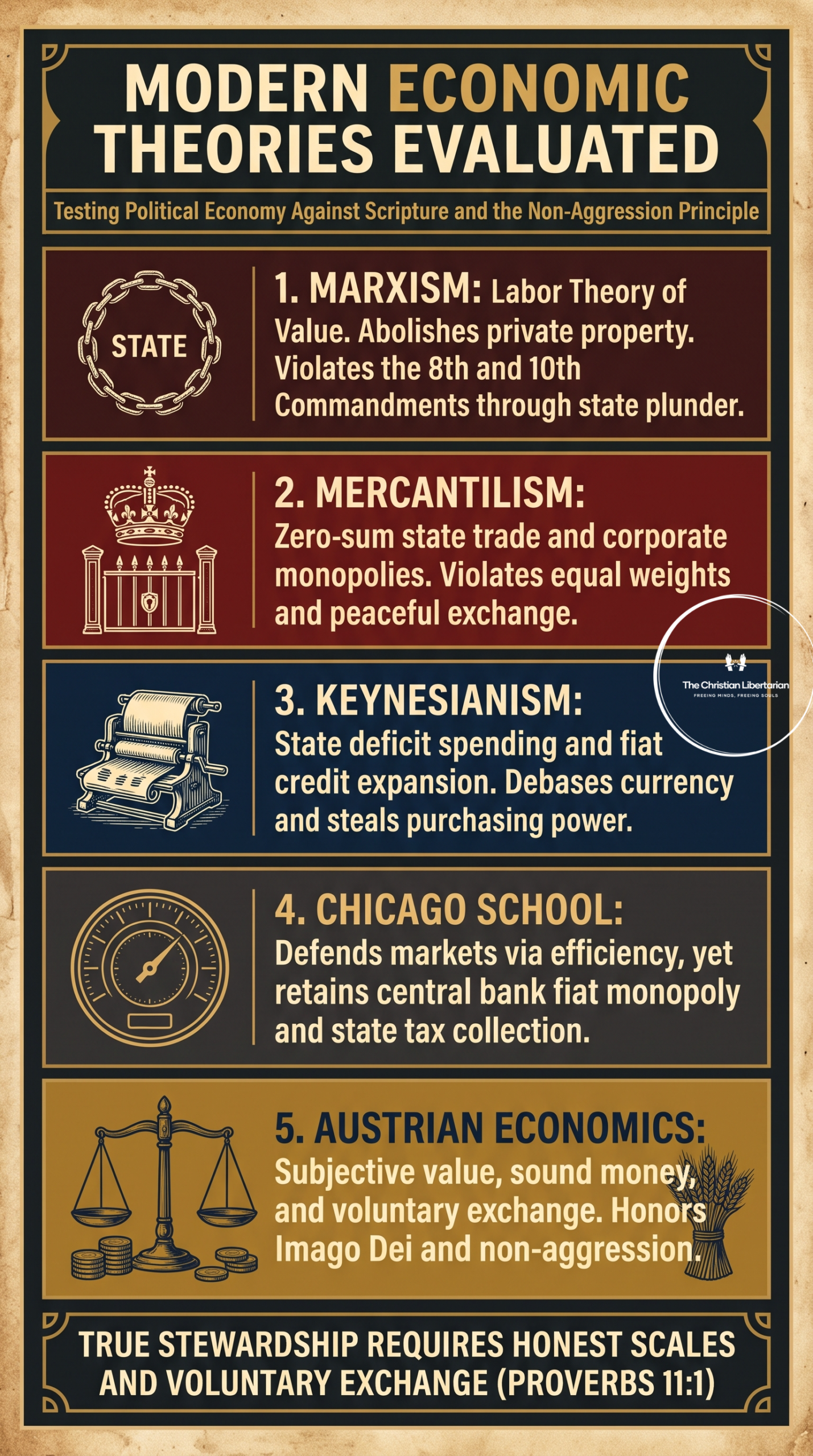
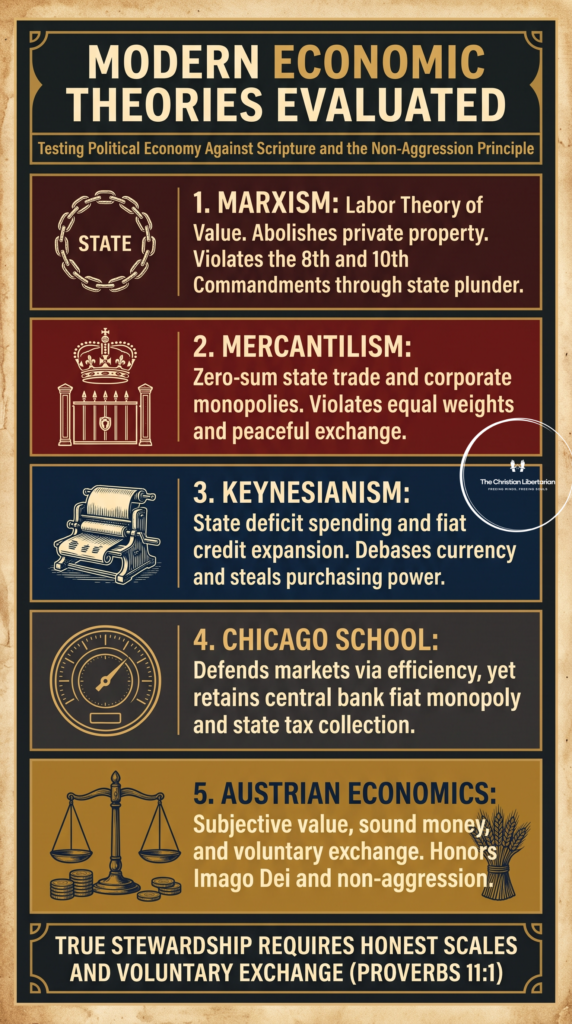
Mercantilism dominated European statecraft from the sixteenth through the eighteenth centuries and survives today as crony capitalism, industrial policy, and economic nationalism. Its underlying assumption is that wealth is a fixed pie and trade is a zero sum contest between rival nations. Under mercantilism, the state partners with favored corporations, erects tariff walls, grants monopoly privileges, and subsidizes domestic industries to hoard bullion or secure political power.
Mercantilism fails both the biblical and libertarian tests. By using state force to block peaceful citizens from trading across borders or competing with politically connected firms, it initiates aggression against consumers and independent producers. Biblically, it violates Deuteronomy 25:13 to 16, which condemns unequal weights and measures. When the civil magistrate uses the sword to pick winners and losers in the marketplace, it practices partiality in judgment and turns law into what Frédéric Bastiat called legal plunder.
Marxism and Collectivist Socialism
Karl Marx built his system on historical materialism and the labor theory of value, which assumes that the value of any good is determined strictly by the physical labor hours required to produce it. From this flawed premise, Marxism concludes that business owners who earn profits are exploiting workers. Its political approach demands the abolition of private property in the means of production and the centralization of capital, land, and labor under collective state control.
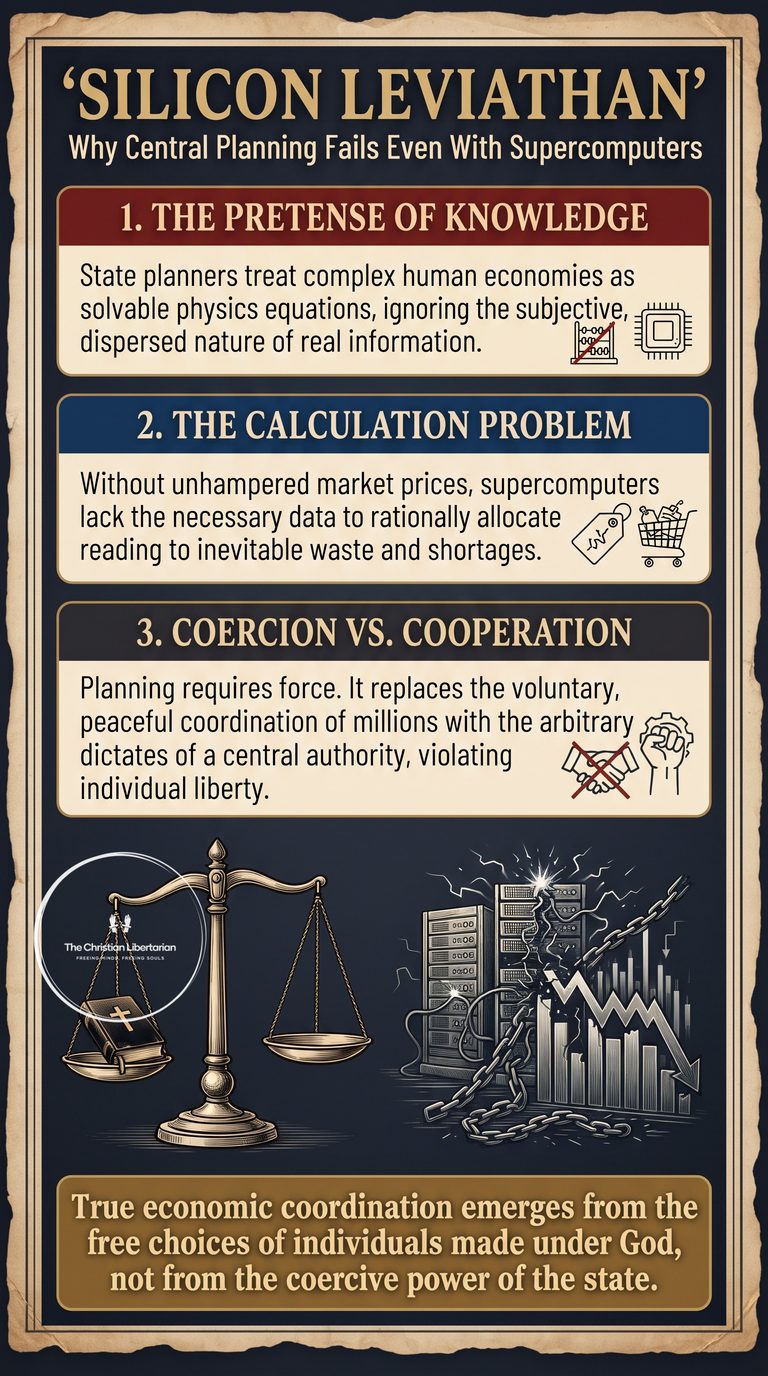
Marxism is a direct assault on biblical orthodoxy and the Non-Aggression Principle. It institutionalizes covetousness and theft on a national scale, turning the Eighth and Tenth Commandments upside down. By denying private property, Marxism also destroys the material basis for voluntary Christian charity and family provision required in 1 Timothy 5:8. Worse still, because fallen human rulers cannot calculate prices without private property and market exchange, Marxist regimes inevitably descend into economic calculation chaos, shortages, and totalitarian terror.
Keynesianism and Modern Monetary Theory
Formulated by John Maynard Keynes during the Great Depression, Keynesianism assumes that free markets are inherently unstable and prone to prolonged slumps caused by insufficient aggregate demand. Rather than viewing the economy as a web of individual choices, Keynesians treat it as a mechanical engine managed by macroeconomic aggregates. When downturns hit, Keynesian political economy calls for government deficit spending, central bank interest rate manipulation, and fiat credit expansion to stimulate consumption. Its radical modern offshoot, Modern Monetary Theory, goes even further by claiming a sovereign state that issues its own fiat currency can print and spend without financial limit, using taxation merely to drain excess inflation.
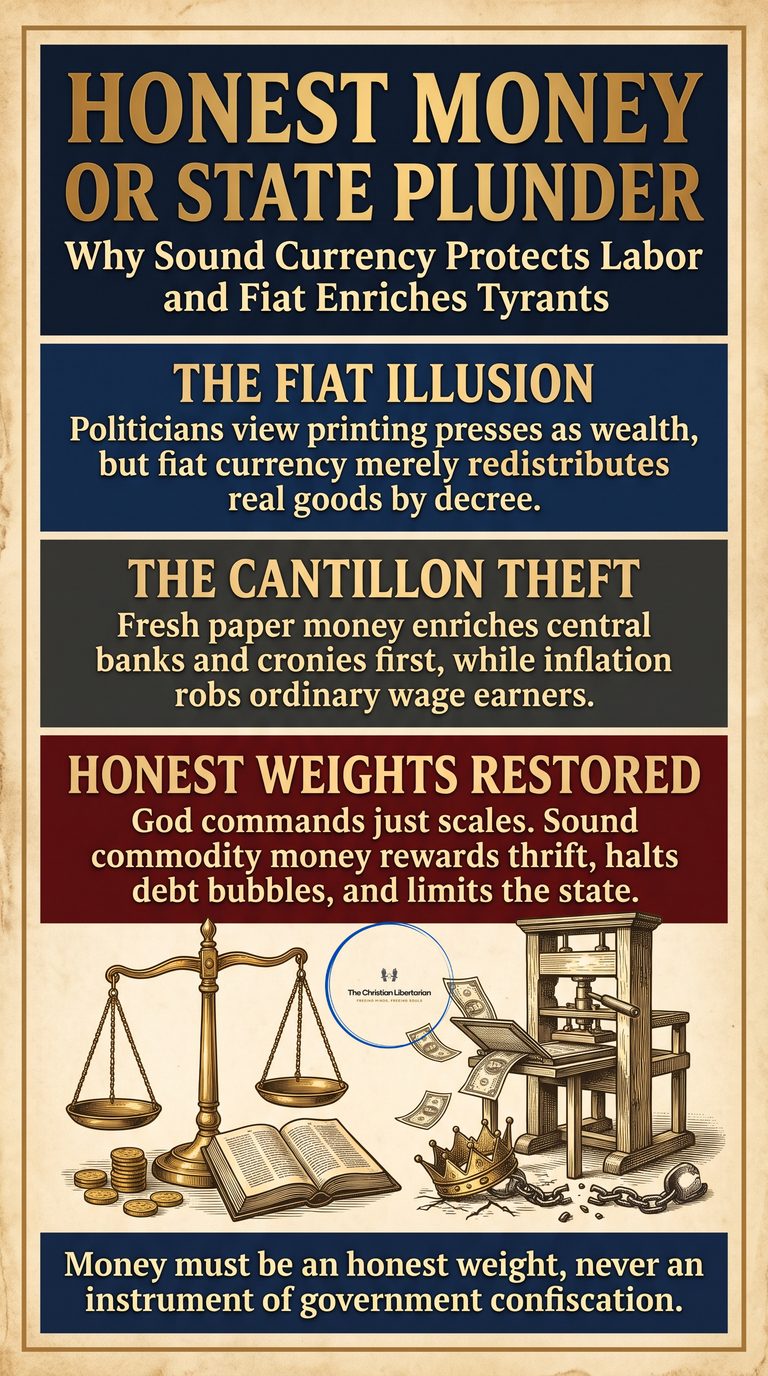
Keynesianism violates both the Non-Aggression Principle and biblical ethics through generational debt and monetary debasement. Deficit spending forces future taxpayers to pay for current political favors without their consent. Expanding the fiat money supply counterfeits credit, distorts price signals, and triggers the boom and bust cycle. Scripture explicitly condemns the debasement of money as a moral abomination, equating watered down silver and dishonest scales with theft in Isaiah 1:22 and Proverbs 11:1.
The Chicago School and Monetarism
Led by twentieth century economists such as Milton Friedman, the Chicago School championed free enterprise, deregulation, and privatization against Keynesian intervention. However, its underlying methodology is positivist and utilitarian. It defends capitalism primarily because markets allocate resources efficiently, rather than because private property is a God given moral right. In political economy, while the Chicago School opposes price controls and heavy regulation, it still concedes that the state should hold a monopoly over currency through a central bank that expands the money supply at a steady rate, and it devised mechanisms like federal income tax withholding and state funded welfare vouchers.
From a Christian libertarian perspective, the Chicago School is an inconsistent ally. Its empirical work exposing government failure is valuable, yet you cannot defend liberty forever on mere efficiency grounds. By compromising with the Non-Aggression Principle on central banking and taxation, monetarism leaves the state in control of the printing press and the tax apparatus. Because human rulers are fallen, a central bank tasked with a modest inflation rule will eventually abuse that power to fund state growth.
The Austrian School of Economics
Founded by Carl Menger and developed by Ludwig von Mises, Friedrich Hayek, and Murray Rothbard, the Austrian School begins with praxeology, the logic of purposeful human action. Austrians recognize that economic value is not an objective quantity of labor built into an object, nor a macro statistic managed by bureaucrats. Value is subjective, determined by acting individuals choosing under scarcity. Prices are vital signals that coordinate human cooperation, and interest rates reflect real time preference, showing how much people save for the future versus consuming today. Austrian political economy rejects central banking, fiat money, fractional reserve expansion, and state intervention, advocating instead for pure free markets and sound, commodity backed money.
The Austrian framework aligns naturally with Reformed biblical principles and the Non-Aggression Principle. It respects the Imago Dei by treating individuals as purposeful moral agents rather than cogs in a state machine. It upholds honest weights and measures by demanding sound money that politicians cannot debase. It honors sphere sovereignty by confining force to the defense of life and property, leaving production, trade, and charity to peaceful cooperation.
A Tale of Five Towns
In this hypothetical scenario, imagine a hardworking carpenter who builds oak tables and saves his earnings in silver coins to expand his workshop and support his local church. Under a Marxist regime, state commissars seize his tools in the name of the collective and assign him a production quota. Under a Mercantilist regime, the king grants a royal furniture monopoly to a court favorite and bans our carpenter from buying affordable timber from the next valley. Under a Keynesian regime, the central bank prints paper notes to fund public works, driving up the price of lumber while cutting the purchasing power of the carpenter’s savings in half. Under a Chicago School advisor, the carpenter is freed from lumber tariffs, yet the central bank still quietly dilutes his paper money by three percent a year and withholds his income before he ever sees his pay. Only under an Austrian order of sound money and non-aggression does the carpenter keep the full fruit of his labor, trade freely with his neighbors, and save in honest coin that holds its value across generations.
Empirical Evidence and Policy Impact
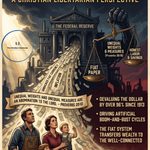
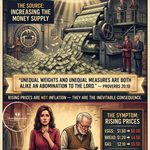
More than a century of American economic history confirms the Austrian warning against Keynesian and monetarist compromises. Since the creation of the Federal Reserve in 1913, the United States dollar has lost approximately 97 percent of its purchasing power. According to Bureau of Labor Statistics Consumer Price Index data through 2026, goods that cost $3.05 in 1914 require $100 today, representing a 96.9 percent erosion in the value of cash savings. Since 1970 alone, right before the final link between the dollar and gold was severed in 1971, a single dollar has lost nearly 88 percent of its buying power, requiring $8.51 in 2026 to purchase what $1.00 bought then.
Meanwhile, the Keynesian promise that governments would run surpluses during good times to pay off recession deficits proved to be a political fiction. According to official United States Treasury data in October 2026, the total national debt has surpassed $40.4 trillion, growing by another $2 trillion deficit in fiscal year 2026 alone and saddling every citizen with over $120,000 in federal liabilities.
The Free and Moral Alternative
Christians do not need to choose between the iron fist of Marxism, the crony privilege of Mercantilism, or the paper illusions of Keynesianism. The biblical and libertarian alternative is a return to honest scales, voluntary exchange, and strict sphere sovereignty. We can practice this today by rejecting the covetous politics of state redistribution, building resilient local enterprises, supporting voluntary church and community mutual aid, and advocating for the restoration of sound, competitive money free from central bank manipulation. When we defend private property and peaceful exchange, we do not worship wealth. We defend the moral order God designed for human flourishing.
Sources and References:
See less
- Holy Bible: Genesis 1:26 to 27, Exodus 20:15, Exodus 20:17, Deuteronomy 25:13 to 16, 1 Samuel 8:10 to 18, Proverbs 11:1, Isaiah 1:22, Romans 13:1 to 4, 1 Timothy 5:8.
- Frédéric Bastiat, The Law (1850).
- Karl Marx and Friedrich Engels, The Communist Manifesto (1848).
- John Maynard Keynes, The General Theory of Employment, Interest and Money (1936).
- Milton Friedman, Capitalism and Freedom (1962).
- Ludwig von Mises, Human Action: A Treatise on Economics (1949).
- Murray N. Rothbard, What Has Government Done to Our Money? (1963).
- United States Bureau of Labor Statistics, Consumer Price Index for All Urban Consumers (CPIAUCSL), 1913 to 2026 historical series.
- United States Department of the Treasury, Fiscal Data, Debt to the Penny dataset, October 2026.
- Committee for a Responsible Federal Budget, Treasury Confirms $2 Trillion Deficit for Fiscal Year 2026, October 2026.