
I’ve been taking some seminary classes and some of the ones that connect with counseling have been quite impactful. Personally, I’ve endured verbal abuse, multiple bouts of depression, personal and family health issues, and my wife and I have lost 8 babies via miscarriage. A solid theology of suffering is important to navigate these things and for realizing the limits of what government power can do and how most people need help in forms that political systems cannot ever provide.
When tragedy or hardship strikes, our culture tends to run to one of two extremes. On one hand, therapeutic culture insists you are a pure victim of external systems or bad luck, completely denying personal moral responsibility. On the other hand, a hyper-individualistic karma or prosperity mindset assumes that if your life is falling apart, you must have secretly earned every ounce of it.
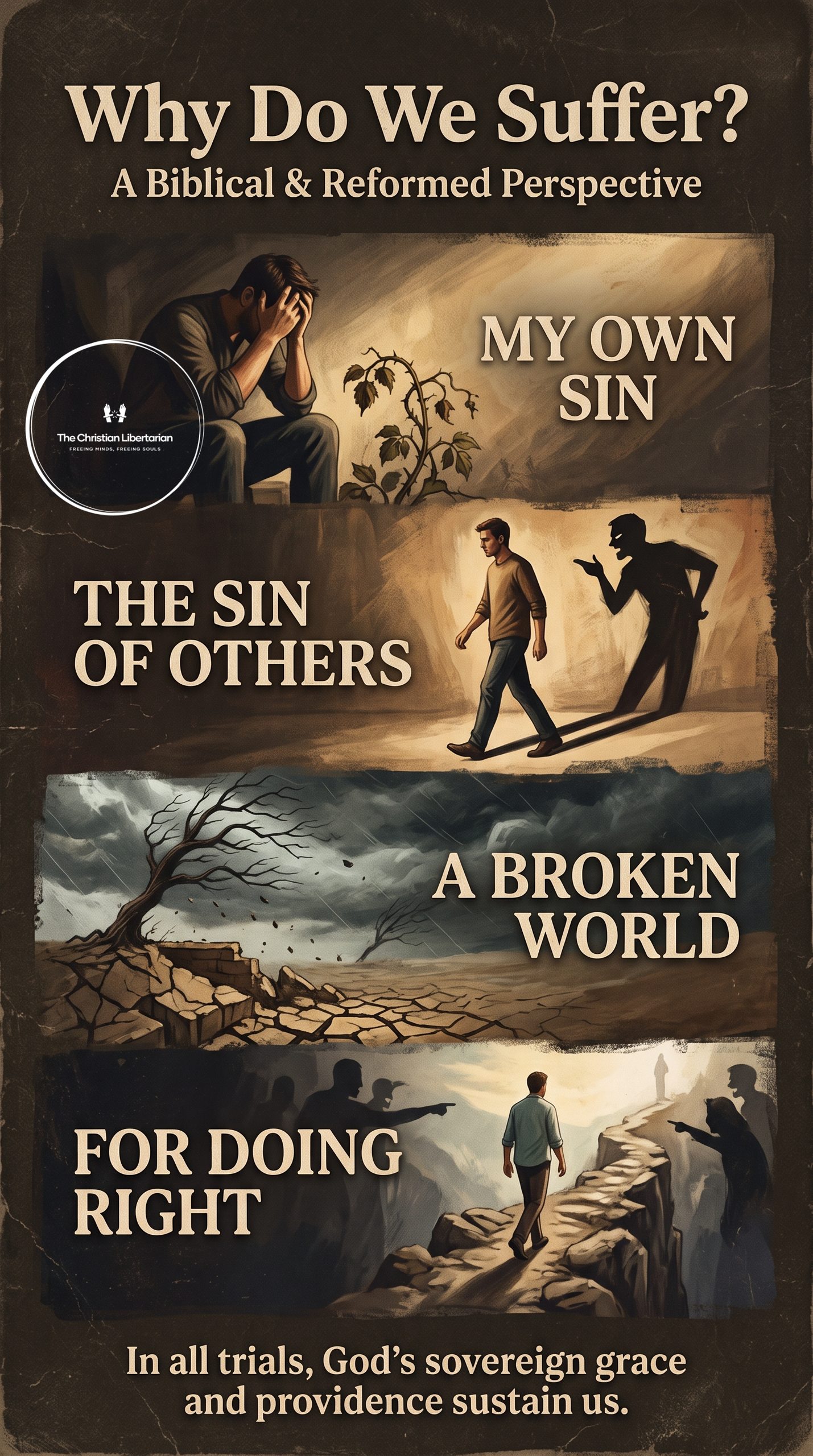
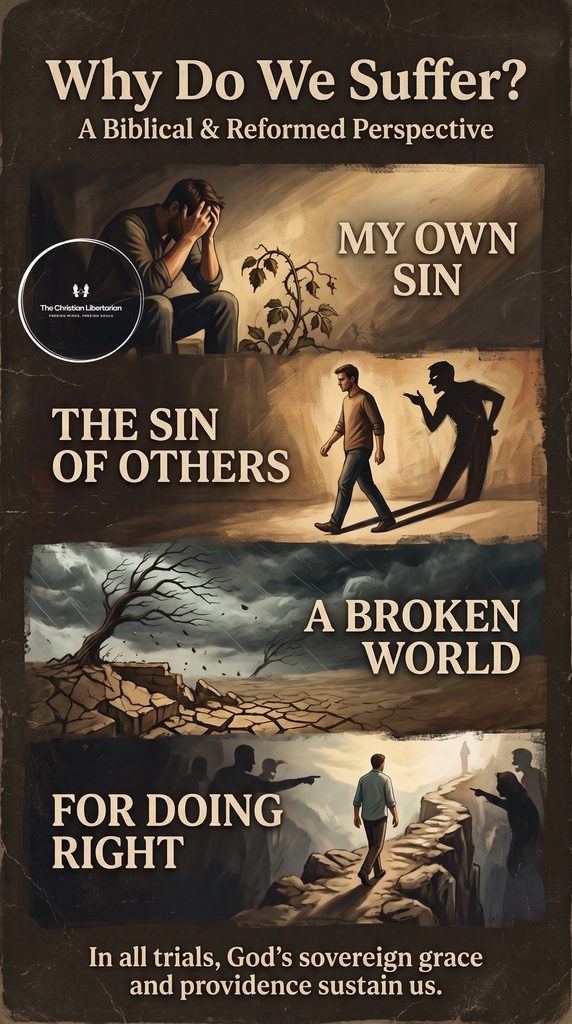
Both views flatten reality. Scripture gives us a far more honest, nuanced, and comforting framework. From a Reformed biblical perspective, suffering isn’t random chaos, nor is it a simplistic one-to-one equation. In Scripture, pain generally traces back to four distinct sources:
First, sometimes suffering comes directly from my own sin. We reap what we sow. When we give in to dishonesty, addiction, pride, or unchecked anger, the natural harvest is relational destruction, guilt, and tangible loss. David’s grief after his sin with Bathsheba is a sober picture of this reality. God forgives, but the temporal fallout remains real. Acknowledging this isn’t self-hatred; it is an honest confession that our rebellion against God bears bitter fruit in daily life.
Second, much of our suffering stems from the sin of others against us. You can walk with integrity and still be betrayed by a spouse, abused by someone in power, slandered by a colleague, or defrauded in business. Joseph understood this intimately. Thrown into a pit and sold into slavery by his own brothers, his agony had nothing to do with personal wrongdoing and everything to do with others’ cruelty. In a fallen world, human selfishness inevitably collides with the innocent.
Third, we suffer simply because we live in a world broken by the Fall. When Adam fell, creation itself was subjected to frustration and futility. Cancer cells multiply, hurricanes level neighborhoods, miscarriages happen, and bodies age and decay. Jesus explicitly confronted our instinct to blame the individual in these situations. When asked whether a man’s blindness was caused by his own sin or his parents’, Jesus responded that neither was the cause—it occurred so that the works of God might be displayed. Not every sickness or disaster is a targeted divine lightning bolt; it is often the shared groaning of an unredeemed creation waiting for renewal.
Fourth, we suffer precisely for doing what is right. Culture often assumes that living honorably guarantees peace, respect, and success. Yet Scripture promises that choosing faithfulness often invites friction. Whether it is enduring ridicule for holding biblical convictions, sacrificing career advancement to maintain integrity, or facing overt persecution, the Christian is called to share in the sufferings of Christ. When we suffer for righteousness’ sake, we are walking the very path our Savior walked.
Recognizing these four streams guards us against cruel counsel and toxic despair. You don’t have to scrounge through your past looking for hidden guilt when facing a medical diagnosis, nor can you pretend your own reckless choices are merely “spiritual warfare.” Above all, Christian theology anchors this realism in God’s absolute sovereignty: suffering never has the final word, nor does it escape His providential hand. He redeems what is broken, comforts the mistreated, and uses even our darkest trials to conform us to the image of His Son.
Sources:
- Bible: Galatians 6:7–8; Psalm 32:3–5; 2 Samuel 12:10–14 (suffering from personal sin)
- Bible: Genesis 37:23–28; Genesis 50:20 (suffering from the sin of others)
- Bible: Romans 8:18–23; John 9:1–3; Luke 13:1–5 (suffering from a fallen creation)
- Bible: 1 Peter 3:13–17; 1 Peter 4:12–16; 2 Timothy 3:12 (suffering for righteousness)
- Heidelberg Catechism, Lord’s Day 1 & Lord’s Day 10 (on providence, comfort, and adversity)
- Westminster Confession of Faith, Chapter V (“Of Providence”)