
I’ve been taking some seminary classes and some of the ones that connect with counseling have been quite impactful. Personally, I’ve endured verbal abuse, multiple bouts of depression, personal and family health issues, and my wife and I have lost 8 babies via miscarriage. A solid theology of suffering is important to navigate these things and for realizing the limits of what government power can do and how most people need help in forms that political systems cannot ever provide.
When trials strike, our instinctive reflex is almost never humble surrender to God. Instead, we scramble for an exit. Much like Edmund in C.S. Lewis’s Narnia, tasting Turkish Delight and running from truth, we look for ways to escape pain rather than confront it before a holy, sovereign God. Reformed theology has long recognized that suffering is never neutral: it exposes the heart, confronting us with our frailty and compelling us either to repent or to rebel.
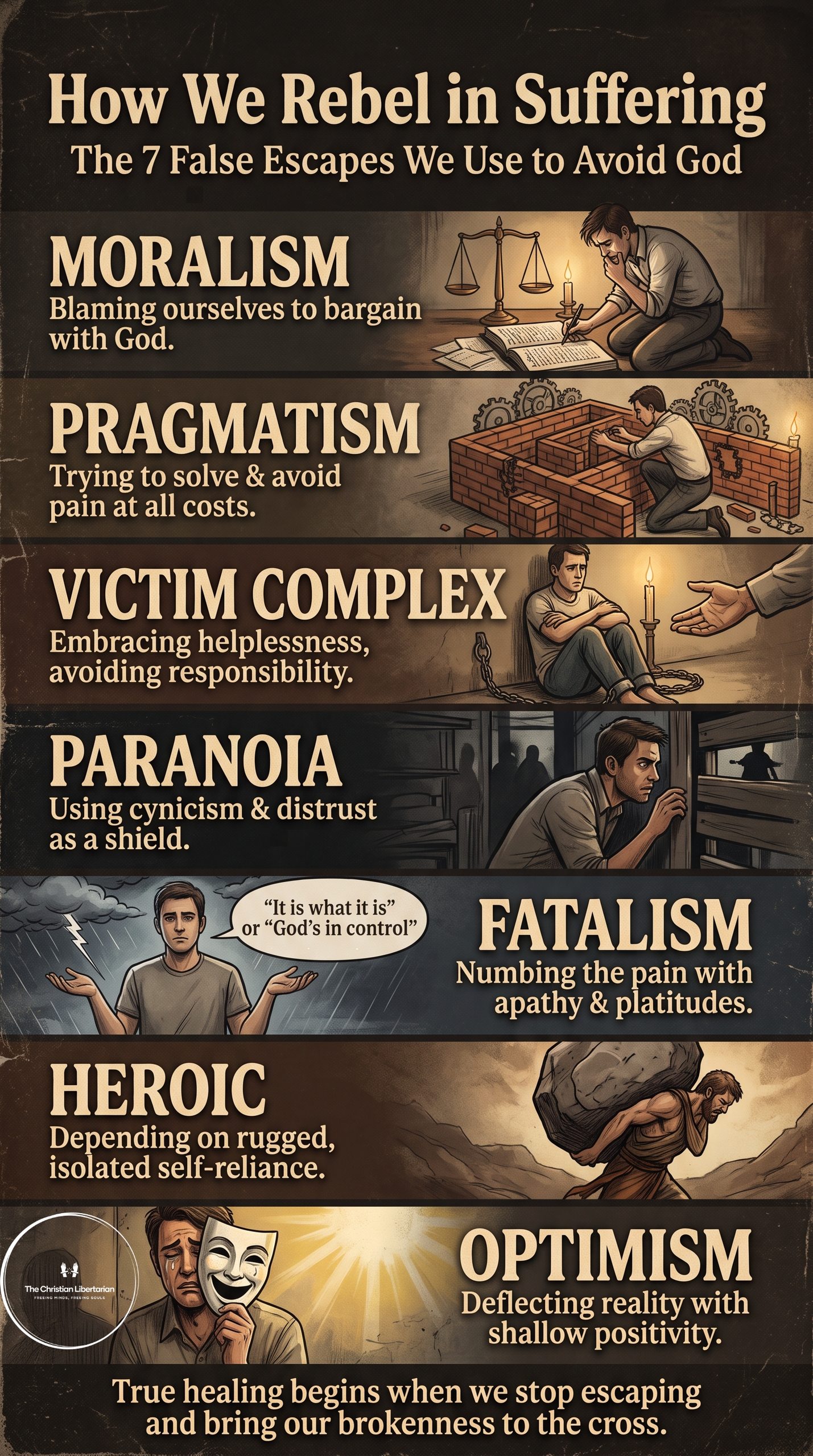
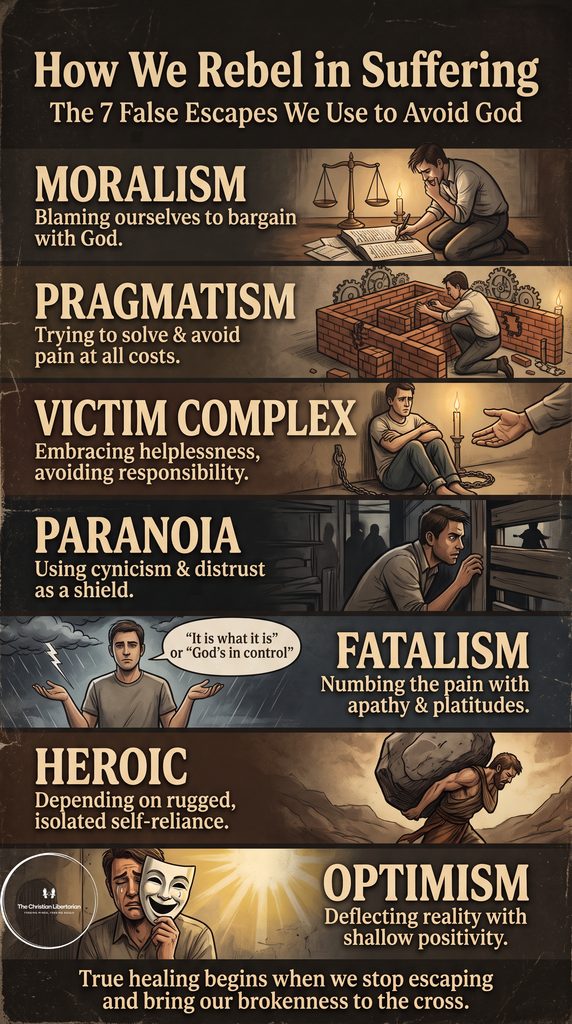
Often, our rebellion doesn’t look like open shaking of our fist at heaven. It looks like sophisticated coping mechanisms—patterns of mind and heart designed to manage our agony on human terms rather than laying ourselves bare before Christ. These functional escapes, drawn out perceptively by thinkers like Tim Keller and Dan Allender, show up in seven distinct, rebellious postures that we adopt when suffering hits.
The first rebellious posture is Moralism. Here, we attempt to regain a sense of control by turning God into a vending machine and suffering into a simple transactional ledger. The moralist asks, “What did I do wrong? Why is God punishing me?” In this framework, obedience is merely a contract to guarantee comfort and insulate ourselves from trouble. It mirrors the cold theology of Job’s friends, who insisted that great misery only follows great personal guilt. Moralism breeds self-righteousness when life is good and crushing despair when calamity strikes. Crucially, it completely misses the gospel: it ignores the curse of a broken creation and forgets that the sinless Son of God chose to enter our suffering willingly to redeem us.
The second posture is Pragmatism. This is the hallmark of modern secular culture. Pragmatism views pain as an absurd, meaningless intrusion that must be engineered out of existence through technique, legislation, therapeutic management, or medical control. The pragmatist assumes that if we just apply the right resources and systems, human suffering can be permanently contained. When suffering inevitably breaks past our defenses—as it always does—the pragmatist collapses into bitter disillusionment with the universe. By attempting to manage away sorrow, pragmatism bypasses the transcendent reality that suffering came into the cosmos through cosmic rebellion against God, refusing to hear the trial as a call to humble repentance.
The third posture is the Victim Complex. In this stance, a person embraces complete helplessness and abdicates moral agency. The victim complex seeks safety by shifting all culpability onto external actors, circumstances, or God Himself, relying entirely on others to rescue, validate, and pity them. While real victimization is tragic and demands justice, the complex weaponizes passive helplessness to avoid repentance. It excuses personal sloth, bitterness, and sin under the banner of trauma. Ultimately, this mindset actively resists the cross of Christ, because coming to Jesus requires us to acknowledge our own sin, take responsibility for our moral bankruptcy, and actively turn to Him in obedience.
The fourth posture is Paranoia. Paranoia builds a fortress of cynicism: “Life is brutal, people are malicious, and then you die.” To protect against future wounds, the paranoid assumes everyone is out to harm them, turning chronic distrust into an emotional shield. Yet in trying to guard against betrayal, the paranoid guarantees their own misery. Cynicism rejects any higher redemptive design, making bitter suspicion feel like wisdom. In the end, God is reduced to just another distant, untrustworthy power to be feared and kept at arm’s length.
The fifth posture is Fatalism. The fatalist shrugs, rolls with the punches, and numbs the ache by minimizing reality. In church circles, this often masquerades as hyper-pious Christianese: “Well, God is sovereign, everything happens for a reason, so just brush it off and move on.” Fatalism minimizes agony by comparing it to worse scenarios, treating genuine grief as a lack of faith. But this is Stoicism, not biblical trust. It produces cold companions who cannot weep with those who weep, substituting callous apathy for the raw lament of the Psalms and the tears Jesus shed at the tomb of Lazarus.
The sixth posture is the Heroic stance. This is the posture of self-reliance, the rugged survivor declaring that “what doesn’t kill me makes me stronger.” The hero scorns the victim’s passivity and vows to conquer pain through raw grit, discipline, and sheer willpower. But the hero refuses to let grief soften their heart. They remain emotionally isolated, marching forward alone without community and without true dependence on the Lord. Because human strength is finite, the heroic facade always crumbles eventually under the crushing weight of real affliction. Man is not the master of his own destiny; we are creatures dependent on our Creator.
The seventh posture is the Optimist. The optimist insists on putting on a brave face, deflecting sorrow with humor, pleasant platitudes, and upbeat diversions. They believe that if they just look on the bright side, hardship will simply evaporate. Yet as Dan Allender observes, optimism is often a polite form of unbelief. It convinces us that God’s love promises immediate earthly resolution and clear-cut happy endings in this life, when in reality God’s providential plan may include prolonged valleys where the earthly purpose remains hidden. Christian hope is rooted in the blood-bought resurrection of Christ, not in superficial cheery escapism.
Every single one of these seven strategies leaves us spiritually paralyzed. When we refuse to face suffering honestly before God, our coping mechanisms end up multiplying the very pain we sought to avoid, often spilling over to wound the people around us. More than that, numbing our hearts to sorrow inevitably numbs our hearts to true joy.
Reformed Christianity does not call us to white-knuckle our way through pain, nor does it ask us to deny reality with trite slogans. It invites us to true lament—to bring our brokenness, our grief, and our confession directly to the foot of the cross. Only when we abandon our rebellious coping mechanisms can we rest in the sovereign hands of a Savior who was Himself a man of sorrows, well-acquainted with grief, and who works all things together for the eternal good of His people.
Sources:
- Bible: Job 4:7–9; Job 42:7–9 (the error of moralism and misjudging providence)
- Bible: Psalm 13; Psalm 88 (biblical lament versus stoic fatalism or shallow optimism)
- Bible: Ecclesiastes 2:1–11; Romans 5:3–5 (the limits of human pragmatism and the nature of true hope)
- Bible: John 11:33–36 (Christ weeping at Lazarus’s tomb against unfeeling resignation)
- Bible: 2 Corinthians 1:8–10; 2 Corinthians 12:9–10 (shattering heroic self-reliance to rely on God)
- Dan B. Allender, The Healing Path: How the Hurts in Your Life Can Lead You to Greatness (WaterBrook, 2000).
- Timothy Keller, The Centrality of the Gospel (Redeemer City to City), and Walking with God through Pain and Suffering (Dutton, 2013), examining moralistic, secular, and stoic postures toward adversity.