
It is a composite of three problems: compulsory attendance laws, taxpayer funding, and educational monopolies.
We have been conditioned to view the government school system as a sacred civic pillar—an indispensable public good that binds communities together. But stripped of nostalgia, compulsory, taxpayer-funded schooling is a coercive state monopoly that violates parental authority, misallocates vast economic resources, and systematically fails the very children it claims to nurture. Education is not a public utility like roads or sewer lines; it is the transmission of values, truth, and worldview. Granting the state a subsidized monopoly over the minds of the next generation was always a catastrophic moral compromise.
Scripture places the duty of educating and discipling children squarely upon the shoulders of the family, never the civil magistrate. Deuteronomy 6:6–7 commands parents directly: “These words that I command you today shall be on your heart. You shall teach them diligently to your children.” Paul reiterates in Ephesians 6:4 that fathers are responsible to bring children up “in the discipline and instruction of the Lord.” Caesar has no divine commission to form the moral and intellectual framework of a child.
The compulsory attendance model—imported from 19th-century Prussia specifically to cultivate civic obedience and industrial compliance—inverts this order. It effectively designates children as wards of the state, relegating parents to custodial supervisors while coercing property owners under threat of foreclosure to fund an ideological apparatus that frequently undermines their deepest religious convictions.
The empirical defense of this monopoly has completely collapsed under the weight of its own expenditures.
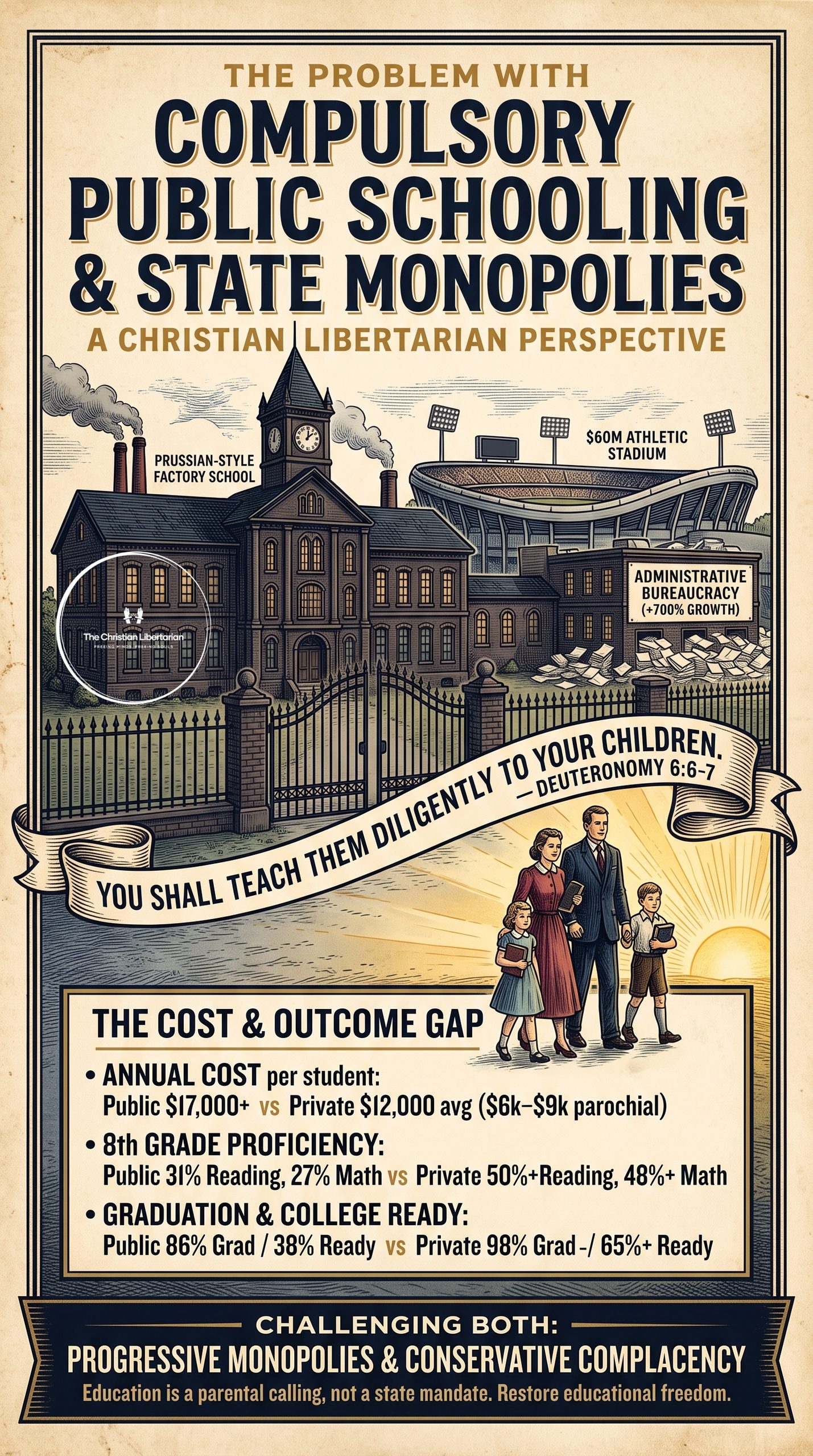
According to data from the National Center for Education Statistics (NCES), public elementary and secondary schools in the United States spend an average of over $17,000 per student each year, with large metropolitan districts like New York City, Chicago, and Baltimore exceeding $25,000 to $32,000 per student annually. For a standard classroom of 25 students, taxpayers are spending between $425,000 and $800,000 per year.
Yet what does this historic river of cash actually produce? The National Assessment of Educational Progress (NAEP), commonly called “The Nation’s Report Card,” reveals that barely 31 percent of American eighth-graders are proficient in reading, and only 27 percent are proficient in math. In major urban districts where per-pupil spending is highest, proficiency rates frequently collapse into single digits.
By comparison, private schools achieve substantially higher academic proficiency, college-readiness benchmarks, and graduation rates at a fraction of the cost—averaging roughly $12,000 per student nationally, with parochial and Christian day schools often operating between $6,000 and $9,000. Public charter schools routinely outperform their district counterparts despite receiving significantly lower operational revenues.
If the money is not producing academic mastery, and classroom teachers are still buying their own paper and pencils, where is the money going?
It is swallowed by two massive structural sinks: administrative bloat and opulent capital projects. Since the 1950s, public school administrative and non-teaching personnel growth has outpaced student enrollment by more than 700 percent. School districts have metastasized into sprawling regional bureaucracies employing diversity coordinators, human resource directors, and supervisory middle managers who never teach a child.
Simultaneously, local school boards routinely pass nine-figure bond packages financed by decades of property tax debt to construct multi-million-dollar administrative headquarters, indoor waterparks, and lavish athletic facilities. High school football stadiums in suburban districts—such as the $60 million stadium in Allen, Texas, or the $70 million complex in McKinney—rival collegiate arenas. The state school system has prioritized entertainment infrastructure and bureaucratic self-preservation over actual educational achievement.
Both political establishments perpetuate this dysfunctional system, differing only in how they manage the decay.
Progressives treat public schools as temples of social engineering and democratic leveling, defending the system’s failures by demanding endless billions in new tax funding. They operate as political enforcers for entrenched teachers’ unions, fiercely opposing school choice or any exit mechanism for low-income minority families trapped in failing, violent district schools. Trapping the poorest children in failing zip codes while claiming to champion the marginalized is not compassion; it is defending an administrative cartel at the expense of human lives.
Conservatives, on the other hand, love to deliver speeches against radical curricula and combative school boards, yet they remain deeply complicit in sustaining the institutional structure. Conservatives eagerly support massive municipal bond issues to fund the local athletic complex and high school stadiums, wrapped in small-town nostalgia. Furthermore, conservative “school choice” legislation often takes the form of state-funded vouchers that invite regulatory capture—attaching state testing mandates and administrative strings to private and Christian schools. Trying to redeem a socialist monopoly by electing a conservative board or trading tax credits for state vouchers is treating the symptom while feeding the disease.
True educational freedom requires acknowledging that state coercion cannot produce wisdom. Loving our children and our neighbors demands separating school and state entirely, restoring the educational mandate to families, and allowing dynamic, voluntary community alternatives to flourish.
Immediate Steps for Educational Separation and Freedom
- Repeal Compulsory Attendance Mandates
Dismantle state compulsory attendance statutes that penalize alternative education, restoring full legal autonomy to families pursuing homeschooling, co-ops, and unschooling without state oversight. - Decouple Public Funding from Capital Athletics and Administrative Edifices
Prohibit municipalities from utilizing taxpayer-backed general obligation bonds to finance competitive athletic stadiums, aquatic centers, and non-instructional administrative palaces. - Institute Direct Tax Separation and Universal Property Tax Credits
Provide a dollar-for-dollar property tax exemption for property owners and parents who choose not to utilize the government school system, ending double-taxation for families funding independent education. - Eliminate State Teacher and Curriculum Licensure Cartels
Abolish state credentialing monopolies that prevent subject-matter experts, trade professionals, and independent scholars from teaching without state administrative certification.
Sources and Documentation
- Biblical Foundations on Parental Authority: Deuteronomy 6:6–7; Ephesians 6:4; Proverbs 22:6 (the primary moral and pedagogical stewardship of parents over children).
- Expenditure and Per-Pupil Cost Statistics: National Center for Education Statistics (NCES), Digest of Education Statistics, Table 236.15: “Current expenditure per pupil in fall enrollment in public elementary and secondary schools” (tracking national and district-level per-pupil spending).
- Academic Performance Data: National Assessment of Educational Progress (NAEP), The Nation’s Report Card: Mathematics and Reading Assessments, National Center for Education Statistics (documenting eighth-grade reading and math proficiency levels).
- Comparative Tuition and Outcomes: Council for American Private Education (CAPE), Facts and Studies on Private Schools, and Stanford University’s CREDO, National Charter School Study, documenting performance and per-student operating costs across private, parochial, and charter models.
- Administrative Staffing Growth: Benjamin Scafidi, The School Staffing Surge: Decades of Substantially Increased Staffing in US Public Schools, EdChoice (analyzing disproportionate non-teaching staff growth relative to student enrollment since 1950).
- Historical Origins of Compulsory Schooling: Murray N. Rothbard, Education: Free and Compulsory (Center for Independent Education, 1971), outlining the historical development of the Prussian educational model and Horace Mann’s Massachusetts reforms.