
Drawing Out Truth or Reading In Bias: Why Exegesis Must Triumph Over Eisegesis
Walk into almost any contemporary small group Bible study across America, and you will likely hear the leader open the discussion with a familiar question. After someone reads a paragraph from one of Paul’s letters or an Old Testament narrative, the leader smiles and asks the room: “So, what does this verse mean to you?”
On the surface, the question sounds warm, inviting, and pastoral. It lowers the barrier to participation because nobody can get a personal feeling wrong. For the next thirty minutes, participants share sentimental reflections, personal anecdotes, and spontaneous impressions sparked by a single word or phrase in the passage. Everyone leaves feeling affirmed. Yet in that very moment, the authority of the Word of God has been quietly overthrown.
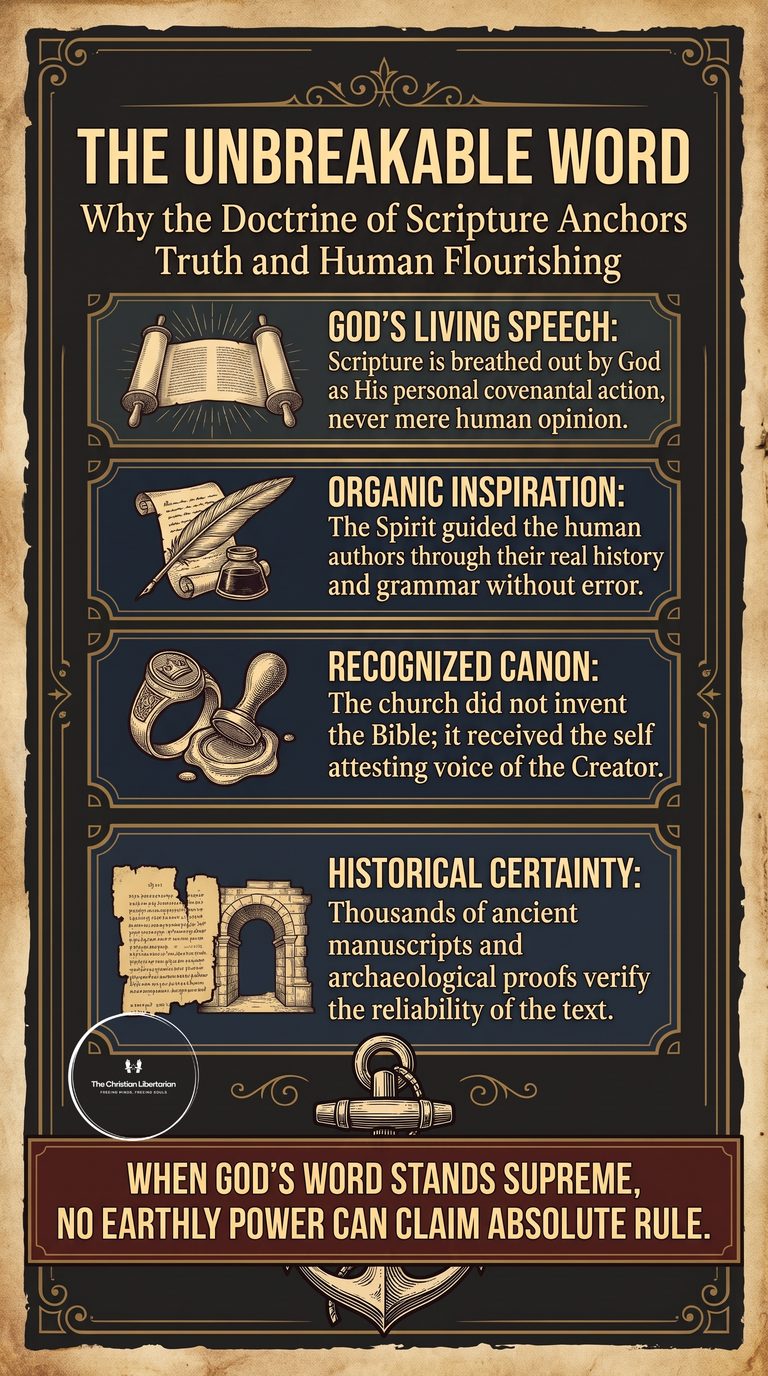
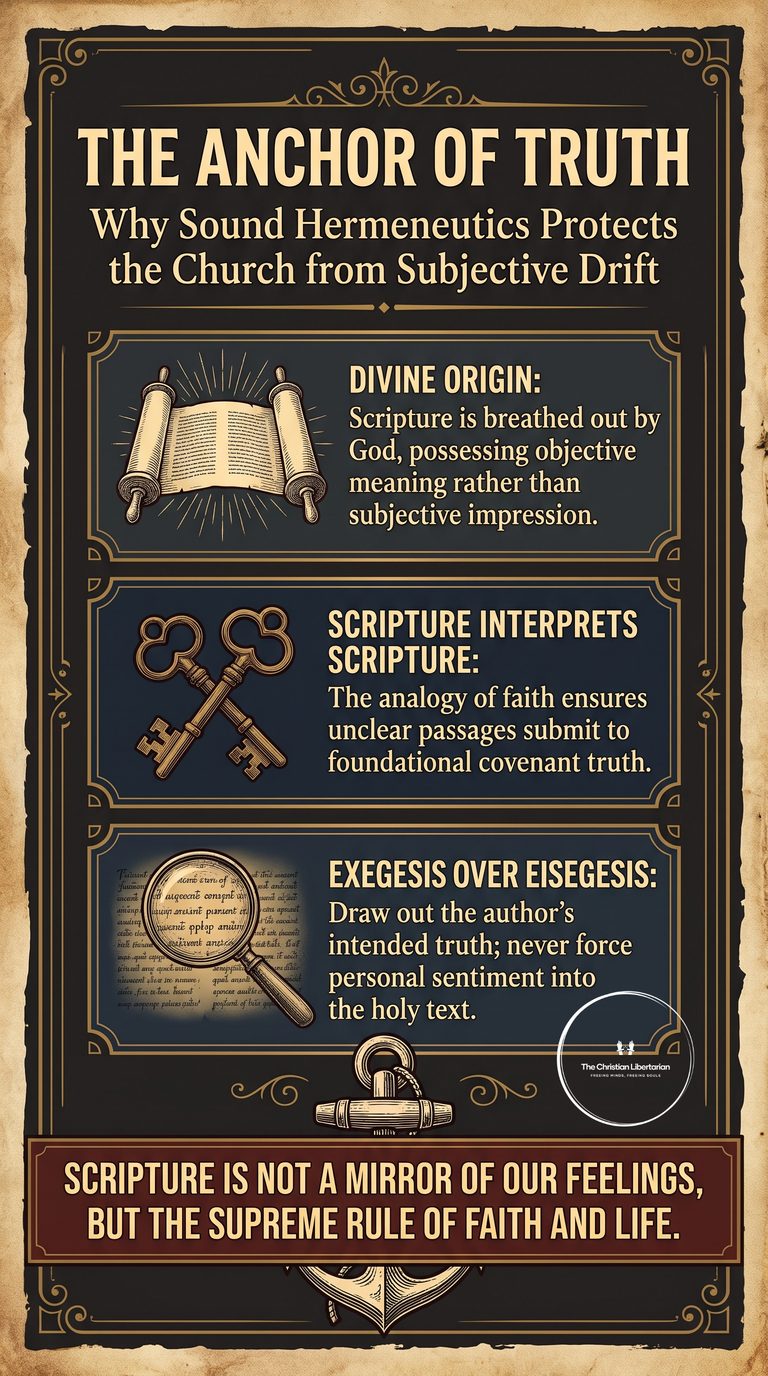
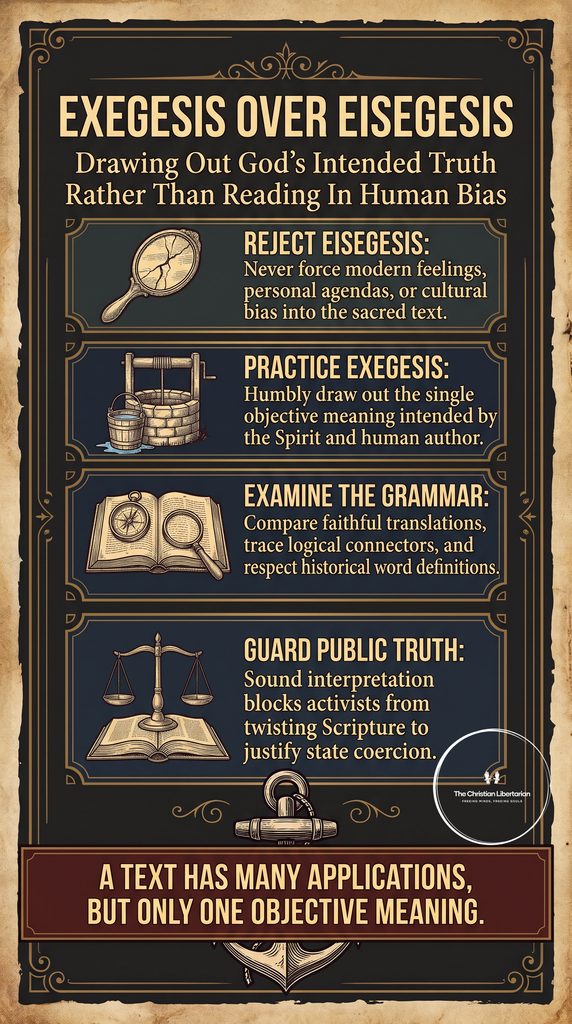
In our previous installment, we established that the Bible is the organic, breathed out, and authoritative speech of the Creator. Because God has spoken in real human history through real human authors, the text possesses a fixed, objective meaning. When we ask what a verse means to us before we have done the hard work of discovering what the author meant when he wrote it, we substitute our subjective imagination for divine revelation. To study the Bible faithfully, every Christian must understand the vital difference between exegesis and eisegesis.
Two Opposite Postures of the Mind
The words exegesis and eisegesis trace their roots to the Greek verb meaning to lead or to guide, separated only by their prefixes. That small difference in prefix represents the grand canyon of biblical interpretation.
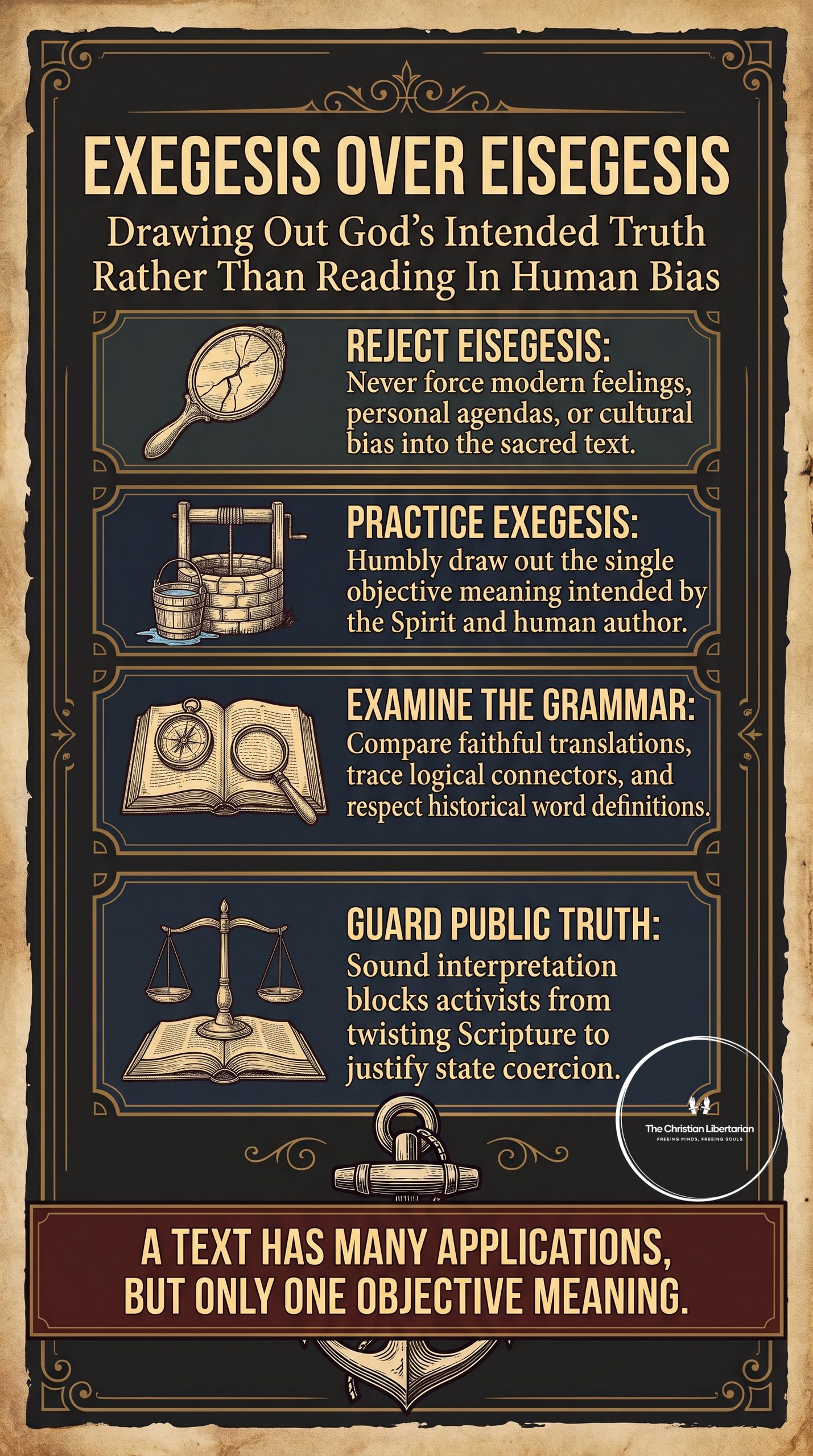
Eisegesis begins with the Greek prefix meaning into. It is the practice of reading our own ideas, modern assumptions, emotional desires, or political agendas into the biblical text. The eisegete approaches the Bible with a conclusion already formed in his mind, scanning the pages for isolated verses that employ similar vocabulary so he can claim divine endorsement for his preselected opinion.
Because of the fallenness of human nature, eisegesis is our natural default setting. In Reformed theology, we speak of the noetic effects of sin, which refers to the way the Fall corrupted human reason and desires. Our hearts are naturally prone to self justification. We want God to agree with our lifestyle, validate our grievances, and condemn our opponents. Eisegesis allows a reader to retain all the prestige of quoting the Bible while remaining completely autonomous from its actual authority.
Exegesis, on the other hand, begins with the Greek prefix meaning out of. It is the patient, disciplined investigation of the sacred text to draw out the meaning that the original author placed there under the inspiration of the Holy Spirit. Exegesis requires intellectual self denial. It demands that we silence our modern assumptions, cross a bridge of thousands of years of history and language, and listen carefully to what Moses, David, Isaiah, Matthew, or Paul actually intended to communicate.
The Reformed Heritage of Humble Interpretation
During the sixteenth century Reformation, the recovery of the gospel was inseparable from the recovery of sound exegesis. Throughout the late Middle Ages, biblical interpretation had become dominated by an elaborate fourfold method known as the Quadriga. While that system acknowledged a literal sense, it prioritized mystical, allegorical, and moralistic readings that detached the text from grammar and history. If a medieval theologian wanted to defend an invented church tradition or papal decree, he could simply allegorize an Old Testament narrative until it yielded the desired conclusion.
The Reformers recognized that if a biblical text can mean four or five unconnected things at once, then it effectively means nothing at all. They insisted on returning to the literal, grammatical, and historical sense of Scripture. This principle was formally codified in the Westminster Confession of Faith (Chapter 1, Section 9), which states that when there is a question about the true and full sense of any Scripture, it must be understood that the sense is not manifold, but one.
John Calvin modeled this interpretive integrity throughout his life. In 1539, Calvin wrote a famous introductory letter to Simon Grynaeus at the beginning of his commentary on the book of Romans. In it, Calvin argued that the chief virtue of an expositor is lucid brevity, and that his sole business is to lay open the mind of the writer whom he has undertaken to explain. Whenever an interpreter leads readers away from the author’s original intention, he strays from his calling.
Remarkably, Calvin routinely criticized fellow Protestant commentators when they used sloppy exegesis to defend true orthodox doctrines, such as the Trinity or justification by faith, from verses that were not actually addressing those topics. For Calvin, handling the Word of God with deceitful or careless methods was an insult to the Holy Spirit, who never needs human manipulation to defend His truth.
In our own generation, the late Reformed theologian R.C. Sproul popularized this crucial boundary in his classic book Knowing Scripture by distinguishing between meaning and significance. Any given passage of Scripture has only one meaning, which is locked in the historical intention of the author. At the same time, that single objective meaning can have countless applications and deep significance for believers across different centuries. When a Bible study leader asks what a verse means to us, they are confusing personal significance with textual meaning. True application can only stand on the foundation of accurate exegesis.
A Contemporary Teaching Illustration
To see how this plays out in everyday Christian life, consider a common scenario. In this hypothetical scenario, imagine a young Christian entrepreneur named Caleb who is preparing to take out a massive, high interest business loan to launch an untested retail store in a saturated market. When wise older men in his church look at his business plan and warn him that the numbers do not work and the debt could ruin his family, Caleb waves away their concerns. He points to the coffee mug on his desk, which bears the words of Philippians 4:13: “I can do all things through him who strengthens me.” In Caleb’s mind, this verse is a divine blank check guaranteeing personal success and financial victory in any venture he sincerely chooses to pursue.
Caleb has committed classic eisegesis. He has injected twenty first century American self help optimism into a first century prison epistle.
Had Caleb practiced basic exegesis, he would have looked at the sentences surrounding that verse. In Philippians 4:10-12, the Apostle Paul is writing from Roman captivity, thanking the church in Philippi for their material gift. Paul explains that throughout his apostolic ministry, he has learned the secret of being content in every physical circumstance, whether he is well fed or hungry, whether he has abundance or suffers painful need. When Paul says he can do all things through Christ who strengthens him, he is not promising worldly triumph or entrepreneurial wealth. He is declaring that Christ supplies the supernatural strength to remain faithful and content even when stripped of all earthly comfort and facing starvation in a dungeon. Eisegesis turned a profound text about contentment in suffering into a slogan for reckless ambition.
The same distortion happens constantly with passages like Matthew 18:20 (“For where two or three are gathered in my name, there am I among them”). People routinely quote this verse at poorly attended prayer meetings as a comfort that Jesus still shows up for small crowds. Yet exegesis reveals that Jesus is actually speaking about the solemn judicial authority of the local church when executing the final steps of church discipline and excommunication.
The Basic Toolkit of Faithful Exegesis
In upcoming posts in this series, we will examine the major pillars of interpretation in detail, including how literary context works, how Scripture interprets Scripture, what it means that the Bible was written for us but not directly to us, and how to read different literary genres like poetry, prophecy, and law. Before we reach those broader categories, however, every believer needs to know the foundational, ground level tools of exegesis.
When you sit down with an open Bible to draw out the author’s meaning, you have five basic tools at your disposal:
- Patient Observation and Interrogation: Good exegesis begins by slowing down. Most of us read the Bible far too quickly because we think we already know what a familiar passage says. Treat the text like a detective examining a witness statement. Ask the basic journalistic questions: Who is speaking? To whom are they speaking? What actions are taking place? Look for words or phrases that the author repeats multiple times, as repetition is how ancient writers highlighted their main point without bold fonts or underlining.
- Translation Comparison: Unless you are fluent in biblical Hebrew, Aramaic, and Koine Greek, you are relying on the work of translators. Different English Bibles use different translation philosophies. Some use formal equivalence (often called word for word), such as the English Standard Version or the New American Standard Bible, which preserve the exact grammatical structure of the original languages. Others use dynamic equivalence (thought for thought), such as the New International Version or the Christian Standard Bible, to smooth out idioms for modern readability. The third category, paraphrase, include The Message, or New Living Bible is not useful for this kind of study. Laying two or three faithful translations side by side immediately reveals where the original phrasing is complex and guards you against building a whole theology on a single English quirk.
- Grammatical and Syntactical Mapping: God chose to reveal Himself through human language, which means His truth is carried by the rules of grammar. Pay close attention to pronouns (who is the “we,” “you,” or “they” in a sentence?), verb tenses (is this a completed past action by God or a present command for the believer?), and prepositions. Above all, watch the conjunctions. Words like “therefore,” “because,” “for,” “so that,” and “nevertheless” are the logical hinges of Scripture. Whenever you see a “therefore,” trace the argument backward to see what the author is building his conclusion upon.
- Responsible Lexical Study: Using an exhaustive concordance (or digital search tool), an interlinear Bible, or a reliable Greek and Hebrew lexicon allows you to study key theological words like justification, covenant, propitiation, or redemption. However, word studies must be done with care. A common mistake is the root fallacy or historical anachronism, where a reader assumes a modern English derivative defines an ancient Greek word. For example, preachers frequently claim that when Paul calls the gospel the “power” of God in Romans 1:16 (the Greek word dunamis), he meant the gospel is like spiritual dynamite. In reality, Alfred Nobel did not invent dynamite until 1867. Paul was writing about God’s effective, creative moral ability to save, not an uncontrolled explosion that blows things to pieces. Words mean what they meant in their usage at the time of writing.
- Reading in Communion with the Historic Church: Exegesis is personal, but it should never be private. The Holy Spirit did not begin teaching the church when you opened your laptop this morning. He has been illuminating faithful pastors, scholars, students, saints, and martyrs for two thousand years. After you have observed the text and mapped its grammar yourself, consult trusted exegetical commentaries, Bible dictionaries, and historic confessions. If you discover a brand new meaning in a verse that nobody in two millennia of church history ever noticed, you can be virtually certain you have slipped into eisegesis.
The Legal, Economic, and Political Ramifications
Why does this distinction between exegesis and eisegesis matter beyond the walls of the local church? Because the intellectual habits a society forms around its most sacred text inevitably shape its legal, economic, and political institutions.
In the realm of law, the triumph of eisegesis in the pulpit directly parallels the rise of judicial activism and legal positivism in the courts. When citizens and clergy grow comfortable treating an authoritative text as a flexible canvas for their own evolving feelings, judges do the exact same thing to written constitutions and contracts. Rather than practicing strict textualism to ask what a constitutional limit meant when it was ratified to restrain government power, modern jurists treat the law as a “living document.” They read novel powers into the text, erasing the boundaries designed to protect individual liberty from the state.
In the realm of economics, eisegesis is the primary weapon used by political actors to clothe state coercion in religious language. Consider how frequently political activists quote Acts 2:44-45, where the early Jerusalem believers sold their possessions and distributed the proceeds to anyone in need, as a biblical mandate for socialism and coercive wealth redistribution.
Even a basic exegetical review of Acts chapters 2-5 shatters that claim. The grammar and narrative show that the early believers sold their property voluntarily, retained private ownership over their goods until they chose to give (as Peter explicitly affirms to Ananias in Acts 5:4), and distributed aid locally within the covenant community rather than handing money to the Roman Empire’s tax collectors. Reading state welfare and compulsory taxation into Acts 2 is pure eisegesis that pits Scripture against God’s own Eighth Commandment (“Thou shalt not steal”).
Finally, in the political sphere, tyrants throughout history have relied on sloppy proof texting to demand absolute obedience from their subjects. By isolating phrases like “be subject to the governing authorities” in Romans 13:1 from the surrounding grammatical structure of verses 3 and 4, which define the ruler strictly as a minister of God who praises the good and punishes the wicked, statists attempt to turn a passage about limited, accountable justice into a charter for unlimited tyranny.
Sound exegesis is a vital safeguard of human freedom. When we humble ourselves before the text of Scripture and draw out what God has actually spoken, we silence the manipulative voices of both false teachers and grasping politicians. We anchor our souls, our churches, and our culture in the unyielding truth of God’s Word.
Sources and References
- Holy Scripture: Acts 2:44 through 45; Acts 5:1 through 4; Romans 1:16; Romans 13:1 through 4; Philippians 4:10 through 13; 2 Timothy 2:15; 2 Timothy 3:16 through 17; 2 Peter 1:20 through 21
- Confessional Standards: Westminster Confession of Faith, Chapter 1, Section 9; Second Helvetic Confession, Chapter 2 (Of Interpreting the Holy Scriptures)
- John Calvin, Commentaries on the Epistle of Paul the Apostle to the Romans, Epistle Dedicatory to Simon Grynaeus (1539)
- R.C. Sproul, Knowing Scripture (InterVarsity Press, 1977, Revised Edition 2009)
- Herman Bavinck, Reformed Dogmatics, Volume 1: Prolegomena (Baker Academic, 2003)
- D.A. Carson, Exegetical Fallacies (Baker Academic, 1984, Second Edition 1996)
- Louis Berkhof, Principles of Biblical Interpretation (Baker Book House, 1950)