
God-given Limits for Stewardship, Love, and Liberty
The conversation around personal boundaries in modern society has become a battlefield between two deeply distorted extremes. On one hand, modern therapeutic individualism weaponizes boundaries as a tool of self-absorption. In this secular view, a boundary is simply an excuse to ghost people, cut off anyone who inconveniences you, and build an impenetrable fortress around your personal comfort under the banner of protecting your peace. On the other hand, traditional religious culture often promotes a toxic codependency that mistakes passivity for piety. Believers are told that to be loving means to be a doormat, enduring endless manipulation, enabling destructive sin, and surrendering all personal agency in the name of grace.
Both postures completely warp biblical truth. From a Reformed Christian perspective, setting appropriate boundaries is neither selfish isolation nor cowardly retreat. Boundaries are an act of faithful stewardship rooted in the created order and covenantal responsibility.
To understand boundaries biblically, we must first recognize that God Himself is a God of order, distinction, and limits. In creation, God separated the light from the darkness, established borders for the oceans, and placed man in a designated garden with explicit boundaries regarding what to cultivate and what to avoid. God created human beings as finite, responsible image-bearers. Each person has been given a particular sphere of moral responsibility, time, energy, and resources. You are responsible for your own obedience, your own repentance, and your own stewardship before God. You are not sovereign over the actions of others, nor does God call you to absorb or shield another person’s unrepentant destruction.
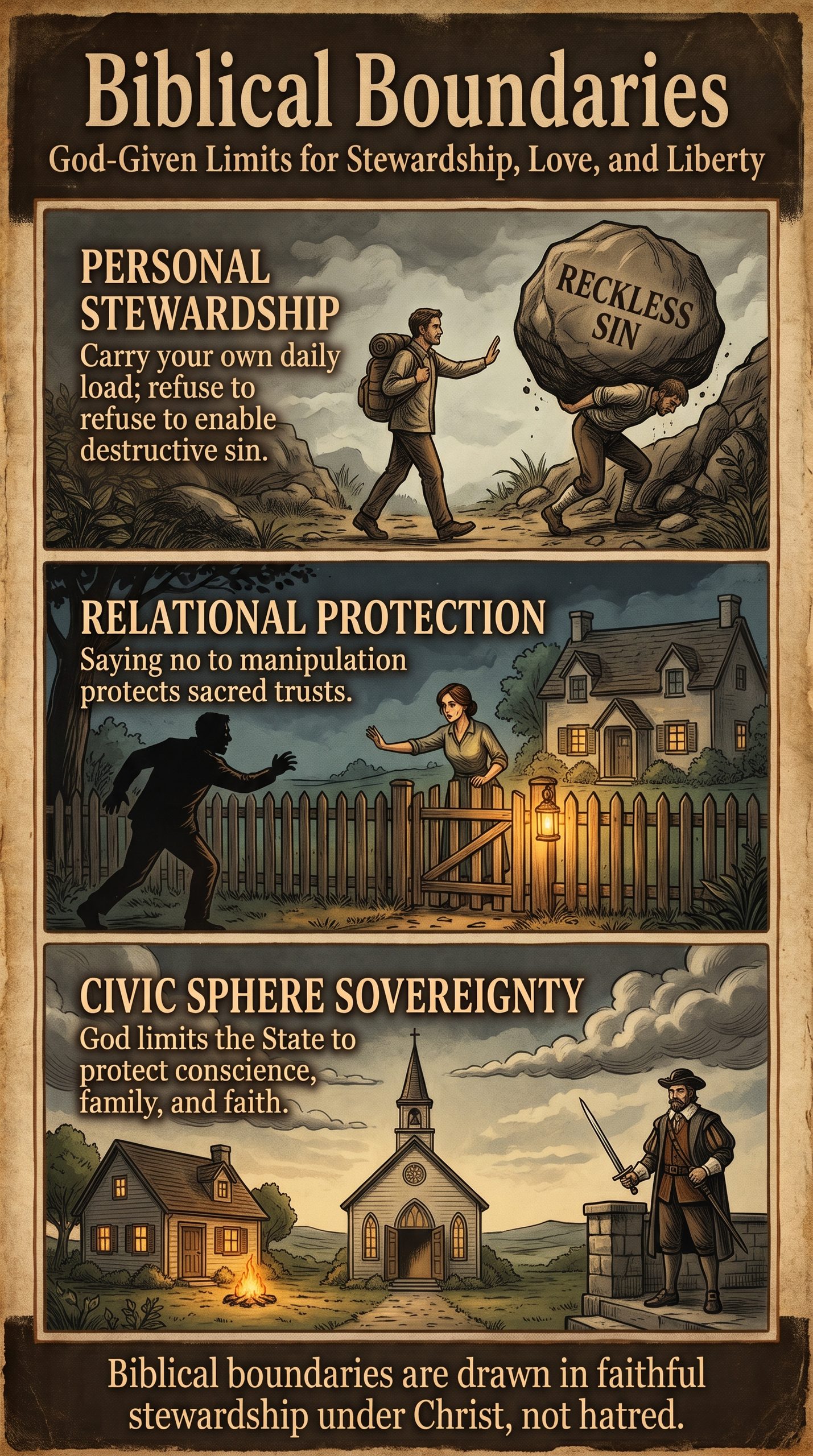
Setting biblically wise boundaries operates across three essential dimensions.
First, boundaries define the line of stewardship and moral agency. Scripture instructs us to carry our own daily loads while also bearing one another’s crushing burdens. There is a profound difference between stepping into a crisis to help someone carry a boulder they cannot lift, and taking on the daily knapsack of another adult’s responsibilities, excusing their laziness, or shielding them from the natural consequences of their sin. When we fail to set boundaries with a reckless, abusive, or chronically entitled person, we are not displaying Christian charity; we are playing God. Proverbs warns repeatedly that anyone who rescues a hot-tempered man will simply have to do it over and over again. Biblical boundaries allow the natural fallout of sin to do its intended work, driving a person to repentance rather than facilitating their rebellion.
Second, boundaries are necessary to guard against evil and preserve genuine love. Real biblical love requires truth and righteousness; it cannot exist alongside enabling and falsehood. In Matthew 18, Jesus gives explicit instructions on how to handle an unrepentant brother. If someone sins against you and refuses to listen to private confrontation, witnesses, and the church, they are to be treated as a tax collector and an outsider. That is a clear, institutional, and relational boundary. It is an act of holy judgment and protective exclusion designed both to protect the community and to wake up the offender. Loving someone does not mean granting them unlimited access to destroy your family, your sanity, or your home. Even Jesus repeatedly withdrew from crowds that demanded His energy on their own terms, walked away from religious leaders seeking to trap Him, and refused to entrust Himself to people whose hearts were deceitful.
Third, the principle of biblical boundaries extends directly into the civic and political spheres. God did not create a singular, centralized, omnipotent state with total claim over every dimension of human life. In biblical covenant theology, God instituted distinct spheres of authority: the individual conscience, the family, the church, and the civil magistrate. Each sphere has God-given jurisdictions and explicit boundaries. The civil magistrate is given the sword for a very narrow purpose: to punish outward civil evil and protect the innocent. When the state crosses its boundary by intruding into the household, regulating faith, coercing charity, or confiscating private property under the guise of compassion, it commits civic idolatry. Totalitarianism and excessive bureaucracy are nothing more than dysregulated, boundary-violating tyrants operating at scale. Just as an abusive individual demands total compliance and shames anyone who asserts healthy agency, a state without boundaries crushes the natural liberties and responsibilities God placed upon the family and the individual.
True Christian boundaries are never motivated by malice, contempt, or a desire to punish. They are drawn out of love for God’s truth, a desire for order, and an honest recognition of creaturely limits. We set limits on destructive behavior not to retaliate, but to create the conditions where truth can be spoken and real relationship can flourish.
When we look to Christ, we do not see a savior who passively permitted sin to run over holiness. Christ set clear boundaries against hypocrisy, upheld divine justice, and laid down His life voluntarily according to the sovereign decree of the Father. His sacrifice was an intentional act of holy obedience, not the helpless submission of a victim. As redeemed people walking under His lordship, we honor Him when we exercise biblical wisdom, refuse to enable wickedness, and protect the sacred trusts He has placed in our care.
Sources:
- Bible: Genesis 1:3–10; Genesis 2:15–17 (God establishing boundaries and spheres in creation)
- Bible: Galatians 6:2–5 (distinguishing between bearing burdens and carrying personal loads)
- Bible: Proverbs 19:19; Proverbs 22:24–25; Proverbs 25:17 (wisdom regarding limits, wrath, and enabling)
- Bible: Matthew 18:15–17 (covenantal boundaries and church discipline)
- Bible: John 2:23–25; Luke 4:28–30; Mark 1:35–38 (Christ asserting relational boundaries and refusing manipulation)
- Bible: Romans 13:1–7; Acts 5:29; 1 Kings 21 (jurisdictional limits of civil authorities versus individual and familial rights)
- Henry Cloud and John Townsend, Boundaries: When to Say Yes, How to Say No to Take Control of Your Life (Zondervan, 1992)
- Abraham Kuyper, Lectures on Calvinism (The Stone Lectures, 1898), on sphere sovereignty and jurisdictional limits
- Westminster Confession of Faith, Chapter XXIII (Of the Civil Magistrate, delineating limits of state power)