
How Evil Fractures the Soul, Faith, and Society
Our culture tends to approach abuse through two flawed lenses. In the secular sphere, trauma is often treated in purely clinical or materialist categories—a neurological injury to be managed through technique, stripped of moral categories like evil, sin, and spiritual devastation. Meanwhile, within religious circles, an equally toxic blind spot often festers: a naive reduction of abuse to mere “marital friction” or a “communication issue,” demanding that victims passively submit to wolves in sheep’s clothing to preserve an institution.
Both errors fail to reckon with what abuse actually is. From a Reformed biblical perspective, abuse is not a misunderstanding; it is a profound desecration of the imago Dei. It is the predatory misuse of power, trust, and authority to subjugate, exploit, and crush an image-bearer of God. Because humans are whole persons—mind, body, and soul—abuse does not merely inflict psychological bruising; it shatters relational wiring, distorts our perception of God, and inevitably cascades outward into broad social collapse.
To confront this devastation honestly, we must name the specific forms abuse takes, the spiritual wreckage it leaves behind, and the societal ripple effects that follow.
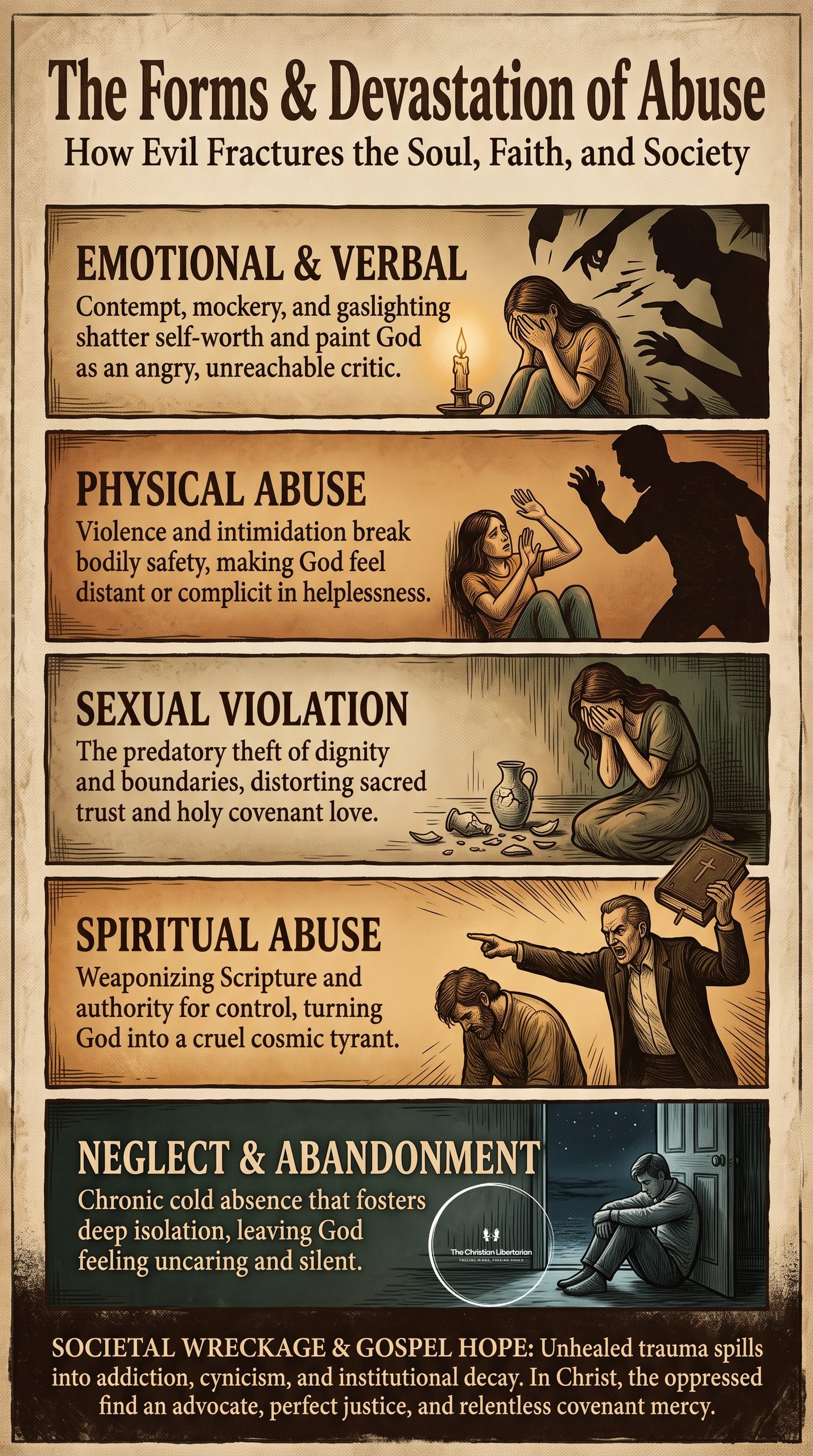
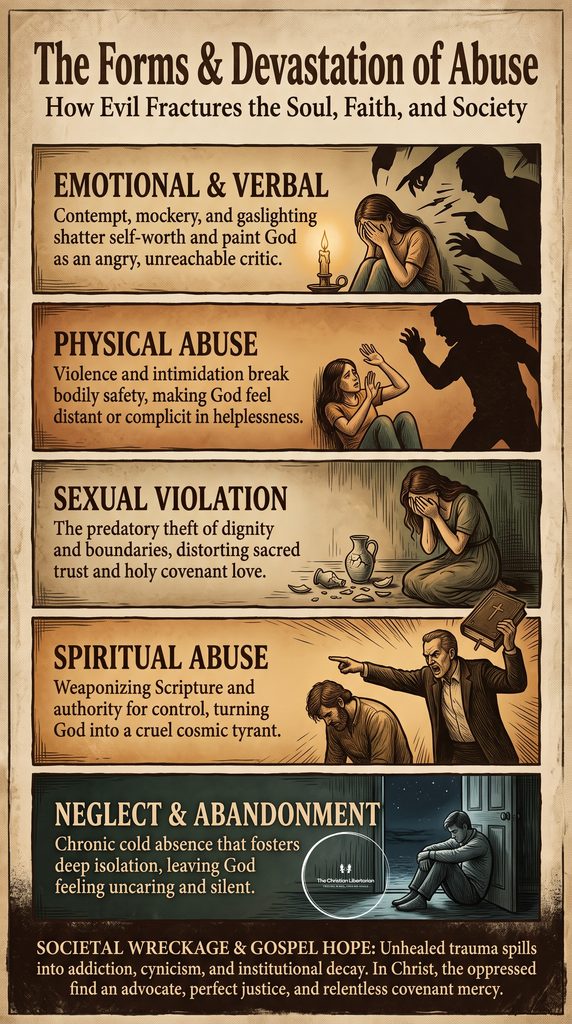
First is Emotional and Verbal Abuse. This is the persistent weaponization of contempt, mockery, gaslighting, rage, and shame to erode another person’s reality and dignity. The abuser manipulates words to keep the victim off-balance, second-guessing their sanity and worth. This damages a person by installing chronic self-loathing and hypervigilance. Spiritually, it warps the victim’s view of God into a cruel, demanding tyrant waiting for them to step out of line—a deity whose favor is impossible to secure and whose words are spoken in irritation rather than grace.
Second is Physical Abuse. This is the overt use of bodily force, intimidation, and violence to enforce dominance and terror. The body, intended to be a temple of the Holy Spirit, is treated as an object to be beaten into submission. Physical abuse shatters the victim’s sense of embodied safety, locking their nervous system into chronic fight-or-flight. Spiritually, physical terror makes the concept of God as a “strong tower” or “shield” feel profoundly hollow or even menacing; an all-powerful God who allows a physically stronger oppressor to overpower them can easily be perceived as indifferent, absent, or complicit in their helplessness.
Third is Sexual Abuse. This is the violation and commodification of the body, intimacy, and sacred trust. It violently strips a person of agency, ownership of their own flesh, and relational boundaries. Sexual abuse inflicts profound existential shame, leaving the victim feeling permanently ruined, contaminated, or worthless. Spiritually, it distorts the foundational biblical picture of covenant love and holy union. God is frequently perceived as an invasive, unsafe entity who ignores consent and boundaries, leaving the victim terrified of vulnerable communion with Christ.
Fourth is Spiritual Abuse. This occurs when an authority figure uses God’s Word, pastoral office, divine threats, or distorted theology to enforce unquestioned control, silence dissent, and protect personal power. Scripture warns sharply against shepherds who fleece the flock and govern with cruelty. Spiritual abuse damages the soul by hijacking the conscience; the victim cannot separate the abuser’s voice from God’s voice. Spiritually, it leads either to cynical deconstruction or a paralyzing fear of damnation for daring to seek safety. God becomes the abuser’s ultimate enforcer—a celestial thug backing up an earthly despot.
Fifth is Emotional Neglect and Abandonment. While often passive, the chronic absence of attunement, care, protection, and responsiveness is its own form of cruelty. As developmental research and pastoral observation show, being ignored or discarded teaches a person that their internal world does not matter. It fosters deep avoidant withdrawal and the conviction that they are utterly alone. Spiritually, the victim views God as cold, indifferent, and distant—a Creator who might run the universe mechanically, but who is entirely uninterested in hearing their personal cries or binding up their wounds.
When individuals endure these forms of abuse without justice, safe community, or true healing, the trauma does not stay contained inside the home or church; it spills over into widespread societal dysfunction. Abused people who have learned that power equals survival frequently develop predatory traits themselves, continuing cycles of domestic violence, workplace toxicity, and coercive leadership. Others collapse into profound addiction, alcoholism, and destructive escapism simply to numb the screaming dysregulation of their nervous systems.
Societally, widespread unaddressed abuse fractures families, destabilizes marriages, fuels generational fatherlessness, and drives rising rates of violent crime and psychiatric collapse. It produces a culture deeply divided between cynical, paranoid isolationists who trust no one, and frantic, reactive populaces easily exploited by demagogues promising safety. When a society tolerates the crushing of its most vulnerable in private, it reaps pervasive institutional corruption and civic decay in public.
Scripture never minimizes or excuses abuse. The God of the Bible is not a passive bystander to oppression. God openly confronts the wicked shepherds in Ezekiel 34, declaring that He will hold them accountable for scattering the sheep and ruling them with force and harshness. Christ reserves His fiercest condemnations for religious hypocrites who tie heavy burdens on people’s backs while lifting not a finger to help, warning that it would be better for a millstone to be hung around an abuser’s neck than for them to harm one of His little ones.
In the Reformed faith, we look to a sovereign Savior who is the ultimate defender of the brokenhearted and the righteous avenger of the oppressed. Christ Himself experienced betrayal, false accusation, physical beating, mockery, and public humiliation at the hands of corrupt religious and political rulers. He knows the agony of the victim from the inside.
Healing does not come through cheap forgiveness that sweeps evil under the rug, nor does it come by demanding that victims reconcile with unrepentant abusers. True restoration begins with bringing the full truth of abuse into the light, establishing safety and justice, and resting in the covenant care of a Father whose authority is characterized by sacrificial protection, perfect justice, and relentless, tender mercy.
Sources:
- Bible: Ezekiel 34:1–16 (judgment against abusive shepherds who rule with force and harshness)
- Bible: Matthew 18:6; Matthew 23:1–4, 27–28 (Christ’s fierce condemnation of religious abusers and millstone warning)
- Bible: Psalm 10:14–18; Psalm 72:12–14 (God delivering the afflicted and redeeming them from oppression and violence)
- Bible: Malachi 2:13–16 (God rejecting worship accompanied by treachery and violence in covenant relationships)
- Bible: Ephesians 5:21–29; Colossians 3:21 (the biblical requirement of sacrificial, nourishing love against harsh domination)
- Diane Langberg, PhD, Redeeming Power: Understanding Authority and Abuse in the Church (Brazos Press, 2020), examining the nature of systemic, emotional, and spiritual abuse and how it distorts the image of God.
- Dan B. Allender, PhD, The Wounded Heart: Hope for Adult Victims of Childhood Sexual Abuse (NavPress, 1989/2008), analyzing the theological and relational wreckage of violation.
- Bessel van der Kolk, MD, The Body Keeps the Score: Brain, Mind, and Body in the Healing of Trauma (Viking, 2014), detailing the neurobiological and broad societal impacts of developmental and relational trauma.
- Westminster Larger Catechism, Q&A 135–136 (the Sixth Commandment, requiring the preservation of life and forbidding the crushing of body or spirit).