
Moving from Dysregulation to Biblical Self-Control
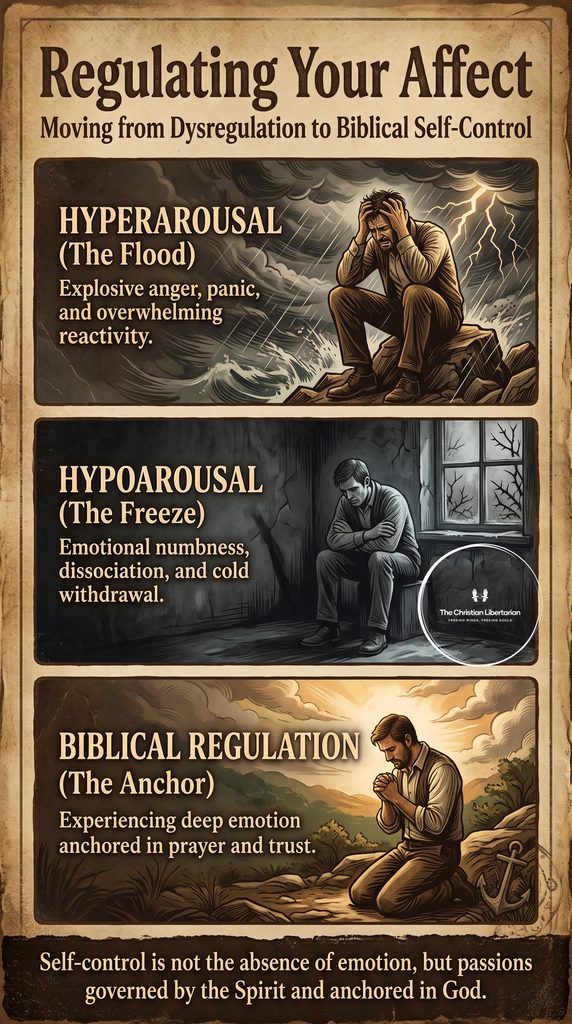
We live in a culture that swings wildly between two destructive errors when it comes to human emotion. On one side is an expressive individualism that treats every internal impulse as sacred truth: “If I feel it, it is valid, and anyone asking me to contain it is oppressing me.” On the other side is a rigid, stoic moralism—frequently baptized in conservative Christian circles—that treats strong feelings as spiritual failure, demanding that we suppress, ignore, or spiritualize away our pain.
Both views fundamentally misunderstand how God created the human soul. Scriptural wisdom and developmental neurobiology reveal that godliness is neither emotional anarchy nor stoic detachment; it is the capacity for biblical affect regulation.
To understand affect regulation, we first have to understand what “affect” actually is. In psychological terms, affect is the physiological, felt expression of emotion within your body and nervous system before you even put words to it. It is the sudden racing heart of fear, the gut-wrenching heaviness of sorrow, the rush of adrenaline in anger, or the expansiveness of joy. Affect regulation is simply your capacity to experience and tolerate these intense internal states without either being swept away by them or shutting down to escape them.
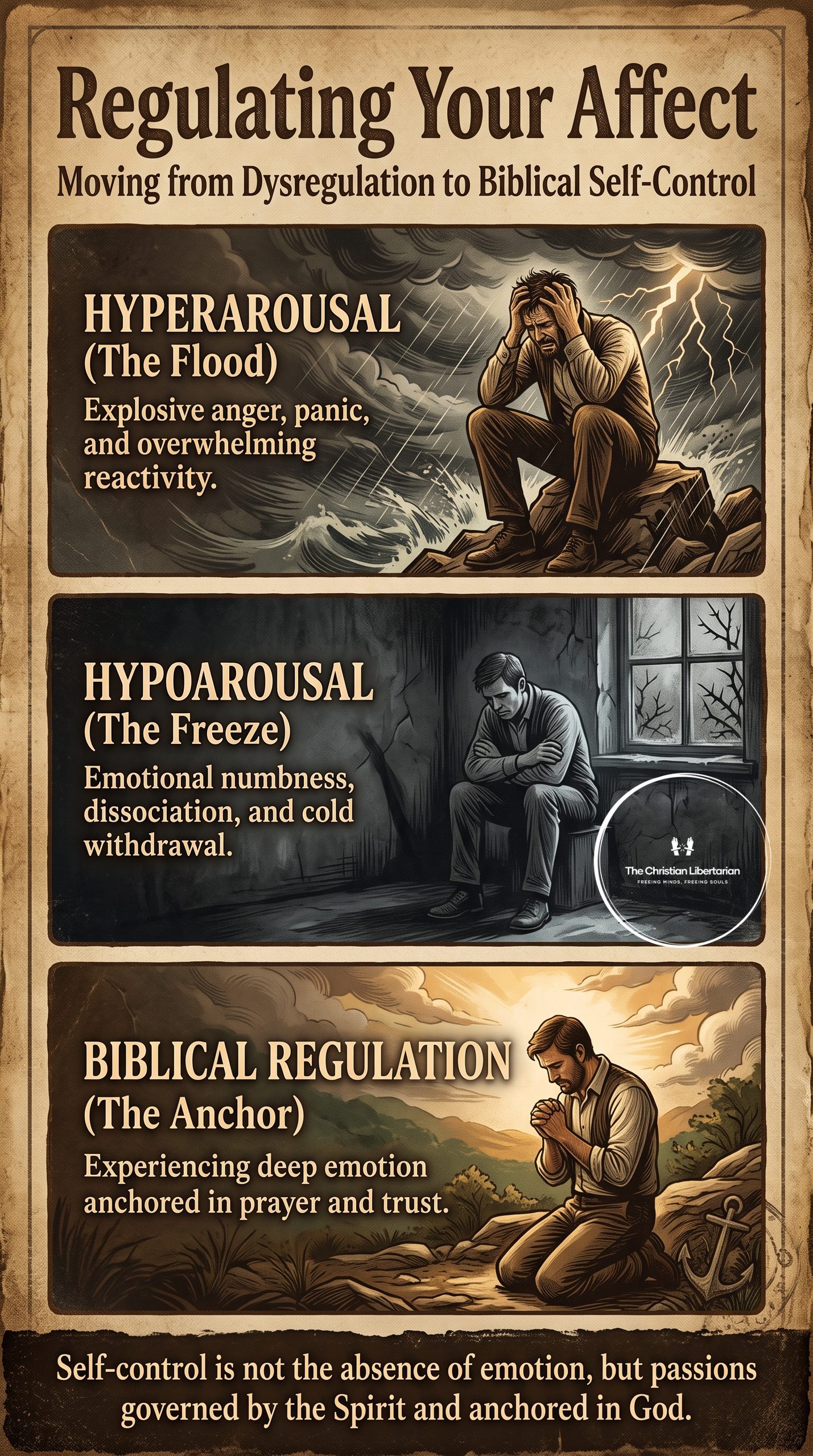
Dysregulated affect generally breaks out in one of two directions: hyperarousal or hypoarousal. In hyperarousal, the emotional throttle is jammed wide open. It looks like explosive rage, panicked catastrophizing, chronic reactivity, or a frantic flood of words that consumes everyone in the room. In hypoarousal, the nervous system throws the breaker switch. It looks like emotional numbness, dissociation, stone-cold withdrawal, apathy, or collapsing into lethargy. In both states, we lose the ability to love our neighbor well, speak the truth with clarity, or rest in God’s presence.
Scripture repeatedly points us to a better, sturdier way. Consider David in Psalm 131. He does not deny his distress or pretend he is unaffected by life. Instead, he writes, “I have calmed and quieted my soul, like a weaned child with its mother; like a weaned child is my soul within me.” Notice that David actively engages in regulating his internal state, yet he doesn’t do it through cold self-reliance or dissociation. He does it by leaning into the presence of the Lord. Similarly, the fruit of the Spirit explicitly includes “self-control” (enkrateia), which is not the elimination of emotion, but the Holy Spirit’s governing power over our passions.
Jesus Himself demonstrates perfect affect regulation. In the Garden of Gethsemane, Christ did not numb out or offer stoic platitudes. He was “sorrowful, even to death,” sweating drops like blood under immense anguish. Yet in the very crucible of that agony, His affect remained anchored: He brought His unedited grief directly to the Father, submitted His will, and rose to face the cross with resolute courage.
From a Reformed perspective, true affect regulation begins when we acknowledge that we are embodied, fallen creatures who cannot regulate ourselves in isolation. God never intended infants or adults to be islands of solitary self-soothing. We learn regulation through relationship: first through attuned parents, and ultimately through the sovereign, steadying presence of our Heavenly Father. When our internal world is overwhelmed, we do not need to numb out with screens and cynicism, nor do we need to weaponize our reactivity against our family. We can bring our raw, racing hearts to the throne of grace, knowing that the God who rules the cosmos is sturdy enough to hold our grief, calm our storms, and anchor our souls.
Sources:
- Bible: Psalm 131:1–3 (calming and quieting the soul before the Lord)
- Bible: Matthew 26:36–46; Luke 22:41–44 (Christ’s sorrow and prayer in Gethsemane)
- Bible: Galatians 5:22–23; Proverbs 25:28 (the fruit of the Spirit, self-control, and governed passions)
- Bible: Psalm 42:5–11 (the psalmist preaching truth to downcast emotions)
- Adam Young, LCSW, Make Sense of Your Story: How Engaging Your Past Can Lead to Freedom and Healing (Chapters 4–5, on affect regulation and neurobiological development)
- Allan N. Schore, The Science of the Art of Psychotherapy (W. W. Norton, 2012), on interpersonal neurobiology and affect regulation
- Daniel J. Siegel and Mary Hartzell, Parenting from the Inside Out (TarcherPerigee, 2003)