
How Early Relational Bonds Shape the Heart
We live in a culture deeply confused about human connection. On one side, radical modern individualism preaches total autonomy: you are enough on your own, needing nobody, self-actualized and unbothered. On the other side, pop-psychology codependency treats relational anxiety as a permanent romantic aesthetic or an unchangeable identity label. Both viewpoints miss the biblical design. We were created in the image of a Triune God—built for covenant communion with God and neighbor.
Yet because we live in a fallen world, our earliest experiences of connection vary widely. In developmental psychology and trauma work—summarized clearly by Adam Young in Make Sense of Your Story, as well as pioneers like John Bowlby and Mary Ainsworth—we learn that our nervous systems adapt to how our primary caregivers treated us. When parents are attuned, responsive, and quick to repair, we develop secure attachment. But when those foundational needs are broken or absent, children do not stop needing love; their brains simply wire self-protective strategies to survive the absence of safety.
From a Reformed perspective, these attachment styles aren’t mere clinical categories; they reflect either the quiet peace of covenant trust or the embodied, instinctive ways our fallen nature learns to cope without God and community.
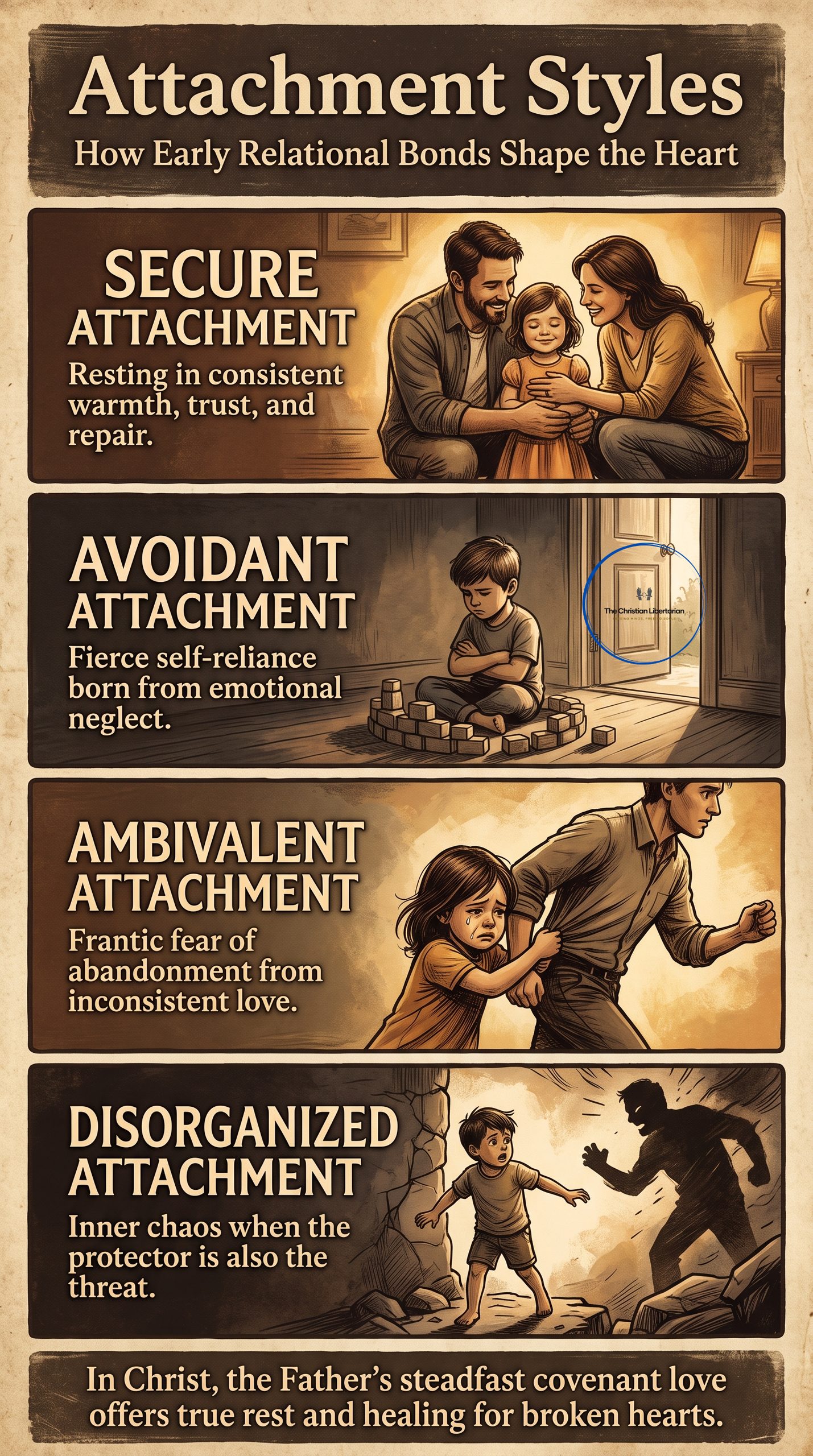
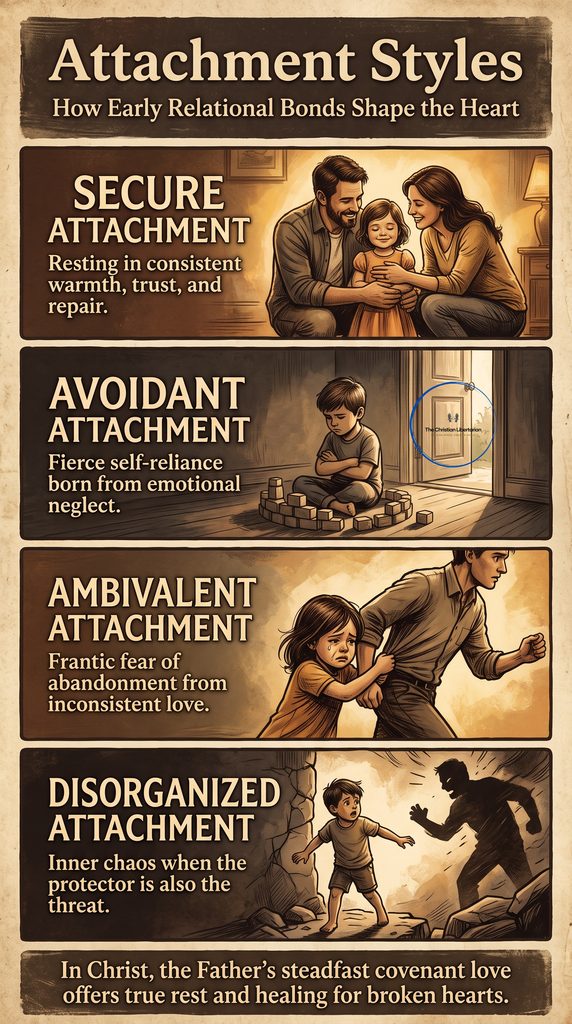
First is Secure Attachment. This develops when primary caregivers are sufficiently attuned, responsive, and engaged, and most importantly, willing to repair relational ruptures when they fail. The securely attached person possesses an embodied confidence that they matter, that others can be counted on, and that conflict does not mean abandonment. In adulthood, this looks like the freedom to both self-regulate and vulnerably reach out for help without panic or shame. They live in relational hopefulness. Spiritually, secure attachment mirrors the peace described in Psalm 131—a soul quieted and resting securely in the Father’s unshakeable love.
When that safety is broken, however, our nervous systems adapt into three primary dysregulated forms:
The first dysregulated form is Avoidant Attachment (often called Dismissive in adults). This develops when caregivers are chronically cold, unavailable, dismissive, or rejecting. The young child discovers that crying out brings no comfort, or worse, invites rebuke. To survive, the child’s nervous system cuts the wire to conscious longing. In adulthood, avoidant individuals become fiercely self-reliant. They manage their distress through solitary “autoregulation”—work, screens, isolated hobbies, or intellectualizing life—while maintaining an allergic aversion to vulnerability. In church, this often masquerades as stoic piety: “I just take my problems to God alone, not to people.” But it is an illusion of strength. It is an internal fortress built out of the childhood terror of being ignored.
The second dysregulated form is Ambivalent Attachment (often called Anxious or Preoccupied). This forms when caregiving is wildly inconsistent and often emotionally intrusive. One day the parent is affectionate; the next day they are consumed by their own anxieties, volatile moods, or expecting the child to soothe them. Because connection is unpredictable, the child’s nervous system stays stuck in hyperarousal. In adulthood, this manifests as chronic relational franticness, an obsessive fear of abandonment, and constant demands for reassurance. They often feel “too needy” or fundamentally defective, yet they cling tightly, anticipating betrayal and feeling that love is never truly secure. In spiritual life, this often looks like an exhausting, performance-driven fear that God is about to turn His back the moment their devotion wavers.
The third, and most debilitating form, is Disorganized Attachment (Fearful-Avoidant). Documented extensively by Mary Main and Judith Solomon, this occurs when the primary caregiver is also the primary source of terror, abuse, or profound chaos. For an infant, biology drives them toward the caregiver for safety, while survival instincts scream to flee from the danger. The brain faces an insoluble biological paradox: the refuge is the threat. As adults, disorganized individuals crave intimacy with intense desperation, but as soon as someone draws close, their nervous system sounds the alarm of imminent danger. They swing wildly between clinging pursuit and explosive retreat, living in persistent relational disorientation.
These relational patterns do not remain confined to human relationships; they deeply color how we perceive our Heavenly Father. The avoidant heart instinctively treats God as a distant, austere taskmaster who demands performance and expects us to handle our own messes. The ambivalent heart treats God as a fickle monarch whose favor must be frantically managed through hyper-vigilance. The disorganized heart expects divine intimacy to inevitably turn into betrayal or wrath.
Here is the glory of the Gospel: our neurobiology is not our ultimate lord, and our attachment style is not an unchangeable prison. In Reformed theology, God’s covenantal love (hesed) is the ultimate foundation for earned, redemptive security. God does not relate to us avoidantly—He drew near in the flesh, entering our dust and tears. Nor does He love us ambivalently—His decree of election is steadfast, unconditional, and immutable, holding fast even when we are faithless.
Healing begins when we stop defending our coping strategies and bring our developmental grief into the light of Christ. By His Spirit and within the body of Christ, our nervous systems and souls can experience true repair—learning to trade isolation, franticness, and fear for the secure rest of a child held in the unchanging embrace of the Father.
Sources:
- Bible: Psalm 131:1–3; Psalm 27:10; Romans 8:15–16; Romans 8:38–39 (adoption, steadfast love, and comfort against parental abandonment)
- Bible: 1 John 4:18–19; Zephaniah 3:17 (unfailing covenant presence casting out fear)
- Adam Young, LCSW, Make Sense of Your Story: How Engaging Your Past Can Lead to Freedom and Healing (Chapter 4: “What If You Engaged Your Family of Origin Story?” & Chapter 5: “Insecure Attachment: Avoidant and Ambivalent Attachment”, pp. 67–108)
- John Bowlby, Attachment and Loss (Vol. 1–3, Basic Books, 1969–1980)
- Mary S. Ainsworth et al., Patterns of Attachment: A Psychological Study of the Strange Situation (Lawrence Erlbaum, 1978)
- Mary Main and Judith Solomon, “Discovery of an Insecure-Disorganized/Disoriented Attachment Pattern,” in Affective Development in Infancy (Ablex Publishing, 1986)
- Daniel J. Siegel and Mary Hartzell, Parenting from the Inside Out (TarcherPerigee, 2003)
- Curt Thompson, MD, Anatomy of the Soul: Surprising Connections between Neuroscience and Spiritual Practices That Can Transform Your Life and Relationships (Tyndale Momentum, 2010)