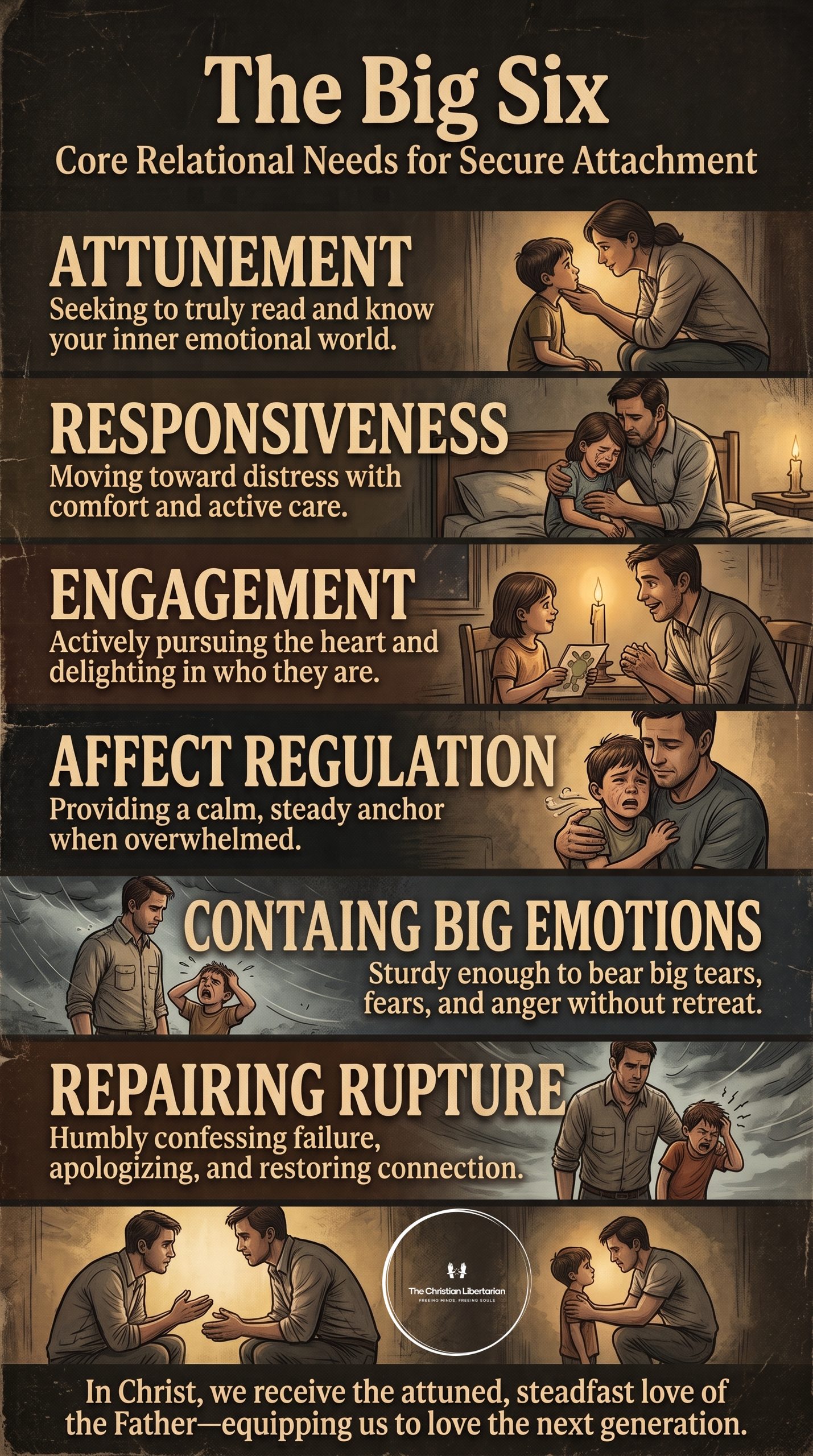

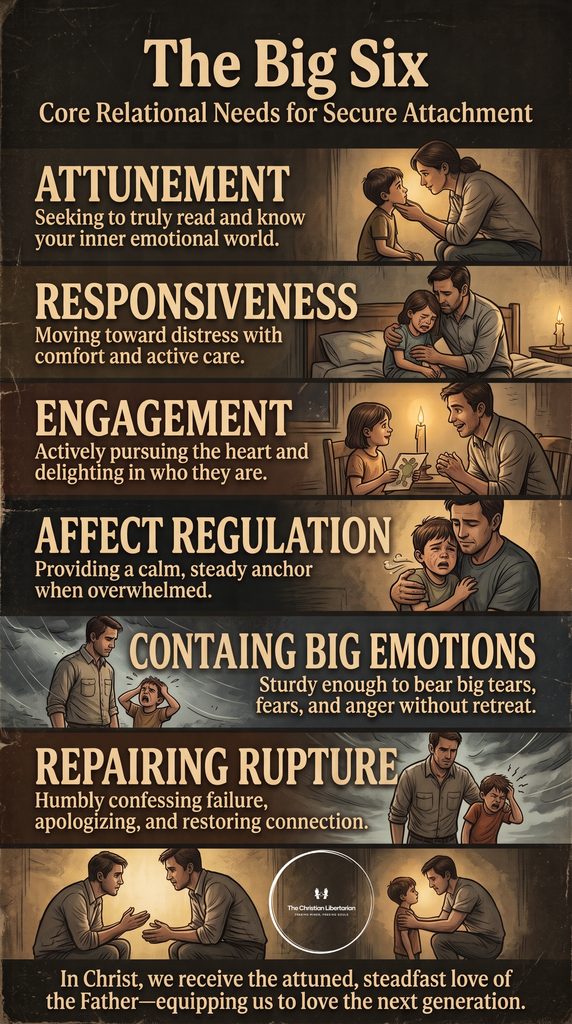
When Christian parents think about raising their children, the conversation usually tilts toward behavior, doctrine, or academic success. We teach them the catechism, enforce family rules, take them to church, and make sure their physical needs are met. But our children are not merely disembodied souls or behavior machines; they are embodied image-bearers designed by God to grow in deep communion with others. In his book Make Sense of Your Story, counselor Adam Young points out that our relational development hinges on what he calls “the Big Six”—core experiences every child needs from primary caregivers to form a secure attachment.
Our modern Christian culture often defaults to two unhelpful ditches. One is an authoritarian moralism that demands outward submission while ignoring the child’s heart and emotional reality. The other is a sentimental secular parenting that views emotional attunement as the end in itself, divorcing connection from moral accountability and gospel grace. But Reformed theology provides a sturdier reality: God made us as whole persons—heart, mind, and body—and the primary way young children learn to trust God’s covenant faithfulness and tenderness is through the tangible care of the parents He placed over them.
Before we can even ask whether we are giving these things to our children, we have to honestly ask whether we received them ourselves. Adam Young outlines these six essential dynamics:
First is Attunement. This is a parent’s capacity and desire to notice and read what is happening inside a child—to look at their face and discern their sorrow, fear, or joy so that the child feels known and understood. Psalm 139 describes a God who searches us and knows us, discerning our thoughts from afar. When parents pay attention, children learn that their inner world is not invisible to God or man.
Second is Responsiveness. If attunement is noticing the distress on a child’s face, responsiveness is what you do with what you see. Does a parent move toward a hurting, fearful, or angry child with comfort and curious kindness, or are they met with cold silence, dismissal, or avoidance? Scripture consistently portrays God as One who hears our cries and draws near to the brokenhearted, rather than turning away from our distress.
Third is Engagement. Engagement means pursuing the heart of the child. It is the proactive desire to draw out their passions, their fears, and who they uniquely are as an image-bearer. It is delighting in them simply because they are yours. God’s covenant love is never passive; He seeks us out before we ever seek Him. When a father or mother actively pursues their child’s inner life, they mirror the pursuing grace of God.
Fourth is Affect Regulation. Young children have no innate ability to soothe their overwhelmed nervous systems or pull themselves out of shutdown; their bodies depend on a calm, regulated parent to act as an anchor. God models this tender containment in Psalm 131, picturing a quieted soul like a weaned child resting against its mother. When parents cannot regulate themselves, they leave their children alone in terror or fury, forcing them to numb out or panic.
Fifth is the Strength to Handle Big Emotions. Children need to know that their grief, anger, and fear will not shatter their parents or cause them to withdraw in disgust. Too many Christian homes demand that children suppress hard emotions to keep everyone comfortable, treating sorrow or anger as an immediate spiritual failure. Yet Scripture is full of raw lament—David, Jeremiah, and the prophets brought their unfiltered ache before the Lord. God is strong enough to bear the weight of our unedited souls, and parents must reflect that sturdy patience.
Sixth is the Willingness to Repair Rupture. No parent gets the first five right all the time. Research shows that even healthy parents misread and mis-attune frequently; what sets healthy relationships apart is the humble, intentional work of repair. When a parent loses their temper, speaks harshly, or breaks trust, do they go back, own their failure, and genuinely apologize? In Reformed terms, this is modeling daily repentance. When parents refuse to apologize out of pride or fear of losing authority, children either conclude they are fundamentally crazy or entirely at fault. A parent who admits fault and seeks reconciliation models the gospel of grace more powerfully than a parent who pretends to be flawless.
Looking back on our family of origin can stir up grief. Many of us never received these six gifts in childhood; instead, we received emotional absence, shame, or volatile anger. If you did not receive them, it is easy to pass that deficit on to your own children out of habit or blind self-protection.
Yet in Christ, our ultimate identity is not determined by our parents’ failures, nor are we left to parent out of our own bankrupt reserves. We have an attuned, responsive, and pursuing heavenly Father whose steadfast love pursues us relentlessly. Bringing our own story to the light before Him allows us to be healed, so that by His sovereign grace, we can begin offering these very gifts of attunement, engagement, and humble repair to the next generation.
Sources:
- Bible: Psalm 139:1–4; Psalm 34:18; Psalm 131:2; Matthew 11:28–30 (God’s attunement, responsiveness, and soothing care)
- Bible: Ephesians 6:4; Colossians 3:21 (exhortations to fathers not to provoke or embitter their children)
- Bible: James 5:16; Matthew 5:23–24 (confession, reconciliation, and relational repair)
- Adam Young, LCSW, Make Sense of Your Story: How Engaging Your Past Can Lead to Freedom and Healing (Chapter 4: “What If You Engaged Your Family of Origin Story?”, pp. 67–92)
- Daniel J. Siegel and Mary Hartzell, Parenting from the Inside Out: How a Deeper Self-Understanding Can Help You Raise Children Who Thrive (TarcherPerigee, 2003)
- Curt Thompson, MD, Anatomy of the Soul (Tyndale Momentum, 2010), on attachment and interpersonal neurobiology
- Edward Z. Tronick, “Of Course All Relationships Are Unique,” Psychoanalytic Inquiry 23, no. 3 (2003)